



SPT-IN-1
Based on 1 publication(s) in Google Scholar
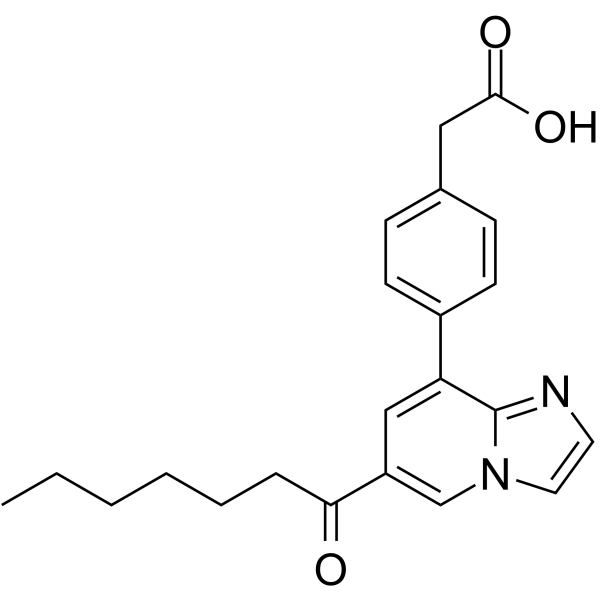
SPT-IN-1 (compound 1) is an orally active and potent SPT (serine palmitoyl transferase) inhibitor, with an IC50 of 5.19 nM for hSPT1. SPT-IN-1 can be used for type 2 diabetes and dyslipidemia research.
For research use only. We do not sell to patients.
- Purity : 99.21%
- CAS No.: 1933533-18-6
- Formula: C22H24N2O3
- Molecular Weight:364.44
-
Storage:
4°C, sealed storage, away from moisture and light
* In solvent : -80°C, 6 months; -20°C, 1 month (sealed storage, away from moisture and light)

To place orders, for customer services and technical support, please contact: MedChemExpress USA
Tel: 609-228-6898 E-mail: [email protected] [email protected]


-
 Biological Activity
-
Chemical Information
-
Solvent & Solubility
- Protocols
- Purity & Documentation
- References
-
 Help & FAQs


Publications Citing Use of MedChemExpress (MCE) SPT-IN-1
More

Biological Activity
Description
IC50 & Target
IC50: 5.19 nM (hSPT1)[1]
Cellular Effect
|
Cell Line

|
Type | Value | Description | References |
|---|---|---|---|---|
| HEK293 | IC50 |
0.00519 μM
Compound: 1
|
Inhibition of human SPT1 expressed in microsomes of HEK293 cells incubated for 1hr by LC/MS analysis
Inhibition of human SPT1 expressed in microsomes of HEK293 cells incubated for 1hr by LC/MS analysis
|
[PMID: 27213958] |
| MCF7 | EC50 |
0.977 μM
Compound: 1
|
Inhibition of SPT1 in human MCF7 cells assessed as suppression of 14C-serine incorporation into ceramide incubated for 2 hrs in presence of 4-HPR
Inhibition of SPT1 in human MCF7 cells assessed as suppression of 14C-serine incorporation into ceramide incubated for 2 hrs in presence of 4-HPR
|
[PMID: 27213958] |
In Vitro
SPT-IN-1 (compound 1) exhibits a dose-dependent inhibition of C14-serine incorporation into ceramide in MCF-7 cells, with EC50 of 0.98 μM[1].
MedChemExpress (MCE) has not independently confirmed the accuracy of these methods. They are for reference only. Further protocols information, click here.
In Vivo
MedChemExpress (MCE) has not independently confirmed the accuracy of these methods. They are for reference only.


Chemical Information
-
CAS No. 1933533-18-6
-
Appearance Solid
-
Molecular Weight 364.44
-
Formula C22H24N2O3
-
Color White to off-white
-
SMILES
CCCCCCC(C1=CN2C=CN=C2C(C3=CC=C(CC(O)=O)C=C3)=C1)=O
-
Shipping
Room temperature in continental US; may vary elsewhere.
-
Storage
4°C, sealed storage, away from moisture and light
* In solvent : -80°C, 6 months; -20°C, 1 month (sealed storage, away from moisture and light)


Publications (1)
-
Journal Impact Factor
-
Most Recent
-
Cell Death Dis
A sphingolipid rheostat controls apoptosis versus apical cell extrusion as alternative tumour-suppressive mechanisms. [Abstract]2024 Oct 14;15(10):746. PMID: 39397024


Solvent & Solubility
In Vitro:
DMSO : 50 mg/mL (137.20 mM; ultrasonic and warming and heat to 60°C; Hygroscopic DMSO has a significant impact on the solubility of product, please use newly opened DMSO)
Please refer to the solubility information to select the appropriate solvent. Once prepared, please aliquot and store the solution to prevent product inactivation from repeated freeze-thaw cycles.
Storage method and period of stock solution: -80°C, 6 months; -20°C, 1 month (sealed storage, away from moisture and light). When stored at -80°C, please use it within 6 months. When stored at -20°C, please use it within 1 month.
Please refer to the solubility information to select the appropriate solvent. Once prepared, please aliquot and store the solution to prevent product inactivation from repeated freeze-thaw cycles.
Storage method and period of stock solution: -80°C, 6 months; -20°C, 1 month (sealed storage, away from moisture and light). When stored at -80°C, please use it within 6 months. When stored at -20°C, please use it within 1 month.
Concentration (start) × Volume (start) = Concentration (final) × Volume (final)

Protocols
-
Cell Cytotoxicity Assay
Cytotoxicity assays are usually based on the assessment of cell membrane damage, which can also be indirectly detected by measuring cell viability. Detection methods include MTT assay, CKK-8 assay, LDH assay and ATP assay, etc.
-
Protocol for Sucrose Preference Test (SPT)
The Sucrose Preference Test is a rodent two-bottle choice assay used to estimate reward-related behavior by measuring preference for a sweet sucrose solution over water. Reduced sucrose preference is commonly interpreted as an anhedonia-like phenotype in stress-based depression models, but it can also be affected by thirst, hunger, body weight, learning, motivation, and general fluid intake.
-
Research Protocol for Metabolic Diseases
AMP-activated protein kinase, AMPK, is a conserved cellular energy sensor that responds to reduced cellular energy status and coordinates metabolism by increasing ATP-generating catabolic pathways while suppressing ATP-consuming anabolic processes. In metabolic disease research, the AMPK pathway is experimentally relevant because it regulates hepatic lipid synthesis, fatty acid oxidation, glucose production, skeletal-muscle glucose disposal, mTORC1-linked biosynthesis, autophagy, mitochondrial homeostasis, and whole-body energy balance. The central pathway logic is that energy stress, metformin, exercise-like stimulation, or direct AMPK activators increase AMPKα Thr172 phosphorylation and downstream substrate phosphorylation, including ACC and RAPTOR. Phosphorylation of ACC suppresses lipogenesis and supports fatty acid oxidation, whereas phosphorylation of RAPTOR suppresses mTORC1 signaling and links cellular energy status to growth and protein synthesis control. The pathway is linked


Purity & Documentation
-
Data Sheet (274 KB)
-
SDS (393 KB)
- English - EN (393 KB)
- Français - FR (393 KB)
- Deutsch - DE (393 KB)
- Norwegian - NO (393 KB)
- Español - ES (393 KB)
- Swedish - SV (393 KB)
- Italian - IT (393 KB)
- Korean - KR (393 KB)
- Portuguese - PT (393 KB)
-
Handling Instructions (2659 KB)
References


Complete Stock Solution Preparation Table
Please refer to the solubility information to select the appropriate solvent. Once prepared, please aliquot and store the solution to prevent product inactivation from repeated freeze-thaw cycles.
Storage method and period of stock solution: -80°C, 6 months; -20°C, 1 month (sealed storage, away from moisture and light). When stored at -80°C, please use it within 6 months. When stored at -20°C, please use it within 1 month.
| Optional Solvent | Concentration Solvent Mass | 1 mg | 5 mg | 10 mg | 25 mg |
|---|---|---|---|---|---|
| DMSO | 1 mM | 2.7439 mL | 13.7197 mL | 27.4394 mL | 68.5984 mL |
| 5 mM | 0.5488 mL | 2.7439 mL | 5.4879 mL | 13.7197 mL | |
| 10 mM | 0.2744 mL | 1.3720 mL | 2.7439 mL | 6.8598 mL | |
| 15 mM | 0.1829 mL | 0.9146 mL | 1.8293 mL | 4.5732 mL | |
| 20 mM | 0.1372 mL | 0.6860 mL | 1.3720 mL | 3.4299 mL | |
| 25 mM | 0.1098 mL | 0.5488 mL | 1.0976 mL | 2.7439 mL | |
| 30 mM | 0.0915 mL | 0.4573 mL | 0.9146 mL | 2.2866 mL | |
| 40 mM | 0.0686 mL | 0.3430 mL | 0.6860 mL | 1.7150 mL | |
| 50 mM | 0.0549 mL | 0.2744 mL | 0.5488 mL | 1.3720 mL | |
| 60 mM | 0.0457 mL | 0.2287 mL | 0.4573 mL | 1.1433 mL | |
| 80 mM | 0.0343 mL | 0.1715 mL | 0.3430 mL | 0.8575 mL | |
| 100 mM | 0.0274 mL | 0.1372 mL | 0.2744 mL | 0.6860 mL |


SPT-IN-1 Related Classifications
HY-125351 Related Classifications
 Powered by Bioz