



SYNTi

Based on 1 Customer Validation
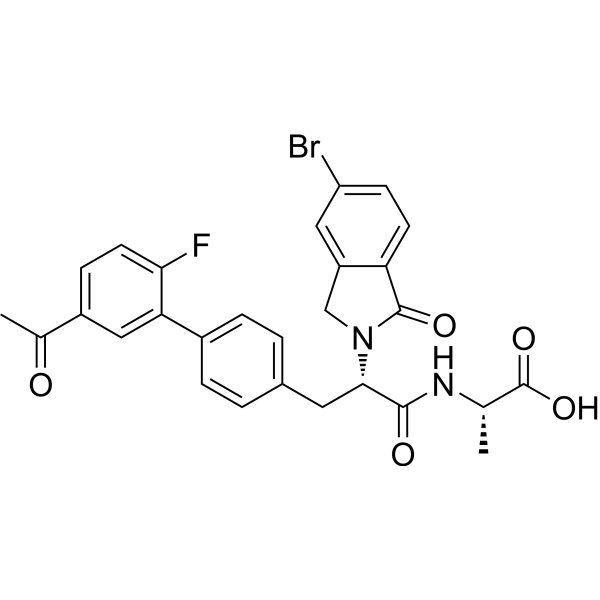
SYNTi is a PDZ domain inhibitor targeting the syndecan/syntenin protein-protein Interaction. SYNTi exhibits an IC50 value of 400 nM and ligand efficiency (LE) value of 0.24. SYNTi can be used for breast cancer research.
연구목적의 판매만을 진행합니다. 환자를 대상으로 한 판매는 하지 않습니다.
- Purity : 99.69%
- 화학식: C28H24BrFN2O5
- 분자량:567.40
-
보관:
4°C, stored under nitrogen
* In solvent : -80°C, 6 months; -20°C, 1 month (stored under nitrogen)

To place orders, for customer services and technical support, please contact: MedChemExpress USA
Tel: 609-228-6898 E-mail: [email protected] [email protected]


-
 Biological Activity
-
Chemical Information
-
용액&용해도
- Protocol
- 순도&문서
- References
-
 Help & FAQs




Biological Activity
제품 설명
In Vitro
SYNTi (1-100 μM) significantly affects the migration speed and Euclidean distance of MDA-MB-231 cells[1].
SYNTi is not toxic at concentrations up to 100 μM in wild-type MDA-MB-231 breast carcinoma cells and in MDA-MB-231 cells with syntenin-KO[1].
MedChemExpress (MCE) has not independently confirmed the accuracy of these methods. They are for reference only.


Chemical Information
-
Appearance Solid
-
분자량 567.40
-
화학식 C28H24BrFN2O5
-
Color White to off-white
-
SMILES
O=C1N(CC2=CC(Br)=CC=C21)[C@H](C(N[C@H](C(O)=O)C)=O)CC3=CC=C(C=C3)C4=CC(C(C)=O)=CC=C4F
-
선적
Room temperature in continental US; may vary elsewhere.
-
보관
4°C, stored under nitrogen
* In solvent : -80°C, 6 months; -20°C, 1 month (stored under nitrogen)


용액&용해도
In Vitro:
DMSO : 100 mg/mL (176.24 mM; Need ultrasonic; Hygroscopic DMSO has a significant impact on the solubility of product, please use newly opened DMSO)
Please refer to the solubility information to select the appropriate solvent. Once prepared, please aliquot and store the solution to prevent product inactivation from repeated freeze-thaw cycles.
Storage method and period of stock solution: -80°C, 6 months; -20°C, 1 month (stored under nitrogen). When stored at -80°C, please use it within 6 months. When stored at -20°C, please use it within 1 month.
Please refer to the solubility information to select the appropriate solvent. Once prepared, please aliquot and store the solution to prevent product inactivation from repeated freeze-thaw cycles.
Storage method and period of stock solution: -80°C, 6 months; -20°C, 1 month (stored under nitrogen). When stored at -80°C, please use it within 6 months. When stored at -20°C, please use it within 1 month.
Concentration (start) × Volume (start) = Concentration (final) × Volume (final)


순도&문서
-
Data Sheet (273 KB)
-
SDS (252 KB)
- English - EN (252 KB)
- Français - FR (252 KB)
- Deutsch - DE (252 KB)
- Norwegian - NO (252 KB)
- Español - ES (252 KB)
- Swedish - SV (252 KB)
- Italian - IT (252 KB)
- Korean - KR (252 KB)
- Portuguese - PT (252 KB)
-
Handling Instructions (2659 KB)
References


Complete Stock Solution Preparation Table
Please refer to the solubility information to select the appropriate solvent. Once prepared, please aliquot and store the solution to prevent product inactivation from repeated freeze-thaw cycles.
Storage method and period of stock solution: -80°C, 6 months; -20°C, 1 month (stored under nitrogen). When stored at -80°C, please use it within 6 months. When stored at -20°C, please use it within 1 month.
| Optional Solvent | Concentration Solvent Mass | 1 mg | 5 mg | 10 mg | 25 mg |
|---|---|---|---|---|---|
| DMSO | 1 mM | 1.7624 mL | 8.8121 mL | 17.6243 mL | 44.0606 mL |
| 5 mM | 0.3525 mL | 1.7624 mL | 3.5249 mL | 8.8121 mL | |
| 10 mM | 0.1762 mL | 0.8812 mL | 1.7624 mL | 4.4061 mL | |
| 15 mM | 0.1175 mL | 0.5875 mL | 1.1750 mL | 2.9374 mL | |
| 20 mM | 0.0881 mL | 0.4406 mL | 0.8812 mL | 2.2030 mL | |
| 25 mM | 0.0705 mL | 0.3525 mL | 0.7050 mL | 1.7624 mL | |
| 30 mM | 0.0587 mL | 0.2937 mL | 0.5875 mL | 1.4687 mL | |
| 40 mM | 0.0441 mL | 0.2203 mL | 0.4406 mL | 1.1015 mL | |
| 50 mM | 0.0352 mL | 0.1762 mL | 0.3525 mL | 0.8812 mL | |
| 60 mM | 0.0294 mL | 0.1469 mL | 0.2937 mL | 0.7343 mL | |
| 80 mM | 0.0220 mL | 0.1102 mL | 0.2203 mL | 0.5508 mL | |
| 100 mM | 0.0176 mL | 0.0881 mL | 0.1762 mL | 0.4406 mL |


SYNTi Related Classifications
HY-149204 Related Classifications
 Powered by Bioz