



Carnostatine
Based on 2 publication(s) in Google Scholar
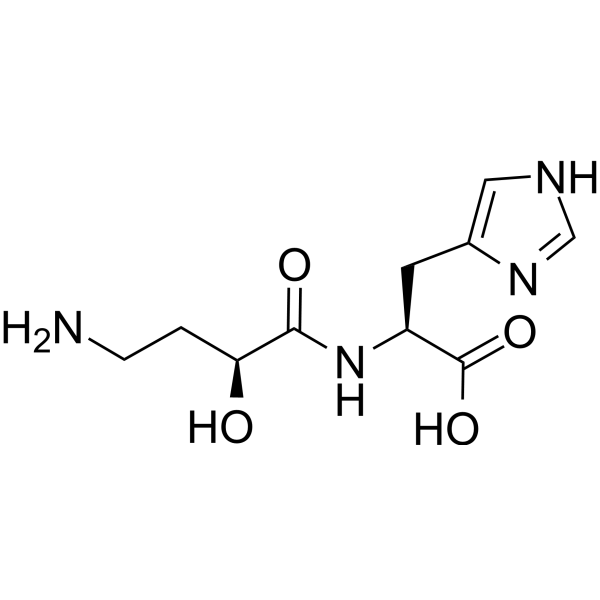
Carnostatine (SAN9812) is a potent and selective carnosinase 1 (CN1) inhibitor with a Ki of 11 nM for human recombinant CN1. Carnostatine (SAN9812) can be used for the treatment of diabetic nephropathy (DN).
For research use only. We do not sell to patients.
- Formula: C10H16N4O4
- Molecular Weight:256.26
-
Storage:
Please store the product under the recommended conditions in the Certificate of Analysis.

To place orders, for customer services and technical support, please contact: MedChemExpress USA
Tel: 609-228-6898 E-mail: [email protected] [email protected]


-
 Biological Activity
-
Chemical Information
- Purity & Documentation
- References
-
 Help & FAQs


Publications Citing Use of MedChemExpress (MCE) Carnostatine
More

Biological Activity
Description
IC50 & Target
Ki: 11 nM (human CN1)[1]
In Vitro
Carnostatine (SAN9812) also inhibits CN1 activity in human serum and serum of transgenic mice-overexpressing human CN1. Carnostatine, with an IC50 value of 18 nM on human recombinant CN1 at a carnosine concentration of 200 μM, i.e., close to the Km of 190 μM[1].
MedChemExpress (MCE) has not independently confirmed the accuracy of these methods. They are for reference only. .
In Vivo
MedChemExpress (MCE) has not independently confirmed the accuracy of these methods. They are for reference only.
-
Animal Model:Human carnosinase (CNDP1) transgenic mice on a BTBR wt/ob background[1]
-
Dosage:3 mg/kg i.v. or 30 mg/kg s.c. (Pharmacokinetic Analysis)
-
Administration:Single bolus administration
-
Result:Subcutaneous administration of 30 mg/kg led to a sustained reduction in circulating CN1 activity.


Chemical Information
-
Molecular Weight 256.26
-
Formula C10H16N4O4
-
Synonyms
SAN9812
-
Shipping
Room temperature in continental US; may vary elsewhere.
-
Storage
Please store the product under the recommended conditions in the Certificate of Analysis.


Publications (2)
-
Journal Impact Factor
-
Most Recent
-
J Neuroinflammation
Acarbose modulates microglial Pkm2 acetylation to reshape immunometabolism and preserve retinal neurons after ischemia-reperfusion. [Abstract]2026 May 2;23(1):206. PMID: 42069589 -
Cell Death Discov
Low-dose TNF-α drives malignant progression and lipid metabolism in glioblastoma through the TRAF2-FASN axis. [Abstract]2026 Apr 9;12(1):242. PMID: 41956989


Purity & Documentation
References

Calculators
Concentration (start) × Volume (start) = Concentration (final) × Volume (final)


Carnostatine Related Classifications
HY-112431 Related Classifications
 Powered by Bioz