



WAY-181187 hydrochloride
Based on 2 publication(s) in Google Scholar
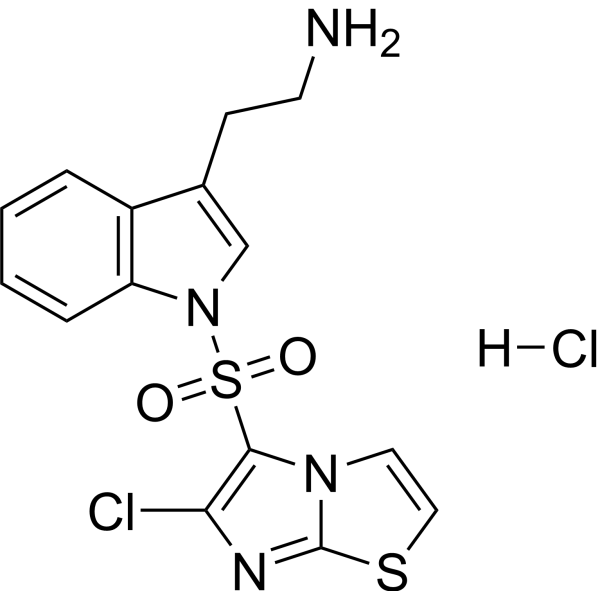
WAY-181187 (SAX-187) hydrochloride is a potent and selective full 5-HT6 receptor agonist with a Ki of 2.2 nM and an EC50 of 6.6 nM. WAY-181187 hydrochloride mediates 5-HT6 receptor-dependent signal pathways, such as cAMP, Fyn and ERK1/2 kinase, as specific agonist.
For research use only. We do not sell to patients.
- CAS No.: 554403-08-6
- Formula: C15H14Cl2N4O2S2
- Molecular Weight:417.33
-
Storage:
Please store the product under the recommended conditions in the Certificate of Analysis.

To place orders, for customer services and technical support, please contact: MedChemExpress USA
Tel: 609-228-6898 E-mail: [email protected] [email protected]


-
 Biological Activity
-
Chemical Information
- Purity & Documentation
- References
-
 Help & FAQs


Publications Citing Use of MedChemExpress (MCE) WAY-181187 hydrochloride
MoreAll 5-HT Receptor Isoforms
More

Biological Activity
Description
IC50 & Target
sup>[1]|
5-HT6 Receptor |
5-HT6 Receptor 2.2 nM (Ki) |
5-HT6 Receptor 6.6 nM (EC50) |
In Vitro
In Vivo
MedChemExpress (MCE) has not independently confirmed the accuracy of these methods. They are for reference only.
-
Animal Model:Adult male Sprague-Dawley rats weighing 280-350 g[1]
-
Dosage:3, 10, or 30 mg/kg
-
Administration:Acute dministered by s.c.
-
Result:Significantly increased extracellular GABA concentrations without altering the levels of glutamate or norepinephrine.


Chemical Information
-
CAS No. 554403-08-6
-
Molecular Weight 417.33
-
Formula C15H14Cl2N4O2S2
-
SMILES
NCCC1=CN(S(=O)(C2=C(Cl)N=C3SC=CN32)=O)C4=C1C=CC=C4.[H]Cl
-
Synonyms
SAX-187 hydrochloride
-
Shipping
Room temperature in continental US; may vary elsewhere.
-
Storage
Please store the product under the recommended conditions in the Certificate of Analysis.


Publications (2)
-
Journal Impact Factor
-
Most Recent
-
Thromb Res
2024 May:237:1-13. PMID: 38513536 -


Purity & Documentation
References
[1]. Lee E Schechter, et al. Neuropharmacological Profile of Novel and Selective 5-HT6 Receptor Agonists: WAY-181187 and WAY-208466. Neuropsychopharmacology. 2008 May;33(6):1323-35. [Content Brief]
[2]. Teresa Riccioni, et al. ST1936 Stimulates cAMP, Ca2+, ERK1/2 and Fyn Kinase Through a Full Activation of Cloned Human 5-HT6 Receptors. Eur J Pharmacol. 2011 Jul 1;661(1-3):8-14. [Content Brief]

Calculators
Concentration (start) × Volume (start) = Concentration (final) × Volume (final)


WAY-181187 hydrochloride Related Classifications
HY-W746031 Related Classifications
 Powered by Bioz