



Glycocyamine
Based on 1 publication(s) in Google Scholar
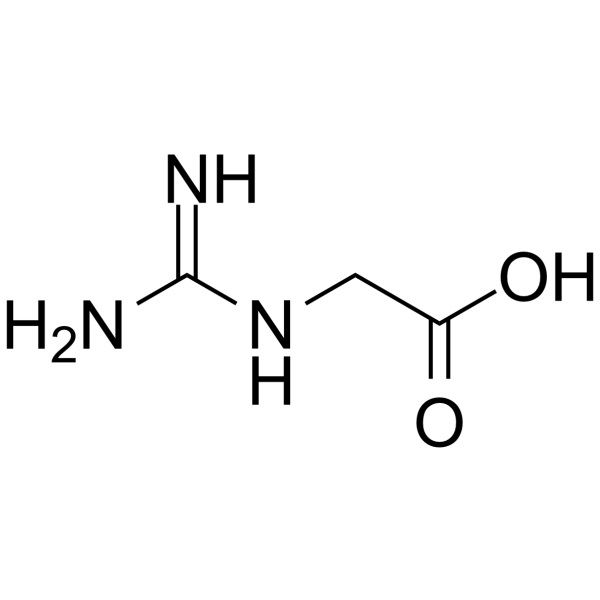
Glycocyamine (Guanidinoacetic acid) is a direct precursor of creatine and an orally active energy metabolism regulator and myogenic differentiation inducer. Glycocyamine can activate the Akt/mTOR/S6K signaling pathway via miR-133a-3p and miR-1a-3p, and stimulate the mRNA expression of myogenic differentiation factor 1 (MyoD) and myopoietin (MyoG). Glycocyamine can increase muscle creatine concentration and maintain ATP homeostasis through the creatine phosphate/creatine kinase system. Glycocyamine can be used in research on feed additives for poultry farming.
For research use only. We do not sell to patients.
- Purity : 99.96%
- CAS No.: 352-97-6
- Formula: C3H7N3O2
- Molecular Weight:117.11
-
Storage:Powder -20°C, 3 years , 4°C, 2 years ; In solvent -80°C, 6 months , -20°C, 1 month

To place orders, for customer services and technical support, please contact: MedChemExpress USA
Tel: 609-228-6898 E-mail: [email protected] [email protected]


-
 Biological Activity
-
Chemical Information
-
Solvent & Solubility
- Protocols
- Purity & Documentation
- References
-
 Help & FAQs



Publications Citing Use of MedChemExpress (MCE) Glycocyamine
MoreAll Endogenous Metabolite Isoforms
More

Biological Activity
Description
IC50 & Target
|
Human Endogenous Metabolite |
In Vitro
Glycocyamine promotes myoblast differentiation and skeletal muscle development in mouse C2C12 cells via miRNA-mediated activation of the AKT/mTOR/S6K signalling pathway[1].
MedChemExpress (MCE) has not independently confirmed the accuracy of these methods. They are for reference only. Further protocols information, click here.
In Vivo
Glycocyamine (0.6-2.4 g/kg; p.o.; ad libitum in feed; breeding period) supplementation at 1.4 g/kg optimises meat-type quail breeder fertility, reducing embryonic mortality and improving egg hatchability, while enhancing progeny performance via increased creatine transfer[1].
Glycocyamine (0.6 g/kg; p.o.; ad libitum in feed; day 11 to 24 of age) supplementation at 0.6 g/kg improves tibia flexibility and energy absorption in male broiler chicks, supporting skeletal development[1].
Glycocyamine (p.o.; ad libitum in feed) supplementation improves growth performance and energy utilisation in turkeys fed all-vegetable diets[1].
Glycocyamine (up to 600-800 mg/kg feed; oral; via diet) increases breast muscle creatine and ATP content and improves growth and performance in chickens[2].
Glycocyamine (0.06-0.78% of diet; p.o.; ad libitum; 9 days) produces consistent improvements in weight gain and feed efficiency in young male New Hampshire × Columbian chicks fed arginine-deficient semi-purified diets, with greater efficacy observed in Arg-deficient versus Arg-adequate diets[3].
MedChemExpress (MCE) has not independently confirmed the accuracy of these methods. They are for reference only.
-
Animal Model:Ross 308 (male, female; includes broiler breeder roosters, broiler chicks)[1]
-
Dosage:0.6 g/kg; 1.2 g/kg; 1.8 g/kg
-
Administration:p.o.; ad libitum in feed; grow-out period
-
Result:Increased muscle creatine by 14% (0.6 g/kg); improved feed conversion ratio by 4.5 points (0.6 g/kg); increased breast muscle phosphocreatine:ATP ratio to 28.4 (vs. control 20.3, 0.6 g/kg); increased breast meat yield (0.6 g/kg); increased muscle creatine by 21% (1.2 g/kg); improved feed conversion ratio by 8.8 points (1.2 g/kg); increased jejunal villus surface area in cool temperatures (1.2 g/kg); improved feed efficiency in low-energy diets (1.2 g/kg); improved antioxidant status and growth performance in low-protein, heat-stressed broilers (0.6 g/kg); reduced arginine requirements by ~142% (based on FCR equivalence, 1.2 g/kg in arginine-deficient diets).
-
Animal Model:Ross 308 (29-week-old; broiler breeder roosters)[1]
-
Dosage:0.6 g/kg; 1.2 g/kg; 1.8 g/kg
-
Administration:p.o.; ad libitum in feed
-
Result:Increased fertility rate (all doses); significantly increased semen concentration, total sperm number, and forward motility (1.2 g/kg); increased sperm penetration and improved fertility in aged breeder hens (0.6 and 1.2 g/kg)
Clinical Trial
| NCT Number | Sponsor | Condition | Start Date |
Phase

|
|---|---|---|---|---|
| NCT01329991 | Plexxikon| | 2011-05 | PHASE1 |


Chemical Information
-
CAS No. 352-97-6
-
Appearance Solid
-
Molecular Weight 117.11
-
Formula C3H7N3O2
-
Color White to off-white
-
SMILES
O=C(O)CNC(N)=N
-
Synonyms
Guanidinoacetic acid
-
Structure Classification
-
Initial Source
-
Shipping
Room temperature in continental US; may vary elsewhere.
-
Storage
Powder -20°C 3 years 4°C 2 years In solvent -80°C 6 months -20°C 1 month


Publications (1)
-
Journal Impact Factor
-
Most Recent
-
Phytomedicine
Theabrownins improve burn-induced kidney injury by increasing the levels of guanidinoacetic acid and fumaric acid. [Abstract]2025 May:140:156609. PMID: 40090045


Solvent & Solubility
In Vitro:
1M HCl : 50 mg/mL (426.95 mM; ultrasonic and adjust pH to 1 with HCl)
H2O : < 0.1 mg/mL (insoluble)
DMSO : < 1 mg/mL (insoluble or slightly soluble)
Ethanol : < 1 mg/mL (insoluble)
Please refer to the solubility information to select the appropriate solvent. Once prepared, please aliquot and store the solution to prevent product inactivation from repeated freeze-thaw cycles.
Storage method and period of stock solution: -80°C, 6 months; -20°C, 1 month. When stored at -80°C, please use it within 6 months. When stored at -20°C, please use it within 1 month.
Please refer to the solubility information to select the appropriate solvent. Once prepared, please aliquot and store the solution to prevent product inactivation from repeated freeze-thaw cycles.
Storage method and period of stock solution: -80°C, 6 months; -20°C, 1 month. When stored at -80°C, please use it within 6 months. When stored at -20°C, please use it within 1 month.
Concentration (start) × Volume (start) = Concentration (final) × Volume (final)

Protocols
-
RT-PCR
Reverse transcription technology uses RNA as a template to synthesize DNA. RT-PCR is simple, specific and sensitive, and can be used to detect gene expression levels and expression differences in cells; detect RNA virus content; clone cDNA sequences of specific genes.
-
RNA extraction experimental
By lysing cells, releasing RNA, and removing impurities such as proteins and DNA, high-purity RNA products are finally obtained. The commonly used traditional method is the guanidine isothiocyanate/phenol/chloroform method (Trizol), which is suitable for a variety of animal materials including animal tissues, microorganisms, cultured cells, etc., and most plant materials.
-
Real Time qPCR (Q-PCR)
Real-time quantitative PCR (qPCR) quantifies an amplifiable nucleic-acid target by monitoring fluorescence during PCR cycling rather than measuring product only after amplification. The increase in fluorescence tracks accumulation of PCR product, and the quantification cycle (Cq; historically also Ct/CP) is related to the initial amount of target: samples containing more starting target generally reach the defined fluorescence threshold in fewer cycles.


Purity & Documentation
-
Data Sheet (281 KB)
-
SDS (393 KB)
- English - EN (393 KB)
- Français - FR (393 KB)
- Deutsch - DE (393 KB)
- Norwegian - NO (393 KB)
- Español - ES (393 KB)
- Swedish - SV (393 KB)
- Italian - IT (393 KB)
- Korean - KR (393 KB)
- Portuguese - PT (393 KB)
-
Handling Instructions (2659 KB)
References


Complete Stock Solution Preparation Table
Please refer to the solubility information to select the appropriate solvent. Once prepared, please aliquot and store the solution to prevent product inactivation from repeated freeze-thaw cycles.
Storage method and period of stock solution: -80°C, 6 months; -20°C, 1 month. When stored at -80°C, please use it within 6 months. When stored at -20°C, please use it within 1 month.
| Optional Solvent | Concentration Solvent Mass | 1 mg | 5 mg | 10 mg | 25 mg |
|---|---|---|---|---|---|
| 1M HCl | 1 mM | 8.5390 mL | 42.6949 mL | 85.3898 mL | 213.4745 mL |
| 5 mM | 1.7078 mL | 8.5390 mL | 17.0780 mL | 42.6949 mL | |
| 10 mM | 0.8539 mL | 4.2695 mL | 8.5390 mL | 21.3475 mL | |
| 15 mM | 0.5693 mL | 2.8463 mL | 5.6927 mL | 14.2316 mL | |
| 20 mM | 0.4269 mL | 2.1347 mL | 4.2695 mL | 10.6737 mL | |
| 25 mM | 0.3416 mL | 1.7078 mL | 3.4156 mL | 8.5390 mL | |
| 30 mM | 0.2846 mL | 1.4232 mL | 2.8463 mL | 7.1158 mL | |
| 40 mM | 0.2135 mL | 1.0674 mL | 2.1347 mL | 5.3369 mL | |
| 50 mM | 0.1708 mL | 0.8539 mL | 1.7078 mL | 4.2695 mL | |
| 60 mM | 0.1423 mL | 0.7116 mL | 1.4232 mL | 3.5579 mL | |
| 80 mM | 0.1067 mL | 0.5337 mL | 1.0674 mL | 2.6684 mL | |
| 100 mM | 0.0854 mL | 0.4269 mL | 0.8539 mL | 2.1347 mL |


Glycocyamine Related Classifications
HY-W021448 Related Classifications
 Powered by Bioz