



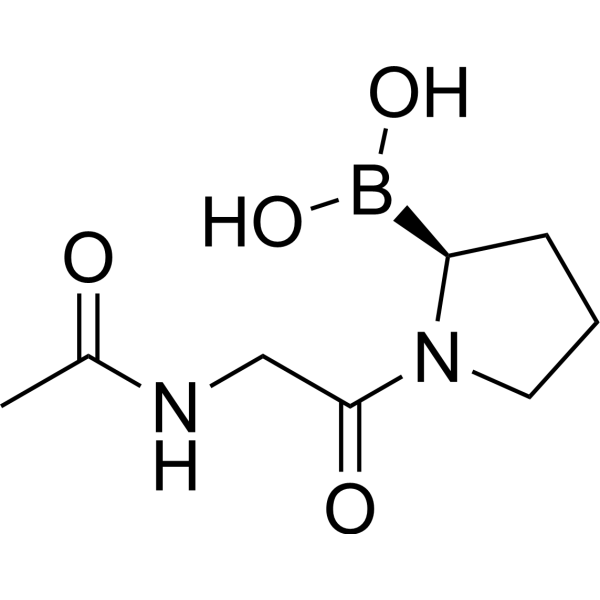
Ac-Gly-BoroPro
Based on 5 publication(s) in Google Scholar
Ac-Gly-BoroPro is a selective FAP inhibitor with a Ki of 23 nM.
For research use only. We do not sell to patients.
- Purity : 99.89%
- CAS No.: 886992-99-0
- Formula: C8H15BN2O4
- Molecular Weight:214.03
-
Storage:
-20°C, protect from light, stored under nitrogen
* The compound is unstable in solutions, freshly prepared is recommended.

To place orders, for customer services and technical support, please contact: MedChemExpress USA
Tel: 609-228-6898 E-mail: [email protected] [email protected]


-
 Biological Activity
-
Chemical Information
-
Solvent & Solubility
- Purity & Documentation
- References
-
 Help & FAQs



Publications Citing Use of MedChemExpress (MCE) Ac-Gly-BoroPro
More Customer Validation & Images

-
WB

-
Bio/Physico-chemical Assay

-
Bio/Physico-chemical Assay

-
Cell Imaging/Staining
-
IHC


Biological Activity
Description
IC50 & Target
Ki: 23 nM (FAP)[1]
Cellular Effect
|
Cell Line

|
Type | Value | Description | References |
|---|---|---|---|---|
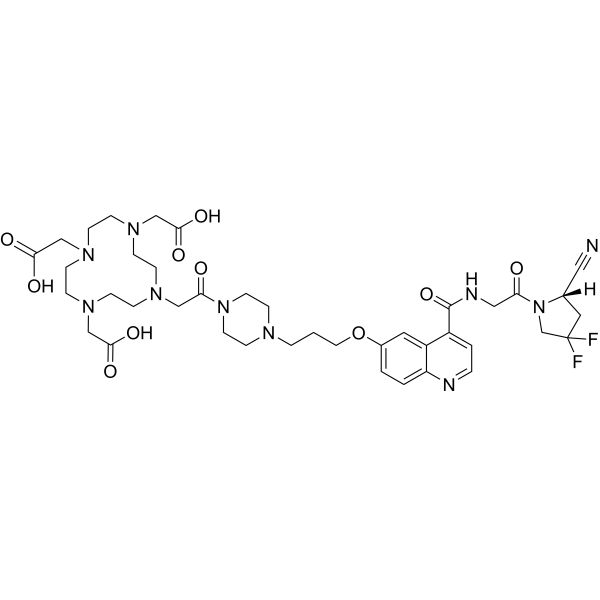
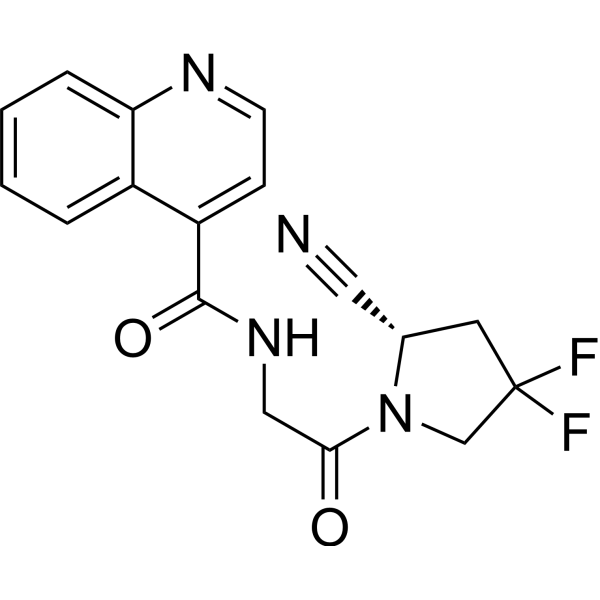
| U-87MG ATCC | IC50 |
0.663 μM
Compound: Ac-Gly-BoroPro
|
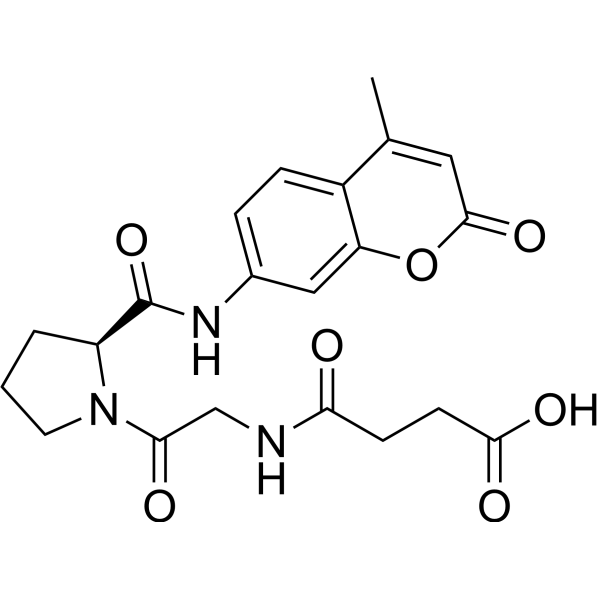
Inhibition of FAP in human U87MG cells using Suc-Gly-Pro-AMC as substrate by fluorescence based assay
Inhibition of FAP in human U87MG cells using Suc-Gly-Pro-AMC as substrate by fluorescence based assay
|
[PMID: 32527554] |
In Vitro
FAP has been implicated in cancer; however, its specific role remains elusive because inhibitors that distinguish FAP from other prolyl peptidases like dipeptidyl peptidase-4 (DPP-4) have not been developed. Ac-Gly-BoroPro selectively inhibits FAP relative to other prolyl peptidases. FAP reacts readily with submicromolar concentrations of Ac-Gly-BoroPro, reaching steady state inhibition levels rapidly (Ki=23±3 nM). In contrast, DPP-4 requires higher Ac-Gly-BoroPro concentrations for inhibition and a longer time to reach steady state inhibition levels (Ki=377±18 nM). Ac-Gly-BoroPro inhibits other prolyl peptidases (DPP-7, DPP-8, DPP-9, prolyl oligopeptidase, and acylpeptide hydrolase) with Ki values ranging from 9- to 5400-fold higher than that for FAP inhibition. The N-acyl-linkage in Ac-Gly-BoroPro blocks the N terminus of the inhibitor, making it less nucleophilic and therefore unlikely to cyclize[1].
MedChemExpress (MCE) has not independently confirmed the accuracy of these methods. They are for reference only. .


Chemical Information
-
CAS No. 886992-99-0
-
Appearance Solid
-
Molecular Weight 214.03
-
Formula C8H15BN2O4
-
Color White to off-white
-
SMILES
O=C(N1[C@@H](B(O)O)CCC1)CNC(C)=O
-
Sequence Shortening
Ac-G-{boroP}
-
Shipping
Room temperature in continental US; may vary elsewhere.
-
Storage
-20°C, protect from light, stored under nitrogen
* The compound is unstable in solutions, freshly prepared is recommended.


Publications (5)
-
Journal Impact Factor
-
Most Recent
-
Bone Res
Inhibition of fibroblast activation protein ameliorates cartilage matrix degradation and osteoarthritis progression. [Abstract]2023 Jan 2;11(1):3. PMID: 36588124 -
Cell Rep
Identification of Fibroblast Activation Protein as an Osteogenic Suppressor and Anti-osteoporosis Drug Target. [Abstract]2020 Oct 13;33(2):108252. PMID: 33053358
Ac-Gly-BoroPro purchased from MedChemExpress. Usage Cited in: Cell Rep. 2020 Oct 13;33(2):108252. [Abstract]
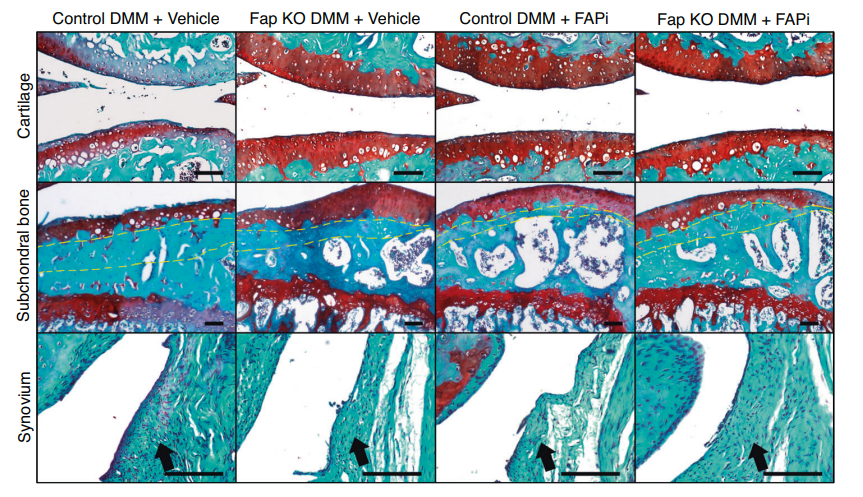
Safranin O/Fast Green staining in control and Fap KO mice treated with FAPi or vehicle after DMM surgery. Weekly intra-articular administration of FAPi (Ac-Gly-BoroPro, 40 μg/kg body weight) or vehicle (PBS) in 10-week-old mice was started 3 days after the surgery and continued for 8 weeks before paraffin sectioning and safranin O/fast green staining of the knee joints. Intra-articular administration of FAPi (Ac-Gly-BoroPro) in control mice also significantly ameliorated cartilage erosion, subchondral bone thickening and synovitis compared to the vehicle group.
Ac-Gly-BoroPro purchased from MedChemExpress. Usage Cited in: Cell Rep. 2020 Oct 13;33(2):108252. [Abstract]
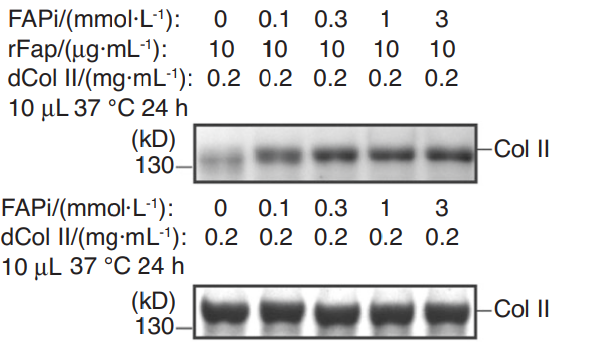
FAPi (Ac-Gly-BoroPro, 0-3 mmol/L) inhibits Fap-mediated degradation of denatured Col II. Different doses of FAPi were preincubated with rFap for 30 min before denatured Col II was added and further incubated at 37 ℃ for 24 h.
-
J Dermatol Sci
2024 Feb;113(2):51-61. PMID: 38155020 -
Exp Cell Res
Enzymatic activity of fibroblast activation protein-α is essential for TGF-β1-induced fibroblastic differentiation of human periodontal ligament cells. [Abstract]2024 Oct 1;442(2):114230. PMID: 39222867
Ac-Gly-BoroPro purchased from MedChemExpress. Usage Cited in: Exp Cell Res. 2024 Oct 1;442(2):114230. [Abstract]
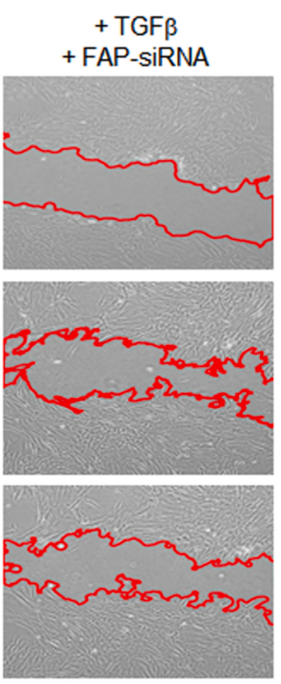
Treatment with a potent FAPα inhibitor was performed during TGF-β1-induced differentiation of periodontal ligament (PDL) fibroblasts. Changes in protein content, collagen degradation activity, and cell morphology were assessed following treatment with 10 μM Ac-Gly-BoroPro.
Ac-Gly-BoroPro purchased from MedChemExpress. Usage Cited in: Exp Cell Res. 2024 Oct 1;442(2):114230. [Abstract]
PDL fibroblasts with Ac-Gly-BoroPro (10 μM, 0-48 h).
-
Biol Reprod
Collagen turnover during cervical remodeling involves both intracellular and extracellular collagen degradation pathways. [Abstract]2025 Apr 13;112(4):709-727. PMID: 39823285
Ac-Gly-BoroPro purchased from MedChemExpress. Usage Cited in: Biol Reprod. 2025 Apr 13;112(4):709-727. [Abstract]
Degradation of dCol1 products was blocked after preincubation with inhibitor Ac-Gly-BoroPro (1 mM) for 30 mins.
Ac-Gly-BoroPro purchased from MedChemExpress. Usage Cited in: Biol Reprod. 2025 Apr 13;112(4):709-727. [Abstract]
Degradation of dCol1 products was reduced using the Ac-Gly-BoroPro (1 mM) inhibitor.


Solvent & Solubility
In Vitro:
DMSO : ≥ 50 mg/mL (233.61 mM; Hygroscopic DMSO has a significant impact on the solubility of product, please use newly opened DMSO)
* "≥" means soluble, but saturation unknown.
Please refer to the solubility information to select the appropriate solvent. The compound is unstable in solutions, freshly prepared is recommended.
Please refer to the solubility information to select the appropriate solvent. The compound is unstable in solutions, freshly prepared is recommended.
Concentration (start) × Volume (start) = Concentration (final) × Volume (final)
In Vivo:
Select the appropriate dissolution method based on your experimental animal and administration route.
- For the following dissolution methods, please ensure to first prepare a clear stock solution using an In Vitro approach and then sequentially add co-solvents:
- To ensure reliable experimental results, the clarified stock solution can be appropriately stored based on storage conditions. As for the working solution for In Vivo experiments, it is recommended to prepare freshly and use it on the same day.
- The percentages shown for the solvents indicate their volumetric ratio in the final prepared solution. If precipitation or phase separation occurs during preparation, heat and/or sonication can be used to aid dissolution.
Add each solvent one by one: 10% DMSO 40% PEG300 5% Tween-80 45% Saline
Solubility: ≥ 2.5 mg/mL (11.68 mM); Clear solution
This protocol yields a clear solution of ≥ 2.5 mg/mL (saturation unknown).
Taking 1 mL working solution as an example, add 100 μL DMSO stock solution (25.0 mg/mL) to 400 μL PEG300, and mix evenly; then add 50 μL Tween-80 and mix evenly; then add 450 μL Saline to adjust the volume to 1 mL.
Preparation of Saline: Dissolve 0.9 g sodium chloride in ddH₂O and dilute to 100 mL to obtain a clear Saline solution.
Add each solvent one by one: 10% DMSO 90% (20% SBE-β-CD in Saline)
Solubility: ≥ 2.5 mg/mL (11.68 mM); Clear solution
This protocol yields a clear solution of ≥ 2.5 mg/mL (saturation unknown).
Taking 1 mL working solution as an example, add 100 μL DMSO stock solution (25.0 mg/mL) to 900 μL 20% SBE-β-CD in Saline, and mix evenly.
Preparation of 20% SBE-β-CD in Saline (4°C, storage for one week): 2 g SBE-β-CD powder is dissolved in 10 mL Saline, completely dissolve until clear.
For the following dissolution methods, please prepare the working solution directly:
It is recommended to prepare fresh solutions and use them promptly within a short period of time.
The percentages shown for the solvents indicate their volumetric ratio in the final prepared solution. If precipitation or phase separation occurs during preparation, heat and/or sonication can be used to aid dissolution.
Add each solvent one by one: PBS
Solubility: ≥ 100 mg/mL (467.22 mM); Clear solution
In Vivo Dissolution Calculator
Please enter the basic information of animal experiments:
-
-
-
-
Recommended: Prepare an additional quantity of animals to account for potential losses during experiments.
Please enter your animal formula composition:
-
%DMSO +
Recommended: Keep the proportion of DMSO in working solution below 2% if your animal is weak.
-
%+
-
+%Tween-80 + +
-
%Saline +
The co-solvents required include: DMSO, . All of co-solvents are available by MedChemExpress (MCE). , Tween 80. All of co-solvents are available by MedChemExpress (MCE).
Working solution concentration: 0.22 mg/mL
Method for preparing stock solution: mg drug dissolved in μL DMSO. Stock solution concentration: mg/mL. * The compound is unstable in solutions, freshly prepared is recommended.
1. Take μL DMSO stock solution;
2. Add μL .
μL , mix evenly;
3. Then add μL Tween 80, mix evenly;
4. Then add μL
Please ensure that the stock solution in the first step is dissolved to a clear state, and add co-solvents in sequence. You can use ultrasonic heating (ultrasonic cleaner, recommended frequency 20-40 kHz), vortexing, etc. to assist dissolution.


Purity & Documentation
-
Data Sheet (278 KB)
-
SDS (394 KB)
- English - EN (394 KB)
- Français - FR (394 KB)
- Deutsch - DE (394 KB)
- Norwegian - NO (394 KB)
- Español - ES (394 KB)
- Swedish - SV (394 KB)
- Italian - IT (394 KB)
- Korean - KR (394 KB)
- Portuguese - PT (394 KB)
-
Handling Instructions (2659 KB)
References


Complete Stock Solution Preparation Table
Please refer to the solubility information to select the appropriate solvent. The compound is unstable in solutions, freshly prepared is recommended.
| Optional Solvent | Concentration Solvent Mass | 1 mg | 5 mg | 10 mg | 25 mg |
|---|---|---|---|---|---|
| DMSO | 1 mM | 4.6722 mL | 23.3612 mL | 46.7224 mL | 116.8061 mL |
| 5 mM | 0.9344 mL | 4.6722 mL | 9.3445 mL | 23.3612 mL | |
| 10 mM | 0.4672 mL | 2.3361 mL | 4.6722 mL | 11.6806 mL | |
| 15 mM | 0.3115 mL | 1.5574 mL | 3.1148 mL | 7.7871 mL | |
| 20 mM | 0.2336 mL | 1.1681 mL | 2.3361 mL | 5.8403 mL | |
| 25 mM | 0.1869 mL | 0.9344 mL | 1.8689 mL | 4.6722 mL | |
| 30 mM | 0.1557 mL | 0.7787 mL | 1.5574 mL | 3.8935 mL | |
| 40 mM | 0.1168 mL | 0.5840 mL | 1.1681 mL | 2.9202 mL | |
| 50 mM | 0.0934 mL | 0.4672 mL | 0.9344 mL | 2.3361 mL | |
| 60 mM | 0.0779 mL | 0.3894 mL | 0.7787 mL | 1.9468 mL | |
| 80 mM | 0.0584 mL | 0.2920 mL | 0.5840 mL | 1.4601 mL | |
| 100 mM | 0.0467 mL | 0.2336 mL | 0.4672 mL | 1.1681 mL |


Ac-Gly-BoroPro Related Classifications
HY-101801 Related Classifications
 Powered by Bioz