



BAY-Y 3118

Based on 1 Customer Validation
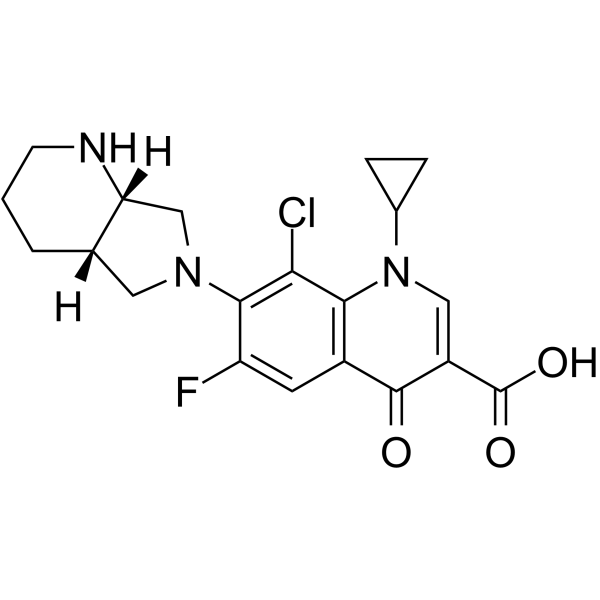
BAY-Y 3118 is a quinolone antibacterial agent. BAY-Y 3118 has a broad antibacterial spectrum in vitro. BAY-Y 3118 exhibits high activity against gram-positive cocci and anaerobes. BAY-Y 3118 shows moderate activity against Enterobacteriaceae and Pseudomonas aeruginosa. BAY-Y 3118 can be used in the research of infectious diseases.
Nur für Forschungszwecke. Wir verkaufen nicht an Patienten.
- Reinheit : 99.22%
- CAS. Nr.: 151213-16-0
- Formel: C20H21ClFN3O3
- Molecular Weight:405.85
-
Speicherung:Powder -20°C, 3 years , 4°C, 2 years ; In solvent -80°C, 6 months , -20°C, 1 month

To place orders, for customer services and technical support, please contact: MedChemExpress USA
Tel: 609-228-6898 E-mail: [email protected] [email protected]


-
 Biologische Aktivität
-
Chemical Information
-
Lösungsmittel & Löslichkeit
- Protokoll
- Reinheit & Dokumentation
- Verweise
-
 Help & FAQs




Biologische Aktivität
Beschreibung
In Vitro
BAY-Y 3118 is potent against Haemophilhs influenzae, Moraxela catarrhalis, Acinetobacter baumannii, Xanthomonas maltophiia, gram-positive cocci, and anaerobes; MICs for 50%o of the strains (MIC50s) and MIC90s are ≤0.015 and ≤0.015, ≤0.015 and ≤0.015, 0.03 and 2, 0.25 and 0.5, 0.06 and 1, and 0.12 and 0.25 μg/mL, respectively[1]. The cellular concentration-to-extracellular concentration ratio of BAY-Y 3118 is higher than 6.3 at extracellular concentrations ranging from 2 to 100 mg/L. The uptake of BAY-Y 3118 is rapid, reversible and nonsaturable. The intracellular penetration of BAY-Y 3118 is significantly affected by environmental temperature and cell viability. BAY-Y 3118 reaches high intracellular concentrations within human polymorphonuclear leukocytes (PMNs) and remains active intracellularly[2]. All strains of L. monocytogenes and other Listeria spp. are highly susceptible; the MICs for these organisms ranges from 0.062 to 0.25 μg/mL. BAY-Y 3118 is rapidly bactericidal in vitro, with a postantibiotic effect occurring for 3 h after removal of the antibiotic. L. monocytogenes is eliminated from infected L929 cells treated with BAY-Y 3118, suggesting a bactericidal effect on the listeriae in these cells[3].
MedChemExpress (MCE) has not independently confirmed the accuracy of these methods. They are for reference only.
In Vivo
MedChemExpress (MCE) has not independently confirmed the accuracy of these methods. They are for reference only.


Chemical Information
-
CAS. Nr. 151213-16-0
-
Appearance Solid
-
Molecular Weight 405.85
-
Formel C20H21ClFN3O3
-
Color White to light yellow
-
SMILES
O=C(C1=CN(C2CC2)C3=C(C=C(F)C(N(C4)C[C@]5([H])[C@@]4([H])CCCN5)=C3Cl)C1=O)O
-
Versand
Room temperature in continental US; may vary elsewhere.
-
Speicherung
Powder -20°C 3 years 4°C 2 years In solvent -80°C 6 months -20°C 1 month


Lösungsmittel & Löslichkeit
In Vitro:
DMSO : 33.33 mg/mL (82.12 mM; ultrasonic and warming and heat to 60°C; Hygroscopic DMSO has a significant impact on the solubility of product, please use newly opened DMSO)
Please refer to the solubility information to select the appropriate solvent. Once prepared, please aliquot and store the solution to prevent product inactivation from repeated freeze-thaw cycles.
Storage method and period of stock solution: -80°C, 6 months; -20°C, 1 month. When stored at -80°C, please use it within 6 months. When stored at -20°C, please use it within 1 month.
Please refer to the solubility information to select the appropriate solvent. Once prepared, please aliquot and store the solution to prevent product inactivation from repeated freeze-thaw cycles.
Storage method and period of stock solution: -80°C, 6 months; -20°C, 1 month. When stored at -80°C, please use it within 6 months. When stored at -20°C, please use it within 1 month.
Konzentration (Stammlösung) × Volumen (Stammlösung) = Konzentration (Ziellösung) × Volumen (Ziellösung)
In Vivo:
Select the appropriate dissolution method based on your experimental animal and administration route.
- For the following dissolution methods, please ensure to first prepare a clear stock solution using an In Vitro approach and then sequentially add co-solvents:
- To ensure reliable experimental results, the clarified stock solution can be appropriately stored based on storage conditions. As for the working solution for In Vivo experiments, it is recommended to prepare freshly and use it on the same day.
- The percentages shown for the solvents indicate their volumetric ratio in the final prepared solution. If precipitation or phase separation occurs during preparation, heat and/or sonication can be used to aid dissolution.
Add each solvent one by one: 10% DMSO 40% PEG300 5% Tween-80 45% Saline
Solubility: ≥ 2.5 mg/mL (6.16 mM); Clear solution
This protocol yields a clear solution of ≥ 2.5 mg/mL (saturation unknown).
Taking 1 mL working solution as an example, add 100 μL DMSO stock solution (25.0 mg/mL) to 400 μL PEG300, and mix evenly; then add 50 μL Tween-80 and mix evenly; then add 450 μL Saline to adjust the volume to 1 mL.
Preparation of Saline: Dissolve 0.9 g sodium chloride in ddH₂O and dilute to 100 mL to obtain a clear Saline solution.
Add each solvent one by one: 10% DMSO 90% (20% SBE-β-CD in Saline)
Solubility: ≥ 2.5 mg/mL (6.16 mM); Clear solution
This protocol yields a clear solution of ≥ 2.5 mg/mL (saturation unknown).
Taking 1 mL working solution as an example, add 100 μL DMSO stock solution (25.0 mg/mL) to 900 μL 20% SBE-β-CD in Saline, and mix evenly.
Preparation of 20% SBE-β-CD in Saline (4°C, storage for one week): 2 g SBE-β-CD powder is dissolved in 10 mL Saline, completely dissolve until clear.
In Vivo Dissolution Calculator
Please enter the basic information of animal experiments:
-
-
-
-
Recommended: Prepare an additional quantity of animals to account for potential losses during experiments.
Please enter your animal formula composition:
-
%DMSO +
Recommended: Keep the proportion of DMSO in working solution below 2% if your animal is weak.
-
%+
-
+%Tween-80 + +
-
%Saline +
The co-solvents required include: DMSO, . All of co-solvents are available by MedChemExpress (MCE). , Tween 80. All of co-solvents are available by MedChemExpress (MCE).
Working solution concentration: 0.22 mg/mL
Method for preparing stock solution: mg drug dissolved in μL DMSO. Stock solution concentration: mg/mL.
1. Take μL DMSO stock solution;
2. Add μL .
μL , mix evenly;
3. Then add μL Tween 80, mix evenly;
4. Then add μL
Please ensure that the stock solution in the first step is dissolved to a clear state, and add co-solvents in sequence. You can use ultrasonic heating (ultrasonic cleaner, recommended frequency 20-40 kHz), vortexing, etc. to assist dissolution.


Reinheit & Dokumentation
-
Data Sheet (277 KB)
-
SDS (251 KB)
- English - EN (251 KB)
- Français - FR (251 KB)
- Deutsch - DE (251 KB)
- Norwegian - NO (251 KB)
- Español - ES (251 KB)
- Swedish - SV (251 KB)
- Italian - IT (251 KB)
- Korean - KR (251 KB)
- Portuguese - PT (251 KB)
-
Handling Instructions (2659 KB)
Verweise
[1]. Fass RJ, et al. In vitro activity of Bay y 3118, a new quinolone. Antimicrob Agents Chemother. 1993 Nov;37(11):2348-57. [Content Brief]
[2]. García I, et al. Intracellular penetration and activity of BAY Y 3118 in human polymorphonuclear leukocytes. Antimicrob Agents Chemother. 1994 Oct;38(10):2426-9. [Content Brief]
[3]. Nichterlein T, et al. Bay Y 3118, a new quinolone derivative, rapidly eradicates Listeria monocytogenes from infected mice and L929 cells. Antimicrob Agents Chemother. 1994 Jul;38(7):1501-6. [Content Brief]


Complete Stock Solution Preparation Table
Please refer to the solubility information to select the appropriate solvent. Once prepared, please aliquot and store the solution to prevent product inactivation from repeated freeze-thaw cycles.
Storage method and period of stock solution: -80°C, 6 months; -20°C, 1 month. When stored at -80°C, please use it within 6 months. When stored at -20°C, please use it within 1 month.
| Optional Solvent | Concentration Solvent Mass | 1 mg | 5 mg | 10 mg | 25 mg |
|---|---|---|---|---|---|
| DMSO | 1 mM | 2.4640 mL | 12.3198 mL | 24.6396 mL | 61.5991 mL |
| 5 mM | 0.4928 mL | 2.4640 mL | 4.9279 mL | 12.3198 mL | |
| 10 mM | 0.2464 mL | 1.2320 mL | 2.4640 mL | 6.1599 mL | |
| 15 mM | 0.1643 mL | 0.8213 mL | 1.6426 mL | 4.1066 mL | |
| 20 mM | 0.1232 mL | 0.6160 mL | 1.2320 mL | 3.0800 mL | |
| 25 mM | 0.0986 mL | 0.4928 mL | 0.9856 mL | 2.4640 mL | |
| 30 mM | 0.0821 mL | 0.4107 mL | 0.8213 mL | 2.0533 mL | |
| 40 mM | 0.0616 mL | 0.3080 mL | 0.6160 mL | 1.5400 mL | |
| 50 mM | 0.0493 mL | 0.2464 mL | 0.4928 mL | 1.2320 mL | |
| 60 mM | 0.0411 mL | 0.2053 mL | 0.4107 mL | 1.0267 mL | |
| 80 mM | 0.0308 mL | 0.1540 mL | 0.3080 mL | 0.7700 mL |


BAY-Y 3118 Related Classifications
HY-U00092 Related Classifications
 Powered by Bioz