



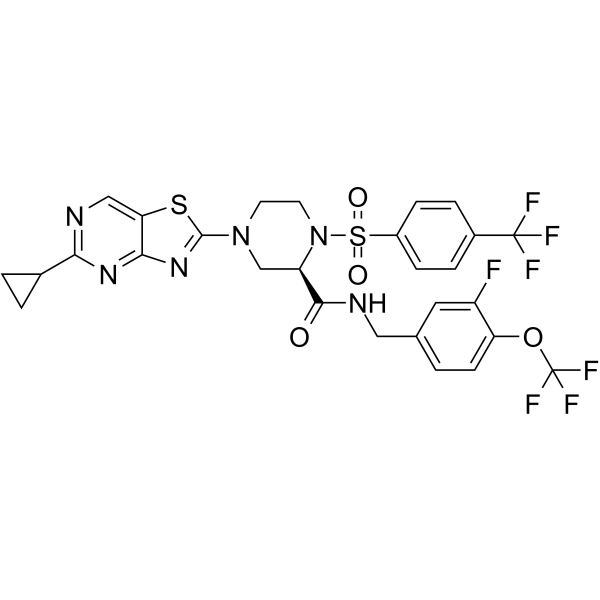
JTK-853
JTK-853 is a novel, non-nucleoside Hepatitis C Virus (HCV) polymerase inhibitor which shows effective antiviral activity in HCV replicon cells with EC50s of 0.38 and 0.035 µM in genotype 1a H77 and 1b Con1 strains, respectively.
연구목적의 판매만을 진행합니다. 환자를 대상으로 한 판매는 하지 않습니다.
- CAS No.: 954389-09-4
- 화학식: C28H23F7N6O4S2
- 분자량:704.64
-
보관:
Please store the product under the recommended conditions in the Certificate of Analysis.

To place orders, for customer services and technical support, please contact: MedChemExpress USA
Tel: 609-228-6898 E-mail: [email protected] [email protected]


-
 Biological Activity
-
Chemical Information
- Protocol
- 순도&문서
- References
-
 Help & FAQs




Biological Activity
제품 설명
IC50 & Target
HCV polymerase[1] EC50: 0.38 μM (1a H77 HCV), 0.035 μM (1b Con1 HCV)[1]
In Vitro
JTK-853 is a novel, non-nucleoside Hepatitis C Virus Polymerase inhibitor which shows effective antiviral activity in HCV replicon cells with EC50s of 0.38 and 0.035 µM in genotype 1a H77 and 1b Con1 strains, respectively. When JTK-853 is incubated with the replicon cells for 48 h, it shows antiviral activity against genotype 1a H77 and 1b Con1 replicon cells with EC90 values of 6.5±0.5 and 0.34±0.05 µM, respectively. At 10 µM, JTK-853 induces apparent Huh-7.5 cell death in 2-week culture. JTK-853 suppresses the drug-resistant colony formation in the genotype 1a replicon cells, and the numbers of JTK-853-resistant colonies are much lower than those of GS-9190-resistant colonies for both genotypes[1].
MedChemExpress (MCE) has not independently confirmed the accuracy of these methods. They are for reference only.
Clinical Trial
| NCT Number | Sponsor | Condition | Start Date |
Phase

|
|---|---|---|---|---|
| NCT01329991 | 2011-05 | PHASE1 |


Chemical Information
-
CAS No. 954389-09-4
-
분자량 704.64
-
화학식 C28H23F7N6O4S2
-
SMILES
O=C([C@@H]1N(S(=O)(C2=CC=C(C(F)(F)F)C=C2)=O)CCN(C3=NC4=NC(C5CC5)=NC=C4S3)C1)NCC6=CC=C(OC(F)(F)F)C(F)=C6
-
선적
Room temperature in continental US; may vary elsewhere.
-
보관
Please store the product under the recommended conditions in the Certificate of Analysis.


순도&문서
References

Calculators
Concentration (start) × Volume (start) = Concentration (final) × Volume (final)


JTK-853 Related Classifications
HY-19921 Related Classifications
 Powered by Bioz