



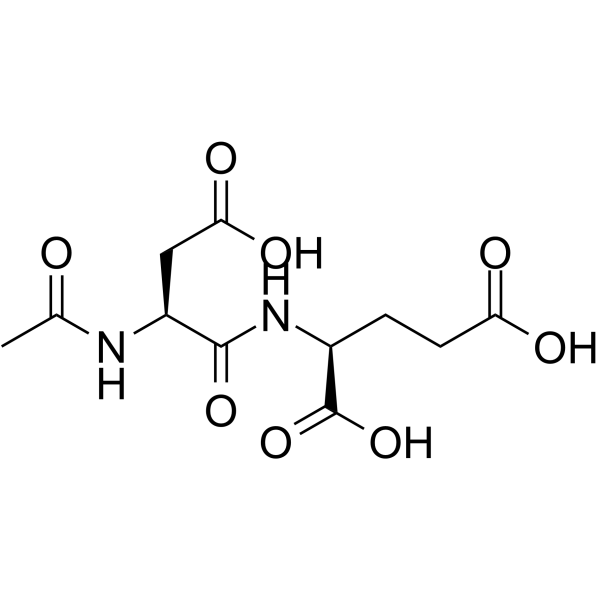
N-Acetyl-L-aspartic acid
Based on 1 publication(s) in Google Scholar
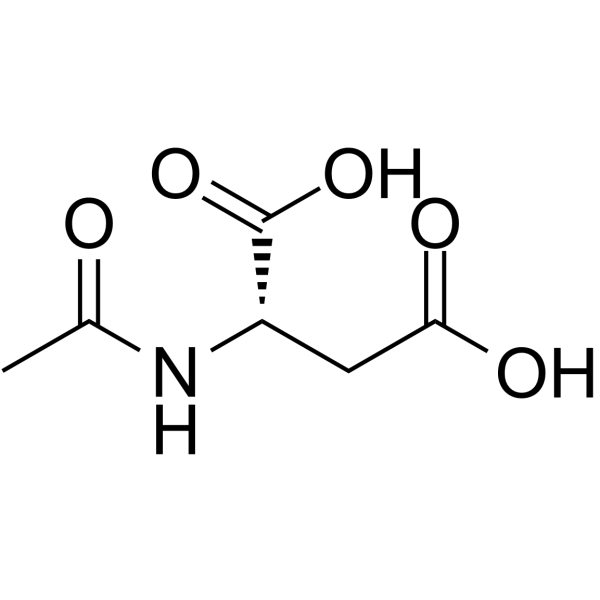
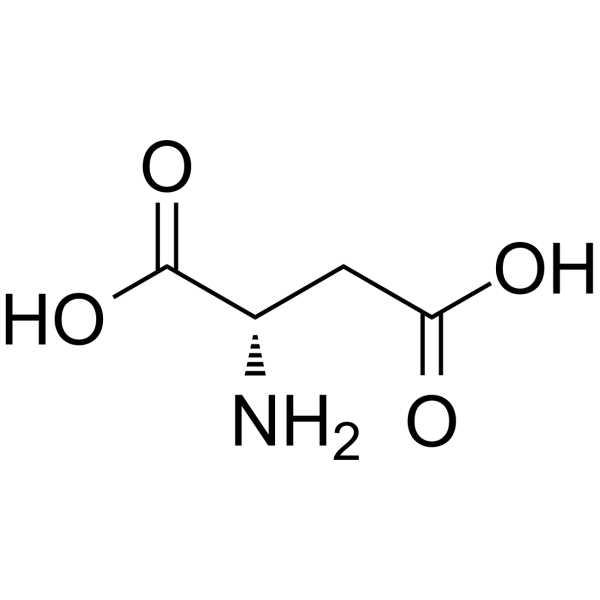
N-Acetyl-L-aspartic acid is a derivative of Aspartic acid (HY-N0666) and endogenous compound. N-Acetyl-L-aspartic acid acts as an acetyl donor. N-Acetyl-L-aspartic acid is involved in brain metabolism. N-Acetyl-L-aspartic acid is used in the research of neurodegenerative diseases (such as Canavan disease).
For research use only. We do not sell to patients.
- Purity : 98.07%
- CAS No.: 997-55-7
- Formula: C6H9NO5
- Molecular Weight:175.14
-
Storage:Powder -20°C, 3 years , 4°C, 2 years ; In solvent -80°C, 2 years , -20°C, 1 year

To place orders, for customer services and technical support, please contact: MedChemExpress USA
Tel: 609-228-6898 E-mail: [email protected] [email protected]


-
 Biological Activity
-
Chemical Information
-
Solvent & Solubility
- Purity & Documentation
- References
-
 Help & FAQs


Publications Citing Use of MedChemExpress (MCE) N-Acetyl-L-aspartic acid
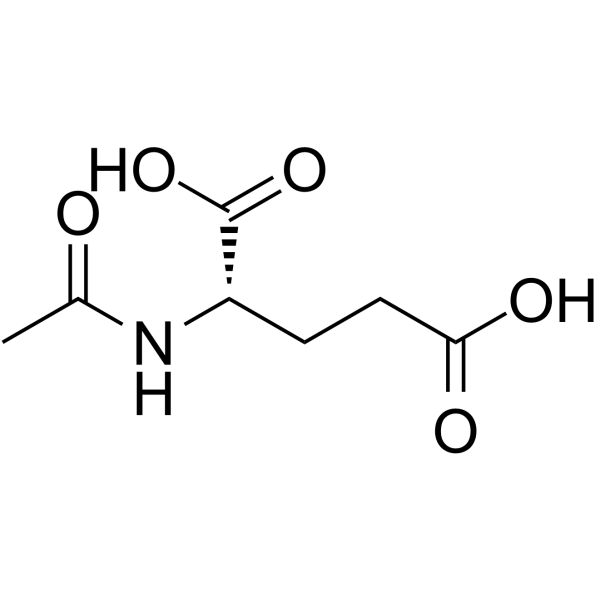
MoreAll Endogenous Metabolite Isoforms
More

Biological Activity
Description
IC50 & Target
|
Human Endogenous Metabolite |
In Vivo
N-acetyl-L-aspartate (100-500 mg/kg bw/day; p.o.; dietary; two generations) does not cause adverse reproductive, neurobehavioral, developmental, or ophthalmological effects in parental Sprague-Dawley rats or their offspring[4].
N-Acetyl-L-aspartic acid (2000 mg/kg; p.o.; once) is not acutely toxic in Sprague-Dawley rats[5].
MedChemExpress (MCE) has not independently confirmed the accuracy of these methods. They are for reference only.
-
Animal Model:Sprague-Dawley rats (male and female, at least 35 days old at receipt)[3]
-
Dosage:100, 250, 500 mg/kg of body weight/day
-
Administration:Administered in the diet daily for 90 consecutive days
-
Result:Allowed all mice to survive until the scheduled sacrifice time.
Showed no diet-related differences in body weights, feed consumption and efficiency, clinical signs, or ophthalmologic findings.
Showed no biologically significant differences or adverse effects in motor activity evaluations, hematology, coagulation, clinical chemistry, urinalysis, organ weights, or gross pathology evaluations.
Showed a higher incidence and degree of acinar cell hypertrophy in salivary glands.


Chemical Information
-
CAS No. 997-55-7
-
Appearance Solid
-
Molecular Weight 175.14
-
Formula C6H9NO5
-
Color White to off-white
-
SMILES
O=C(O)C[C@@H](C(O)=O)NC(C)=O
-
Structure Classification
-
Shipping
Room temperature in continental US; may vary elsewhere.
-
Storage
Powder -20°C 3 years 4°C 2 years In solvent -80°C 2 years -20°C 1 year


Publications (1)
-
Journal Impact Factor
-
Most Recent
-
Nature
2025 Jul;643(8070):192-200. PMID: 39695227


Solvent & Solubility
In Vitro:
H2O : 62.5 mg/mL (356.86 mM; Need ultrasonic)
DMSO : 5 mg/mL (28.55 mM; ultrasonic and warming and heat to 80°C; Hygroscopic DMSO has a significant impact on the solubility of product, please use newly opened DMSO)
Please refer to the solubility information to select the appropriate solvent. Once prepared, please aliquot and store the solution to prevent product inactivation from repeated freeze-thaw cycles.
Storage method and period of stock solution: -80°C, 2 years; -20°C, 1 year. When stored at -80°C, please use it within 2 years. When stored at -20°C, please use it within 1 year.
* Note: If you choose water as the stock solution, please dilute it to the working solution, then filter and sterilize it with a 0.22 μm filter before use.
Please refer to the solubility information to select the appropriate solvent. Once prepared, please aliquot and store the solution to prevent product inactivation from repeated freeze-thaw cycles.
Storage method and period of stock solution: -80°C, 2 years; -20°C, 1 year. When stored at -80°C, please use it within 2 years. When stored at -20°C, please use it within 1 year.
* Note: If you choose water as the stock solution, please dilute it to the working solution, then filter and sterilize it with a 0.22 μm filter before use.
Concentration (start) × Volume (start) = Concentration (final) × Volume (final)
In Vivo:
For the following dissolution methods, please prepare the working solution directly:
It is recommended to prepare fresh solutions and use them promptly within a short period of time.
The percentages shown for the solvents indicate their volumetric ratio in the final prepared solution. If precipitation or phase separation occurs during preparation, heat and/or sonication can be used to aid dissolution.
Add each solvent one by one: PBS
Solubility: 12.5 mg/mL (71.37 mM); Clear solution; Need ultrasonic


Purity & Documentation
-
Data Sheet (275 KB)
-
SDS (394 KB)
- English - EN (394 KB)
- Français - FR (394 KB)
- Deutsch - DE (394 KB)
- Norwegian - NO (394 KB)
- Español - ES (394 KB)
- Swedish - SV (394 KB)
- Italian - IT (394 KB)
- Korean - KR (394 KB)
- Portuguese - PT (394 KB)
-
Handling Instructions (2659 KB)
References
[1]. Buniatian HC, et al. The participation of N-acetyl-L-aspartic acid in brain metabolism. J Neurochem. 1965 Aug;12(8):695-703. [Content Brief]
[2]. Sreekumar A, et al. Metabolomic profiles delineate potential role for sarcosine in prostate cancer progression. Nature. 2009 Feb 12;457(7231):910-4. [Content Brief]
[3]. Karaman S, et al. Subchronic oral toxicity assessment of N-acetyl-L-aspartic acid in rats. Food Chem Toxicol. 2011 Jan;49(1):155-65. [Content Brief]
[4]. Karaman S, et al. Two-generation reproductive and developmental toxicity assessment of dietary N-acetyl-L-aspartic acid in rats. Food Chem Toxicol. 2011 Dec;49(12):3192-205. [Content Brief]
[5]. Delaney B, et al. Acute and repeated dose oral toxicity of N-acetyl-l-aspartic acid in Sprague-Dawley rats. Food Chem Toxicol. 2008 Jun;46(6):2023-34. [Content Brief]
[6]. Birken DL, et al. N-acetyl-L-aspartic acid: a literature review of a compound prominent in 1H-NMR spectroscopic studies of brain. Neurosci Biobehav Rev. 1989 Spring;13(1):23-31. [Content Brief]


Complete Stock Solution Preparation Table
Please refer to the solubility information to select the appropriate solvent. Once prepared, please aliquot and store the solution to prevent product inactivation from repeated freeze-thaw cycles.
Storage method and period of stock solution: -80°C, 2 years; -20°C, 1 year. When stored at -80°C, please use it within 2 years. When stored at -20°C, please use it within 1 year.
| Optional Solvent | Concentration Solvent Mass | 1 mg | 5 mg | 10 mg | 25 mg |
|---|---|---|---|---|---|
| DMSO / H2O | 1 mM | 5.7097 mL | 28.5486 mL | 57.0972 mL | 142.7429 mL |
| 5 mM | 1.1419 mL | 5.7097 mL | 11.4194 mL | 28.5486 mL | |
| 10 mM | 0.5710 mL | 2.8549 mL | 5.7097 mL | 14.2743 mL | |
| 15 mM | 0.3806 mL | 1.9032 mL | 3.8065 mL | 9.5162 mL | |
| 20 mM | 0.2855 mL | 1.4274 mL | 2.8549 mL | 7.1371 mL | |
| 25 mM | 0.2284 mL | 1.1419 mL | 2.2839 mL | 5.7097 mL | |
| H2O | 30 mM | 0.1903 mL | 0.9516 mL | 1.9032 mL | 4.7581 mL |
| 40 mM | 0.1427 mL | 0.7137 mL | 1.4274 mL | 3.5686 mL | |
| 50 mM | 0.1142 mL | 0.5710 mL | 1.1419 mL | 2.8549 mL | |
| 60 mM | 0.0952 mL | 0.4758 mL | 0.9516 mL | 2.3790 mL | |
| 80 mM | 0.0714 mL | 0.3569 mL | 0.7137 mL | 1.7843 mL | |
| 100 mM | 0.0571 mL | 0.2855 mL | 0.5710 mL | 1.4274 mL |
* Note: If you choose water as the stock solution, please dilute it to the working solution, then filter and sterilize it with a 0.22 μm filter before use.


N-Acetyl-L-aspartic acid Related Classifications
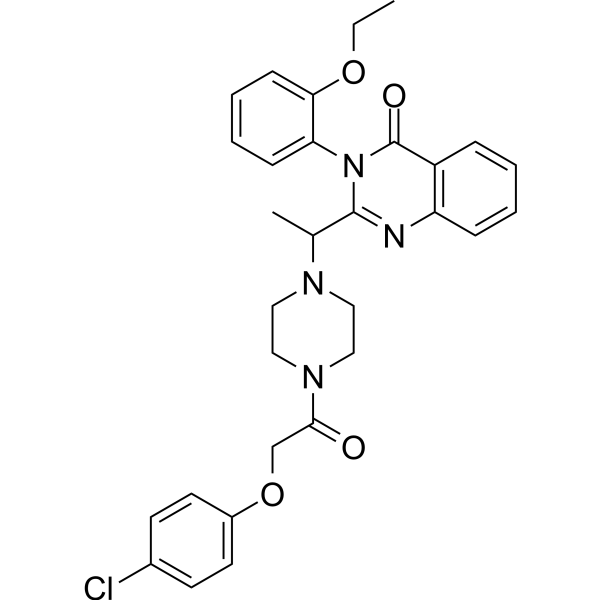
HY-113524 Related Classifications
 Powered by Bioz