



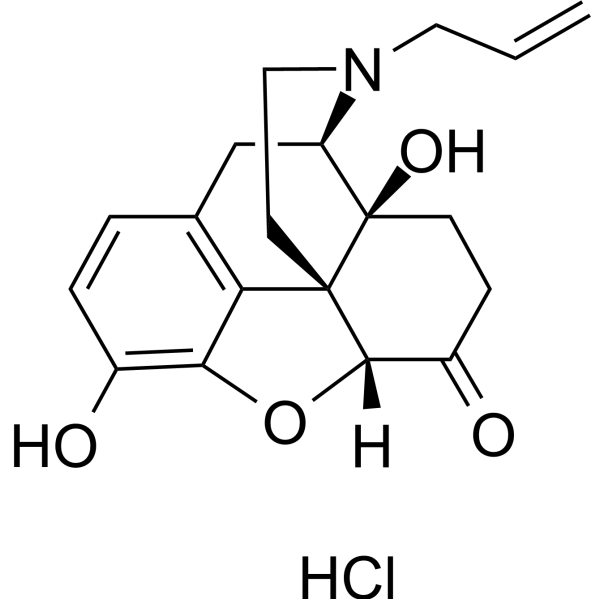
Naloxone hydrochloride
Based on 8 publication(s) in Google Scholar
Naloxone hydrochloride is an orally active opioid receptor antagonist. Naloxone hydrochloride attenuates spinal cord stimulation‑associated anti‑hyperalgesic effects, antagonizes physiologic effects of endogenous opioid peptides linked to central nervous system injury sequelae, functions as a pressor agent to induce modest elevations in mean arterial blood pressure, exerts neuroprotective effects to improve post‑traumatic neurologic motor function, blocks opioid receptor‑mediated amnesic pathways, enhances memory consolidation, reverses Adrenocorticotropic hormone (ACTH) (HY-106373)- and epinephrine‑induced amnesia, and potentiates the memory‑facilitatory effects of ACTH and epinephrine.
For research use only. We do not sell to patients.
- Purity : 99.96%
- CAS No.: 357-08-4
- Formula: C19H22ClNO4
- Molecular Weight:363.84
-
Storage:
4°C, sealed storage, away from moisture
* In solvent : -80°C, 6 months; -20°C, 1 month (sealed storage, away from moisture)

To place orders, for customer services and technical support, please contact: MedChemExpress USA
Tel: 609-228-6898 E-mail: [email protected] [email protected]


-
 Biological Activity
-
Chemical Information
-
Solvent & Solubility
- Purity & Documentation
- References
-
 Help & FAQs


-
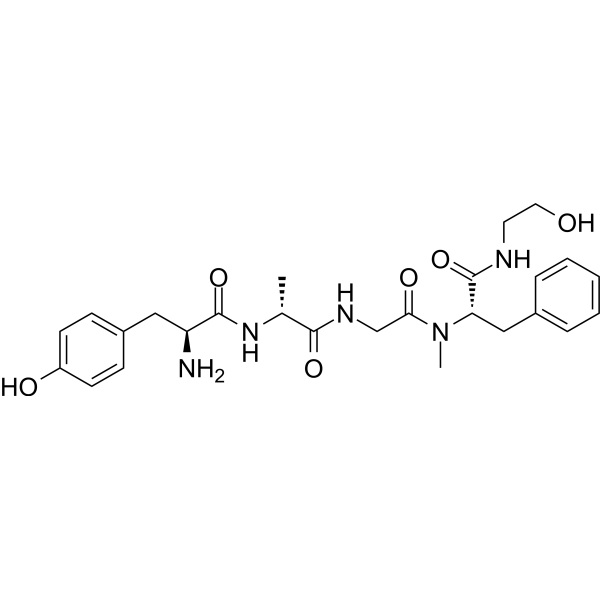
HY-P0210
DAMGO -

HY-76711
Naltrexone -
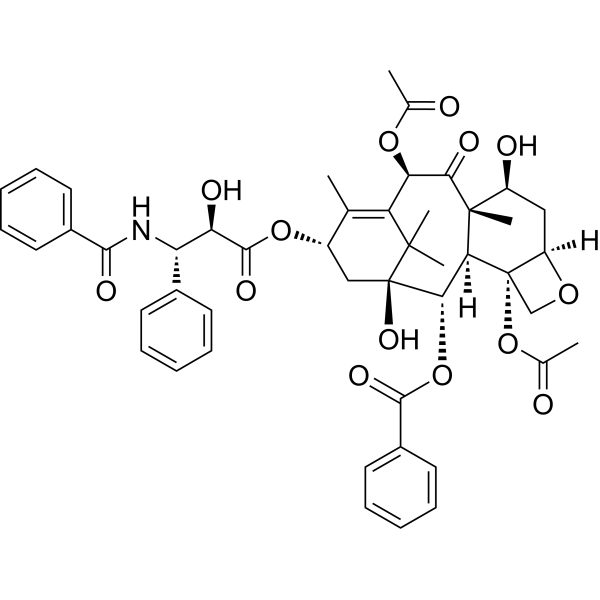
HY-B0015
Paclitaxel -
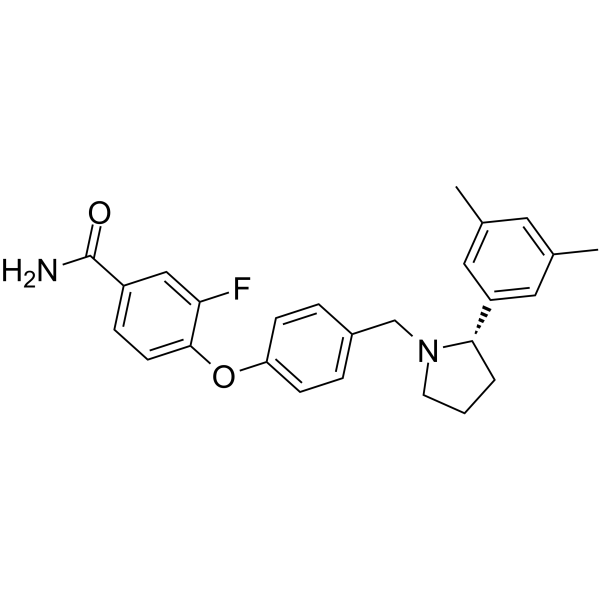
HY-101718
Aticaprant -

HY-17417R
Naloxone hydrochloride (Standard) -
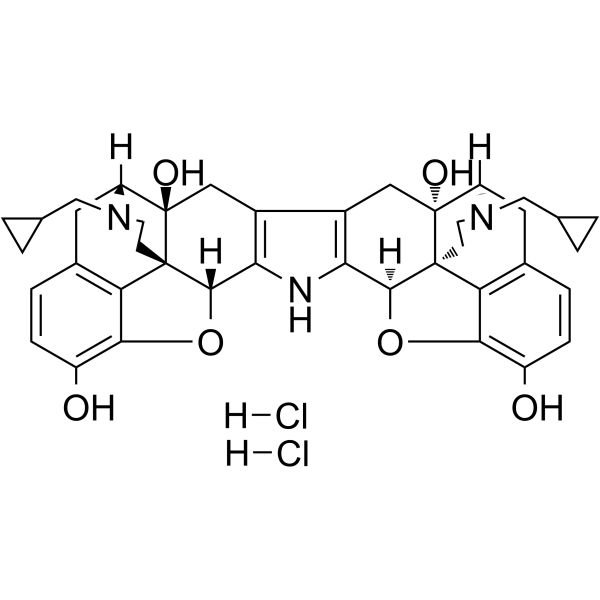
HY-100903
Norbinaltorphimine dihydrochloride -
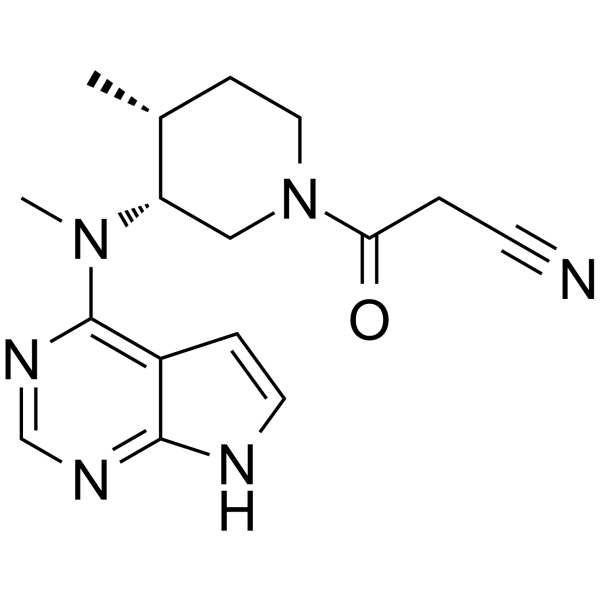
HY-40354
Tofacitinib -
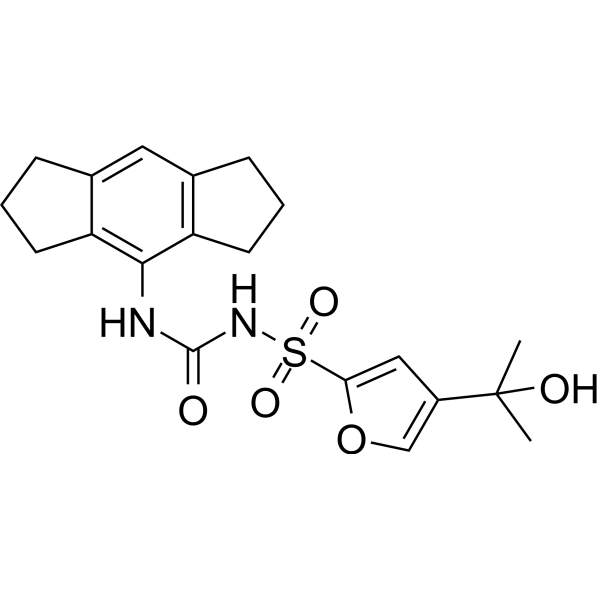
HY-12815
MCC950 -
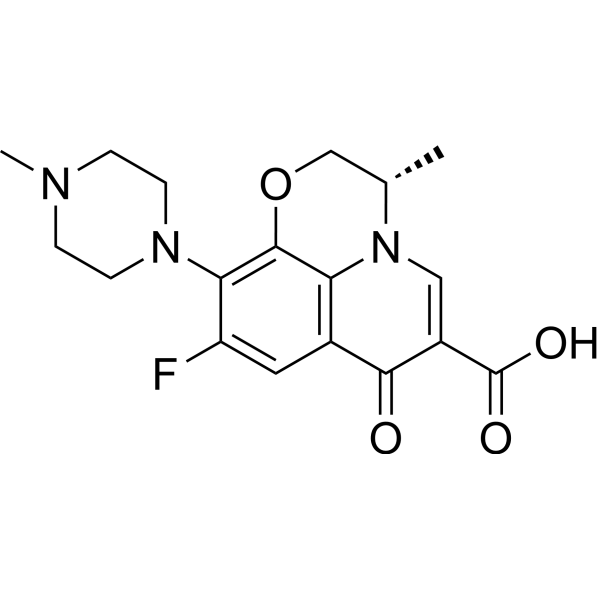
HY-B0330
Levofloxacin -
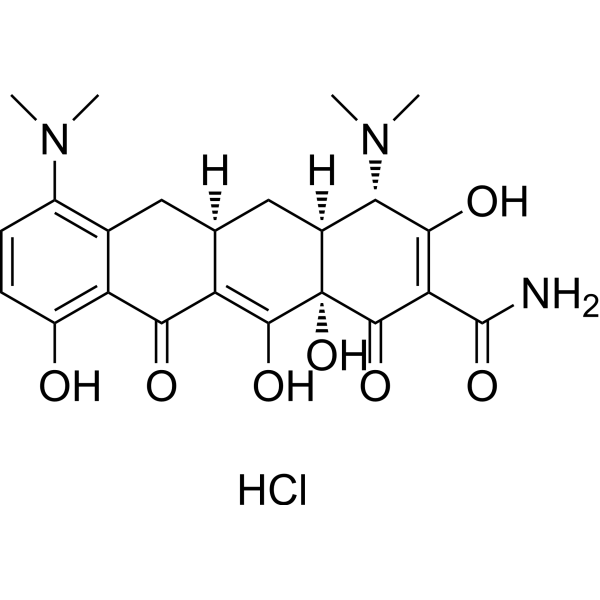
HY-17412
Minocycline hydrochloride -
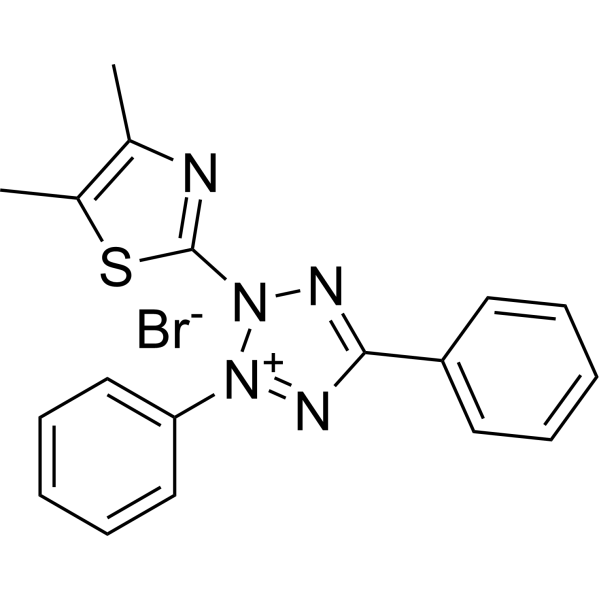
HY-15924
Thiazolyl Blue -
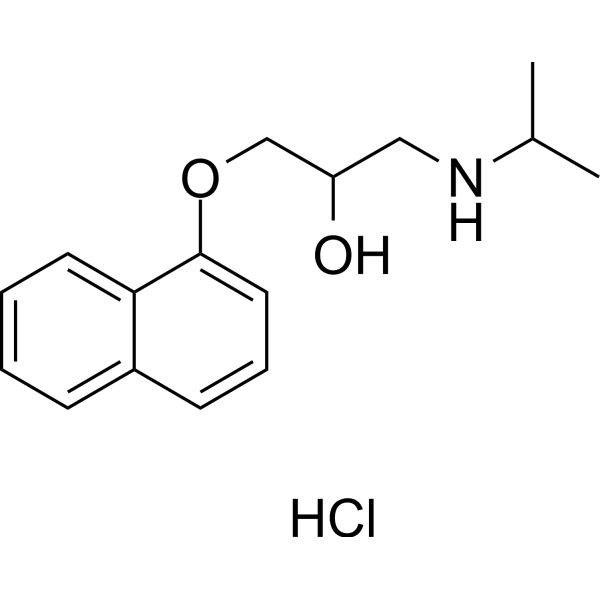
HY-B0573
Propranolol hydrochloride
Publications Citing Use of MedChemExpress (MCE) Naloxone hydrochloride
More- Nature. 2025 Dec;648(8094):755-763. [Abstract]
- Nat Methods. 2026 May;23(5):1011-1023. [Abstract]
- Nat Commun. 2025 Aug 1;16(1):7074. [Abstract]
- Cell Rep. 2020 Mar 17;30(11):3625-3631.e6. [Abstract]
- Br J Pharmacol. 2025 Jul 21. [Abstract]
- J Med Chem. 2026 Mar 5;69(6):6508-6527.
- Eur J Pain. 2017 May;21(5):804-814. [Abstract]
- bioRxiv. 2026 Jun 3.
 Customer Validation & Images

-
Others
-
Cell Proliferation/Viability Assay
-
Others
-
Cell Proliferation/Viability Assay
All Opioid Receptor Isoforms
More

Biological Activity
Description
In Vitro
Naloxone (800 µg per tablet; 2 h annealing, 5 days freeze drying) hydrochloride forms freeze-dried buccal tablets that form a stable amorphous matrix that remains chemically and physically intact for 9 months at 4°C or 25°C[4].
Naloxone (800 µg per tablet; up to 30 s) hydrochloride forms freeze-dried buccal tablets that achieve 90% disintegration in 4.8 seconds under buccal-relevant conditions (37°C, 0.7 mL phosphate buffer) and fully disintegrate within 30 s across all tested temperature and medium volume conditions[4].
MedChemExpress (MCE) has not independently confirmed the accuracy of these methods. They are for reference only.
In Vivo
Naloxone (2.0 mg/kg; 1.7 mg/kg/h; i.v.; bolus over 60 seconds followed by constant infusion; 4 hours) hydrochloride significantly improves long-term neurologic motor recovery up to 4 weeks following moderate fluid-percussion traumatic brain injury in male Sprague-Dawley rats, with a median composite neurologic score of 18.5 at week 4[2].
Naloxone (0.4 mg/kg; i.p.; single immediate post-training injection) hydrochloride produces significant memory facilitation in male Wistar rats trained on task 1 and 2, and reverses the amnesic effects of post-training ACTH and epinephrine administration[3].
MedChemExpress (MCE) has not independently confirmed the accuracy of these methods. They are for reference only.
-
Animal Model:Sprague Dawley (adult male, 200-250 g, neuropathic pain model via partial sciatic nerve ligation and epidural monopolar electrode implantation at spinal segments T12/13)[1]
-
Dosage:10 mg/kg
-
Administration:i.p.; single dose
-
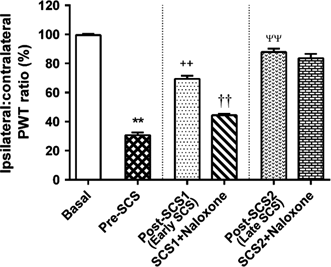
Result:Decreased the ipsilateral:contralateral paw withdrawal threshold ratio after SCS1.
Exerted no discernible effect on the anti-hyperalgesic effect induced by SCS2.
-
Animal Model:Sprague-Dawley (male, moderate severity lateral fluid-percussion traumatic brain injury induced via 2.4 to 2.5 atmosphere pressure pulse)[2]
-
Dosage:2.0 mg/kg (bolus); 1.7 mg/kg/h (infusion)
-
Administration:i.v.; bolus over 60 seconds followed by constant infusion; 4 hours
-
Result:Caused a modest, nonsignificant increase in mean arterial blood pressure during 4-hour postinjury monitoring period.
Showed no significant changes to arterial blood gases, pH, or brain temperature.
Exhibited no significant improvement in composite neurologic motor scores at 24 hours postinjury.
Achieved a significant improvement in median composite neurologic motor scores at 1 week postinjury.
Reached a median composite neurologic motor score of 18.5 out of maximum 20 by week 4.
Resulted in 100% survival rate over the 4-week study period.
-
Animal Model:Wistar rats (male, age 51-69 days, weight 140-200 g, step-down inhibitory avoidance task 1 training)[3]
-
Dosage:0.4 mg/kg
-
Administration:i.p.; single immediate post-training injection
-
Result:Produced a median (mean) training-test step-down latency difference of 180.00 sec.
Produced a median (mean) training-test step-down latency difference of 180.00 (144.45) sec when co-administered with 2.0 μg/kg ACTH1-24, reversing the amnesic effect of ACTH alone and showing a significant difference from naloxone alone.
Produced a median (mean) training-test step-down latency difference of 180.00 (134.98) sec when co-administered with 50.0 μg/kg epinephrine HC1, reversing the amnesic effect of epinephrine alone and showing a significant difference from naloxone alone.
-
Animal Model:Wistar rats (male, age 51-69 days, weight 140-200 g, step-down inhibitory avoidance task 2 training)[3]
-
Dosage:0.4 mg/kg
-
Administration:i.p.; single immediate post-training injection
-
Result:Produced a median (mean) training-test step-down latency difference of 24.13 (56.18) sec, showing significant memory facilitation compared to saline controls.
Produced a median (mean) training-test step-down latency difference of 105.07 (113.65) sec when co-administered with 2.0 μg/kg ACTH1-24, potentiating the facilitatory effect of ACTH alone and showing a significant difference from naloxone alone .
Produced a median (mean) training-test step-down latency difference of 81.85 (96.86) sec when co-administered with 50.0 μg/kg epinephrine HC1, potentiating the facilitatory effect of epinephrine alone and showing a significant difference from naloxone alone.
Clinical Trial
| NCT Number | Sponsor | Condition | Start Date |
Phase

|
|---|---|---|---|---|
| NCT01329991 | Plexxikon| | 2011-05 | PHASE1 |


Chemical Information
-
CAS No. 357-08-4
-
Appearance Solid
-
Molecular Weight 363.84
-
Formula C19H22ClNO4
-
Color White to off-white
-
SMILES
OC1=C(O2)C([C@]([C@]2([H])C(CC3)=O)(CCN4CC=C)[C@]3(O)[C@H]4C5)=C5C=C1.Cl
-
Shipping
Room temperature in continental US; may vary elsewhere.
-
Storage
4°C, sealed storage, away from moisture
* In solvent : -80°C, 6 months; -20°C, 1 month (sealed storage, away from moisture)


Publications (8)
-
Journal Impact Factor
-
Most Recent
-
Nature
2025 Dec;648(8094):755-763. PMID: 41193810 -
Nat Methods
Single-molecule localization and diffusivity microscopy reveals dynamic biomolecular organization in living cells. [Abstract]2026 May;23(5):1011-1023. PMID: 42050111 -
Nat Commun
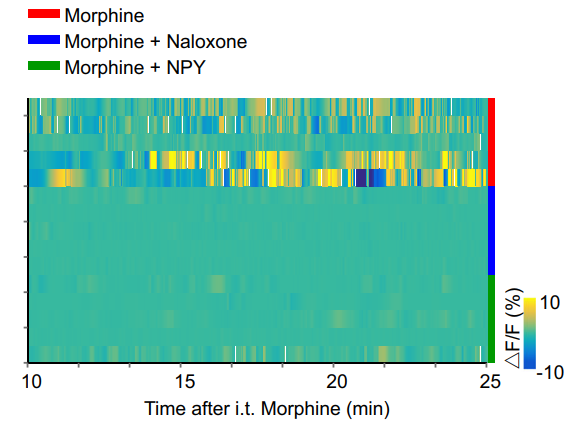
Neuropeptide Y neurons mediate opioid-induced itch by disinhibiting GRP-GRPR microcircuits in the spinal cord. [Abstract]2025 Aug 1;16(1):7074. PMID: 40750771
Naloxone hydrochloride purchased from MedChemExpress. Usage Cited in: Nat Commun. 2025 Aug 1;16(1):7074. [Abstract]
Heatmaps shows the calcium signals within the 10-25 min after drugs injection (i.t., 0.3 nmol Morphine, 10 nmol Naloxone + 0.3 nmol Morphine, and 10 μg NPY + 0.3 nmol Morphine), n = 5 mice per group.
-
Cell Rep
Morphine and Naloxone Facilitate Neural Stem Cells Proliferation via a TET1-Dependent and Receptor-Independent Pathway. [Abstract]2020 Mar 17;30(11):3625-3631.e6. PMID: 32187535
Naloxone hydrochloride purchased from MedChemExpress. Usage Cited in: Cell Rep. 2020 Mar 17;30(11):3625-3631.e6. [Abstract]
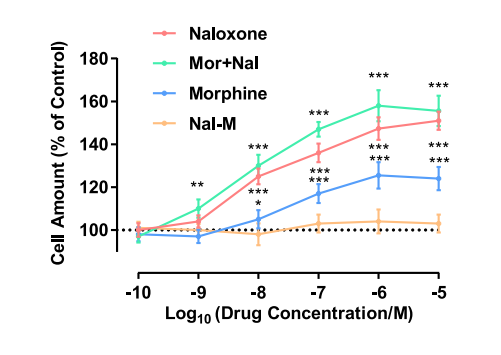
NSCs were treated with different concentrations of Naloxone, Morphine, Naloxone and Morphine (Mor+Nal, 1:1), or Nal-M. Cell numbers were determined on day 3.
Naloxone hydrochloride purchased from MedChemExpress. Usage Cited in: Cell Rep. 2020 Mar 17;30(11):3625-3631.e6. [Abstract]
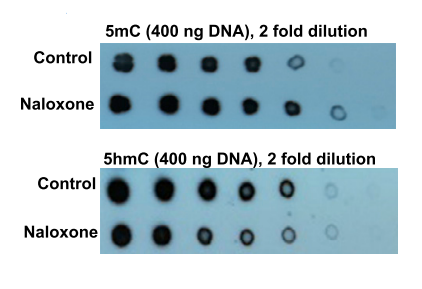
Neural stem cells (NSCs) were treated with 1 μM Naloxone or Morphine. The contents of 5mC and 5hmC in NSCs (day 3) were determined by high-spot Western blot assay.
-
Br J Pharmacol
Semax peptide targets the μ opioid receptor gene Oprm1 to promote deubiquitination and functional recovery after spinal cord injury in female mice. [Abstract]2025 Jul 21. PMID: 40692165 -
-
Eur J Pain
Endocannabinoid activation of CB1 receptors contributes to long-lasting reversal of neuropathic pain by repetitive spinal cord stimulation. [Abstract]2017 May;21(5):804-814. PMID: 28107590
Naloxone hydrochloride purchased from MedChemExpress. Usage Cited in: Eur J Pain. 2017 May;21(5):804-814. [Abstract]
The SCS1 (early SCS)-mediated increase in the ipsilateral:contralateral PWT ratio (compared to pre-SCS) is significantly reduced by the opioid receptor antagonist, Naloxone, which is administered 10 min before SCS1.
-


Solvent & Solubility
In Vitro:
H2O : 62.5 mg/mL (171.78 mM; Need ultrasonic)
DMSO : ≥ 30 mg/mL (82.45 mM; Hygroscopic DMSO has a significant impact on the solubility of product, please use newly opened DMSO)
* "≥" means soluble, but saturation unknown.
Please refer to the solubility information to select the appropriate solvent. Once prepared, please aliquot and store the solution to prevent product inactivation from repeated freeze-thaw cycles.
Storage method and period of stock solution: -80°C, 6 months; -20°C, 1 month (sealed storage, away from moisture). When stored at -80°C, please use it within 6 months. When stored at -20°C, please use it within 1 month.
* Note: If you choose water as the stock solution, please dilute it to the working solution, then filter and sterilize it with a 0.22 μm filter before use.
Please refer to the solubility information to select the appropriate solvent. Once prepared, please aliquot and store the solution to prevent product inactivation from repeated freeze-thaw cycles.
Storage method and period of stock solution: -80°C, 6 months; -20°C, 1 month (sealed storage, away from moisture). When stored at -80°C, please use it within 6 months. When stored at -20°C, please use it within 1 month.
* Note: If you choose water as the stock solution, please dilute it to the working solution, then filter and sterilize it with a 0.22 μm filter before use.
Concentration (start) × Volume (start) = Concentration (final) × Volume (final)
In Vivo:
The following protocol is derived from the literature and is for reference only. It is recommended to first try a small sample.
In Vivo Dissolution Calculator
Please enter the basic information of animal experiments:
-
-
-
-
Recommended: Prepare an additional quantity of animals to account for potential losses during experiments.
Working solution concentration: 0.22 mg/mL
This product has good water solubility, please refer to the measured solubility data in water/PBS/Saline for details.


Purity & Documentation
-
Data Sheet (307 KB)
-
SDS (396 KB)
- English - EN (396 KB)
- Français - FR (396 KB)
- Deutsch - DE (396 KB)
- Norwegian - NO (396 KB)
- Español - ES (396 KB)
- Swedish - SV (396 KB)
- Italian - IT (396 KB)
- Korean - KR (396 KB)
- Portuguese - PT (396 KB)
-
Handling Instructions (2659 KB)
References
[1]. Sun L, et al. Endocannabinoid activation of CB receptors contributes to long-lasting reversal of neuropathic pain by repetitive spinal cord stimulation. European journal of pain (London, England). 2017 May;21(5):804-814. [Content Brief]
[2].
McIntosh TK, et al. Beneficial effect of the nonselective opiate antagonist naloxone hydrochloride and the thyrotropin-releasing hormone (TRH) analog YM-14673 on long-term neurobehavioral outcome following experimental brain injury in the rat. J Neurotrauma. 1993 Winter;10(4):373-84.
[Content Brief]
[3]. Izquierdo I, et al. Effect of ACTH, epinephrine, beta-endorphin, naloxone, and of the combination of naloxone or beta-endorphin with ACTH or epinephrine on memory consolidation. Psychoneuroendocrinology. 1983;8(1):81-7. [Content Brief]


Complete Stock Solution Preparation Table
Please refer to the solubility information to select the appropriate solvent. Once prepared, please aliquot and store the solution to prevent product inactivation from repeated freeze-thaw cycles.
Storage method and period of stock solution: -80°C, 6 months; -20°C, 1 month (sealed storage, away from moisture). When stored at -80°C, please use it within 6 months. When stored at -20°C, please use it within 1 month.
| Optional Solvent | Concentration Solvent Mass | 1 mg | 5 mg | 10 mg | 25 mg |
|---|---|---|---|---|---|
| DMSO / H2O | 1 mM | 2.7485 mL | 13.7423 mL | 27.4846 mL | 68.7115 mL |
| 5 mM | 0.5497 mL | 2.7485 mL | 5.4969 mL | 13.7423 mL | |
| 10 mM | 0.2748 mL | 1.3742 mL | 2.7485 mL | 6.8712 mL | |
| 15 mM | 0.1832 mL | 0.9162 mL | 1.8323 mL | 4.5808 mL | |
| 20 mM | 0.1374 mL | 0.6871 mL | 1.3742 mL | 3.4356 mL | |
| 25 mM | 0.1099 mL | 0.5497 mL | 1.0994 mL | 2.7485 mL | |
| 30 mM | 0.0916 mL | 0.4581 mL | 0.9162 mL | 2.2904 mL | |
| 40 mM | 0.0687 mL | 0.3436 mL | 0.6871 mL | 1.7178 mL | |
| 50 mM | 0.0550 mL | 0.2748 mL | 0.5497 mL | 1.3742 mL | |
| 60 mM | 0.0458 mL | 0.2290 mL | 0.4581 mL | 1.1452 mL | |
| 80 mM | 0.0344 mL | 0.1718 mL | 0.3436 mL | 0.8589 mL | |
| H2O | 100 mM | 0.0275 mL | 0.1374 mL | 0.2748 mL | 0.6871 mL |
* Note: If you choose water as the stock solution, please dilute it to the working solution, then filter and sterilize it with a 0.22 μm filter before use.


Naloxone hydrochloride Related Classifications
HY-17417 Related Classifications
 Powered by Bioz