Neurological Disease
-
Neurological Disease Related Products (19212)
Related Products (19212)

-
Antibodies (42)
-
Related Compound Screening Libraries (7)
-
Zicronapine fumarate
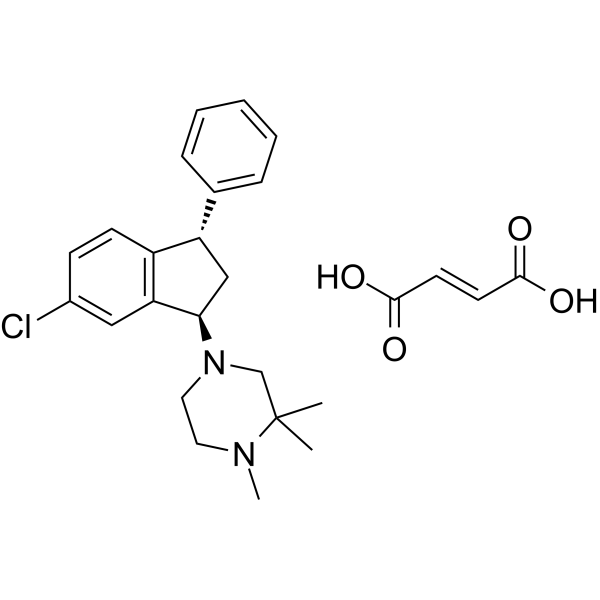 0 ImagesCat. No.: HY-14827ACAS No.: 170381-17-6Synonyms: Lu 31-130 fumarate
Zicronapine (Lu 31-130) fumarate is an antipsychotic agent with a strong pro-cognitive effect in animal models and the potential to treat a number of neurological and psychiatric diseases. Zicronapine (Lu 31-130) fumarate has potent antagonistic effects at dopamine D1/D2, and serotonin 5-HT2A receptors.
-
HCN2-IN-2
 0 ImagesCat. No.: HY-186066CAS No.: 3080808-99-4
HCN2-IN-2 (Compound 35), azaindazole derivative, is a selective HCN2 inhibitor with an IC50 of 145 nM. HCN2-IN-2 inhibits HCN2 channel activity blocks abnormal firing of peripheral nociceptive neurons. HCN2-IN-2 can be used for the research of pain.
-
Protriptyline-d3
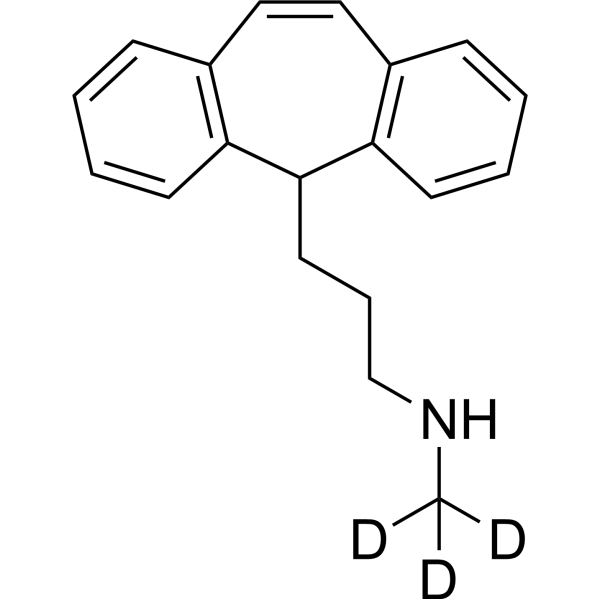 0 ImagesCat. No.: HY-B0949ASCAS No.: 136765-50-9
Protriptyline-d3 is deuterium labeled Protriptyline (HY-B0949). Protriptyline is a potent tricyclic antidepressant (TCA). Protriptyline inhibits AChE activity with an IC50 value of 0.06 mM and inhibits Aβ self-assembly. Protriptyline can be used for the study of depression and Alzheimers disease.
-
Varenicline-d4
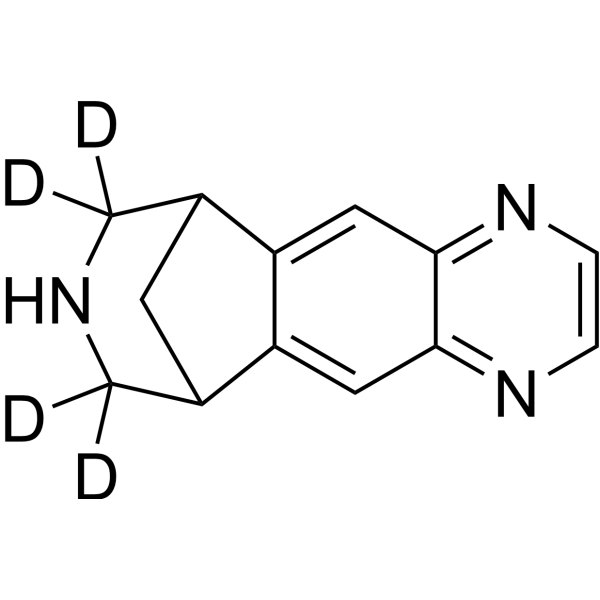 0 ImagesSynonyms: CP 526555-d4
Varenicline-d4 is deuterium labeled Varenicline. Varenicline (CP 526555) is a potent partial agonist for α4β2 nicotinic acetylcholine receptor (nAChR) with an EC50 value of 2.3 μM. Varenicline is a full agonist for α3β4 and α7 nAChRs with EC50 values of 55 μM and 18 μM, respectively. Varenicline is a nicotinic ligand based on the structure of cytisine, has the potential for smoking cessation treatment.
-
TGN, Cys modified
 0 ImagesCat. No.: HY-P11284BCAS No.: 1418155-47-1
TGN, Cys modified is a cysteine modified TGN (HY-P11284) on the C-terminus. TGN, a 12-amino acid ligand, is a BBB-penetrating peptide. TGN can be used as a drug delivery vehicle for Alzheimer's disease research.
-
Erianin (Standard)
 0 Images
Erianin (Standard) is the analytical standard of Erianin. This product is intended for research and analytical applications. Erianin, often used as an antipyretic and analgesic agent, could inhibit IDO-induced tumor angiogenesis.
-
Illudinine
 0 ImagesCat. No.: HY-176245CAS No.: 18500-63-5
Illudinine, a sesquiterpenoid alkaloid, is a monoamine oxidase B (MAO-B) inhibitor with an IC50 of 18.3 μM. Illudinine can be used for research on neurological diseases.
-
C26-Dihydro ceramide
 0 ImagesCat. No.: HY-W777920CAS No.: 182362-38-5
C26-Dihydro ceramide is a dihydroceramide containing a C26 very-long-chain fatty acid. C26-Dihydro ceramide can be used for research on various neurological disorders including Alzheimer's disease, Parkinson's disease, multiple sclerosis, depression, and anxiety disorders.
-
Tracizoline
 0 ImagesCat. No.: HY-182597CAS No.: 65248-90-0
Tracizoline is an orally active I2-imidazoline receptor agonist. Tracizoline functionally modulates I2-imidazoline receptors, regulates hippocampal FADD cell fate adaptor, attenuates mechanical and thermal hyperalgesia, activates α2A-adrenergic receptors with very weak partial agonism, and induces antidepressant-like activity via 5-HT1A receptor activation. Tracizoline can be used for the research of inflammatory pain, neuropathic pain, and depression.
-
Paroxetine-d2
 0 ImagesCat. No.: HY-111124CAS No.: 923932-43-8Synonyms: BRL29060-d2
Paroxetine-d2 (BRL29060-d2) is the deuterated-labeled Paroxetine (HY-122272). Paroxetine (BRL29060) is an orally active and selective serotonin reuptake inhibitor (SSRI) and apoptosis inducer with blood-brain barrier permeability. Paroxetine inhibits nitric oxide synthase and CYP2D6, induces desensitization of 5-HT1A/1B/1D autoreceptors, downregulates 5-HT2 receptors, and promotes the production of inflammatory cytokines. Paroxetine is a weak norepinephrine (NE) uptake inhibitor and possesses antitumor activity. Paroxetine is widely used in research concerning depression, obsessive-compulsive disorder, panic disorder, social phobia, generalized anxiety disorder, post-traumatic stress disorder, premenstrual dysphoric disorder, hot flashes, and related conditions.
-
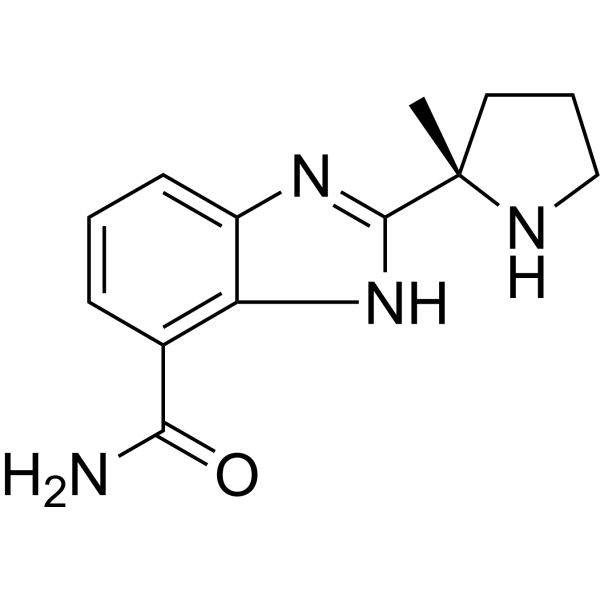
YM-796 dihydroxybutanedioate
 0 ImagesCat. No.: HY-19092CAS No.: 171252-79-2
YM-796 dihydroxybutanedioate is a selective muscarinic M1 receptor agonist. YM-796 dihydroxybutanedioate can improve cognitive impairment and reduce amyloid plaque deposition. YM-796 dihydroxybutanedioate can be used in the research of cognitive impairment diseases such as Alzheimer's disease.

-
JNJ-54082730
 0 ImagesCat. No.: HY-168966CAS No.: 2097493-39-3
JNJ-54082730 (Compound 1) is the orally active inhibitor for phosphodiesterase (PDE) that inhibits PDE2A, PDE3B, and PDE10A2 with IC50s of 0.95 nM, 6.17 μM (pIC50=5.21) and 87.1 nM (pIC50=7.06), respectively. JNJ-54082730 modulates the activity of AMPA receptor, enhance the synaptic plasticity and promotes the learning and memory function in rats models. JNJ-54082730 can cross blood-brain barrier.
-
SLV-317
 0 ImagesCat. No.: HY-19429ACAS No.: 393183-40-9
SLV-317 is an antagonist of the neurokinin-1 receptor with oral activity. SLV-317 can effective antagonist of substance P-induced effects.
-
Q14
 0 ImagesCat. No.: HY-P10416Purity: 98.51%Synonyms: Q14 peptide
Q14 is a polypeptide derived from the USP30 (ubiquitin specific peptidase 30) transmembrane (TM) domain with the ability to inhibit the deubiquitination activity of USP30 (IC50=57.2 nM). Q14 reduces USP30 activity by inhibiting the interaction between the USP30 transmembrane domain and its catalytic domain. Q14 peptide contains the LC3 interaction region (LIR) motif, which enables it to bind to the LC3 and accelerate the formation of autophagosomes, thereby promoting mitophagy. Q14 can be used in the study of neurodegenerative diseases as well as mitochondrial quality control and cell metabolism.
-
NK3R antagonist-2
 0 ImagesCat. No.: HY-184769CAS No.: 909856-46-8
NK3R antagonist-2 (Compound 45) is a small-molecule antagonist of tachykinin NK3R, with an IC50 of 1100 nM and a Ki of 1800 nM. NK3R antagonist-2 can be used in the research of schizophrenia.
-
Fonagepant
 0 ImagesCat. No.: HY-P12136CAS No.: 1966181-14-5Synonyms: FE 205030
Fonagepant (FE 205030) is a calcitonin gene-related peptide (CGRP) receptor antagonist with an IC50 of 0.2 nM. Fonagepant selectively blocks CGRP receptor activity, inhibits CGRP-induced vasodilation, attenuates capsaicin-induced increase in skin blood flow, and blocks CGRP-induced vasodilation in isolated human mesenteric resistance arteries. Fonagepant can be used in studies related to acute migraine attacks.
-
Protopine (Standard)
 0 Images
Protopine (Standard) is the analytical standard of Protopine. This product is intended for research and analytical applications. Protopine (Corydinine), an isoquinoline alkaloid, is a specific reversible and competitive inhibitor of acetylcholinesterase. Protopine exhibits anti-inflammation, anti-microbial, anti-angiogenic and anti-tumour activity.
-
HTL-9936
 0 ImagesCat. No.: HY-148961CAS No.: 1438242-59-1
HTL-9936 is an orally active partial agonist of muscarinic M1 receptor. HTL-9936 has an EC50 of 32 nM for human M1 receptor and an EC50 of 224 nM for human M4 receptor. HTL-9936 activates Gq/11 coupling, promotes inositol phosphate accumulation, ERK1/2 phosphorylation, β-arrestin recruitment and receptor internalization. HTL-9936 can be used in the research of Alzheimer's disease and schizophrenia.