



FGFR
Fibroblast growth factor receptor
FGFR (Fibroblast growth factor receptors) are the receptors that bind to members of the fibroblast growth factor family of proteins. Some of these receptors are involved in pathological conditions. A point mutation in FGFR3 can lead to achondroplasia. Five distinct membrane FGFR have been identified in vertebrates and all of them belong to the tyrosine kinase superfamily (FGFR1, FGFR2, FGFR3, FGFR4, FGFR6). The fibroblast growth factor family constitutes one of the most important groups of paracrine factors that act during development. They are responsible for determining certain cells to become mesoderm, for the production of blood vessels, for limb outgrowth, and for the growth and differentiation of numerous cell types.
All Product Categories
-
FGFR Inhibitors
(319)
View all products
-
FGFR Agonists
(4)
View all products
-
FGFR Antagonist
(1)
View all products
-
FGFR Activators
(6)
View all products
-
FGFR Modulators
(3)
View all products
-
FGFR Degraders
(11)
View all products
-
FGFR Control
(1)
View all products
-
FGFR Ligands
(2)
View all products
-
FGFR Proteins
(97)
View all products
-
FGFR-1 Proteins
(20)
View all products
-
FGFR-2 Proteins
(31)
View all products
-
FGFR-3 Proteins
(26)
View all products
-
FGFR-4 Proteins
(18)
View all products
-
FGFR Related Products (388)
Related Products (388)

-
Recombinant Proteins (97)
-
Antibodies (11)
-
FGFR3 K650E Recombinant Human Active Protein Kinase
 0 ImagesCat. No.: HY-E70719FGFR3 activating mutations are drivers of malignancy in several human tissues, including bladder, lung, cervix, and blood. FGFR3 K650E is a mutant of FGFR3 that may be present in multiple myeloma cell lines. FGFR3 K650E Recombinant Human Active Protein Kinase is a recombinant FGFR3 K650E protein that can be used to study FGFR3 K650E-related functions.
-
FGFR4-IN-6
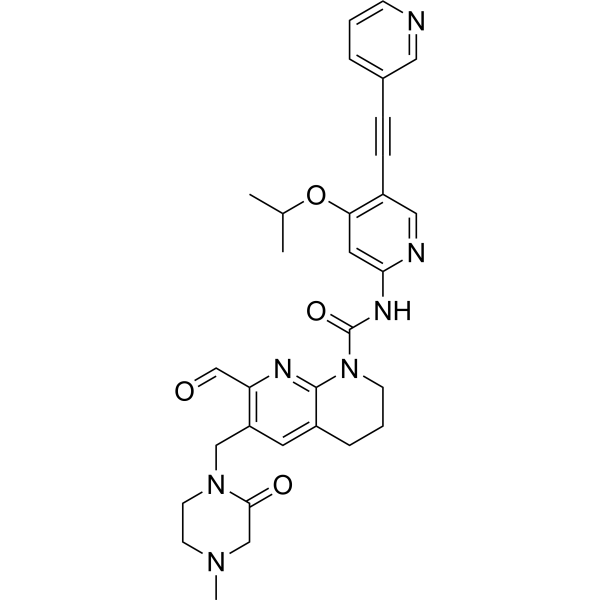 0 ImagesCat. No.: HY-143881CAS No.: 2760970-10-1FGFR4-IN-6 (Compound 9ka) is a covalently reversible FGFR4 inhibitor with an IC50 value of 5.4 nM. FGFR4-IN-6 also exhibits good oral pharmacokinetic properties. FGFR4-IN-6 induces significant tumor regressions in a xenograft mouse model of Hep3B2.1-7 HCC cell line without an obvious sign of toxicity. FGFR4-IN-6 is a click chemistry reagent, it contains an Alkyne group and can undergo copper-catalyzed azide-alkyne cycloaddition (CuAAc) with molecules containing Azide groups.

-
LC-SF-14
 0 ImagesCat. No.: HY-172916LC-SF-14 is a selective dual inhibitor of SHP2 and FGFR (IC50 values are 71.6 and 8.9 nM, respectively). LC-SF-14 inhibits FGFR2-FRS2α-SHP2-MAPK signaling and ERK phosphorylation. LC-SF-14 inhibits the proliferation of KATOIII cancer cells (IC50: 9.2 nM). LC-SF-14 has antitumor activity in the SNU-16 xenograft mouse model. LC-SF-14 can be used in FGFR2-driven gastric cancer research.
-
FGFR2 N549H Recombinant Human Active Protein Kinase
 0 ImagesCat. No.: HY-E70822FGFR2 is a receptor tyrosine kinase that is involved in many human cancers such as intrahepatic cholangiocarcinomas and hepatocellular carcinomas. FGFR2 N549H is a mutant of FGFR3. FGFR2 N549H Recombinant Human Active Protein Kinase is a recombinant FGFR4 N535H protein that can be used to study FGFR4 N535H-related functions.
-
FGFR4-IN-19
 0 ImagesCat. No.: HY-158248CAS No.: 3036751-84-2FGFR4-IN-19 (compound 8B) is a potent covalent fibroblast growth factor receptor 4 (FGFR4) inhibitor (IC50=1.2 nM). FGFR4-IN-19 achieves high efficiency and isotype selectivity by covalently targeting a rare cysteine (C552) in the FGFR4 kinase domain. FGFR4-IN-19 can be used for hepatocellular carcinoma (HCC) research.
-
LC-MG-10
 0 ImagesCat. No.: HY-184322LC-MG-10 is a selective molecular glue degrader targeting FGFR2, with a DC50 of 230.2 nM in KATO III cells. LC-MG-10 induces proteasomal degradation of FGFR2 via a covalent molecular glue mechanism. LC-MG-10 inhibits cancer cell proliferation. LC-MG-10 suppresses FGFR2-mediated PI3K/AKT and MAPK/ERK signaling pathways. LC-MG-10 can be used in studies related to gastric cancer.
-
Umedaptanib pegol
 0 ImagesCat. No.: HY-177668CAS No.: 2734771-59-4Synonyms: RBM-007Umedaptanib pegol is a pegylated aptamer, which can target fibroblast growth factor-2 (FGF2) . It is used for the study of neovascular age-related macular degeneration (nAMD).

-
Multi-kinase-IN-2
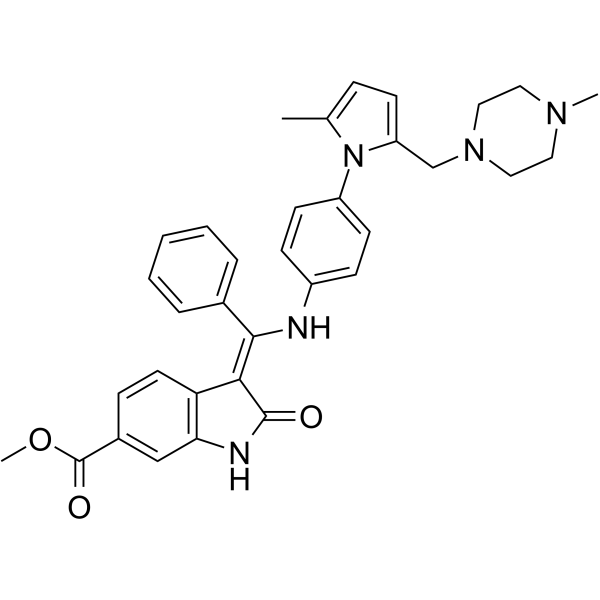 0 ImagesCat. No.: HY-150026CAS No.: 2095628-21-8Multi-kinase-IN-2 (compound 7h) is an orally active and potent angiokinase inhibitor. Multi-kinase-IN-2 exhibits excellent inhibitory activity against angiokinases including VEGFR-1/2/3, PDGFRα/β, and FGFR-1, as well as LYN and c-KIT kinases. Multi-kinase-IN-2 significantly attenuates phosphorylation of AKT and ERK proteins. Multi-kinase-IN-2 induces cell apoptosis. Multi-kinase-IN-2 shows anticancer activity.
-
FGFR1 inhibitor-8
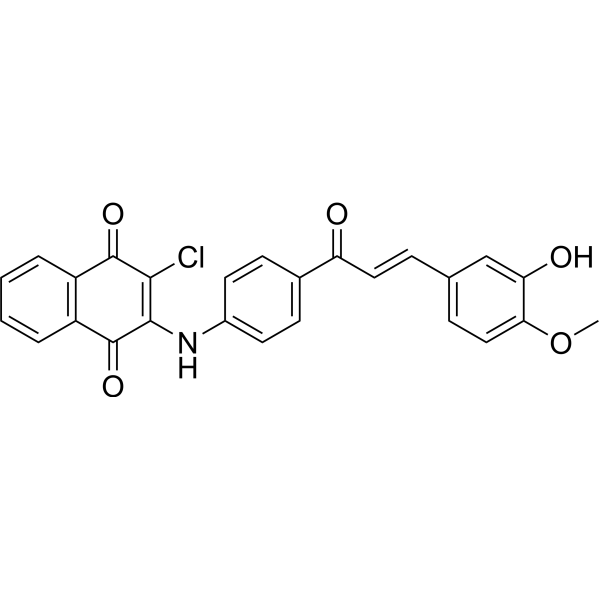 0 ImagesCat. No.: HY-149487FGFR1 inhibitor-8 (Compound 9) is a FGFR1 inhibitor (IC50s: 0.5 nM). FGFR1 inhibitor-8 binds to the ATP-binding pocket of FGFR1. FGFR1 inhibitor-8 has anticancer activity.
-
FGFR1/VEGFR2-IN-2
 0 ImagesCat. No.: HY-161995FGFR1/VEGFR2-IN-2 (compound 6l) is a VEGFR2/FGFR1 dual inhibitor. The IC50 values for VEGFR2 and FGFR1 are 0.025 µM and 0.026 µM respectively, and for EGFR and PDGFR-β, the IC50 values are 0.106 µM and 0.077 µM. FGFR1/VEGFR2-IN-2 showes significant anti-cancer activity (GI=60.38%) on NCI-60 cell line, with an IC50 of 8.51 µM in T-47D cell line and anti-migration. FGFR1/VEGFR2-IN-2 acts to arrest cells in the G1 phase and promote apoptosis and necrosis; the IC50 for MCF-7 cell line exceeds 100 µM, and the IC50 for MDA-MB-231 is 69.17 µM, non-toxic to normal cells.
-
FGFR4-IN-9
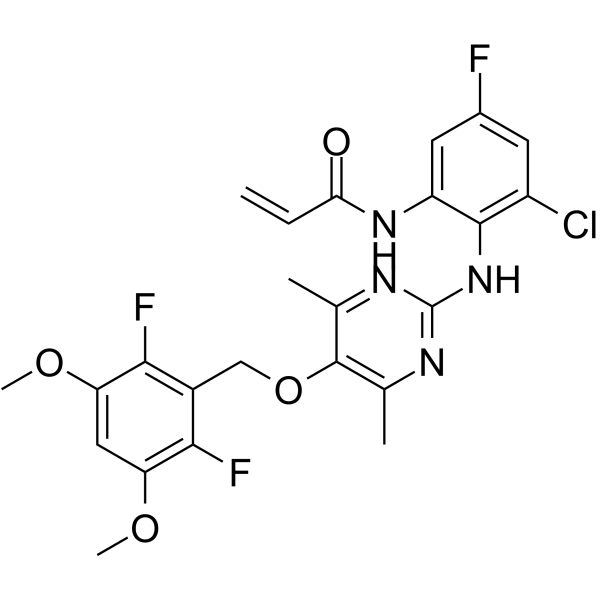 0 ImagesCat. No.: HY-144759CAS No.: 3033043-66-9FGFR4-IN-9 (Compound 6O) is a selective FGFR4 inhibitor with an IC50 of 75.3 nM. FGFR4-IN-9 effectively inhibits both the growth and angiogenesis of HCC.
-
FGFR-IN-12
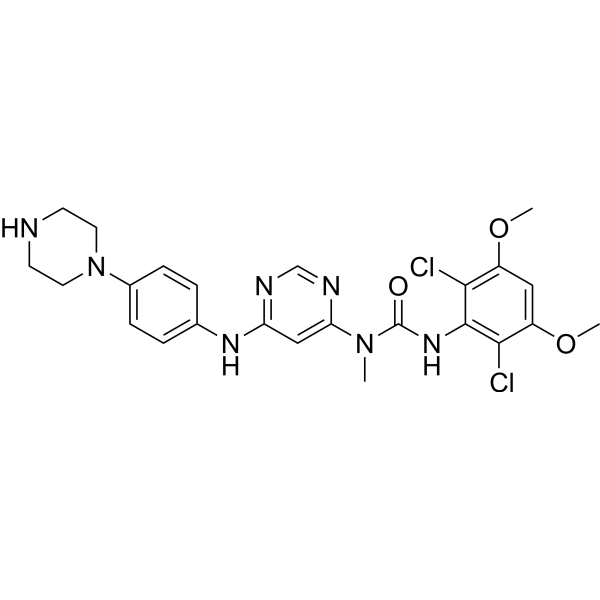 0 ImagesCat. No.: HY-160013CAS No.: 943189-02-4FGFR-IN-12 (example 14), a pyrimidinyl aryl urea derivative, is a potent FGFR inhibitor.
-
FGFR-IN-17
 0 ImagesCat. No.: HY-172251FGFR-IN-17 (Compound 12l) is an orally active irreversible inhibitor of FGFR, which has a strong inhibitory effect on FGFR and its mutants. FGFR-IN-17 can inhibit the proliferation and migration, and induce apoptosis of non-small cell lung cancer cells. FGFR-IN-17 has anti-tumor activity.
-
FGFR4-IN-7
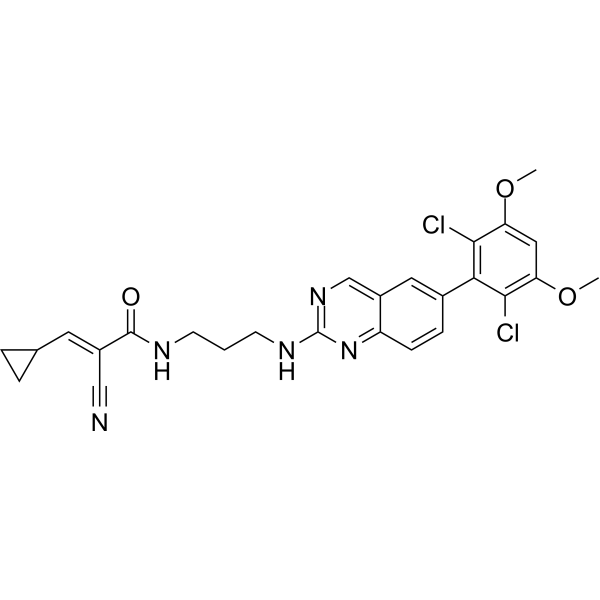 0 ImagesCat. No.: HY-115902CAS No.: 2765046-07-7FGFR4-IN-7 (Compound C3) is a covalent reversible FGFR4 inhibitor with an IC50 value of 0.42 μM. FGFR4-IN-7 induces apoptosis via the FGFR4 signaling pathway blockage. FGFR4-IN-7 can be used for the research of hepatocellular carcinoma (HCC).
-
FGFR3-IN-11
 0 ImagesCat. No.: HY-181152FGFR3-IN-11(compound B11) is a Fibroblast growth factor receptor 3 (FGFR3) inhibitor with a Ka value of 4.8 μM. FGFR3-IN-11 induces apoptosis, suppresses colony formation, and causes dose-dependent G0/G1 cell cycle arrest in cancer cells. FGFR3-IN-11 exerts anticancer activity against cancer cells with minimal toxicity toward normal hepatocytes and demonstrates tumor growth suppression in xenograft mouse models. FGFR3-IN-11 can be used for the research of hepatocellular carcinoma.

-
FGFR2-IN-4
 0 ImagesCat. No.: HY-189204CAS No.: 3110002-64-4FGFR2-IN-4 is a selective, orally active FGFR2 inhibitor, with IC50 values of 10.0 nM and 5.8 nM against wild-type FGFR2 and the FGFR2V565F mutant, respectively. FGFR2-IN-4 induces necroptosis in FGFR2-driven tumor cells. FGFR2-IN-4 induces tumor regression in xenograft models harboring FGFR2 inhibitor-resistant mutations without altering serum phosphate levels. FGFR2-IN-4 is used to investigate FGFR2-driven malignancies, including intrahepatic cholangiocarcinoma and gastric cancer.
-
Triamcinolone acetonide-13C3
 0 ImagesCat. No.: HY-B0636S1CAS No.: 1264131-86-3Triamcinolone acetonide-13C3 is the 13C-labeled Triamcinolone acetonide (HY-B0636). Triamcinolone acetonide inhibits basic fibroblast growth factor (bFGF) induced proliferation of retinal endothelial cells. Triamcinolone acetonide reduces chondrocyte viability and leads to cartilage destruction. Triamcinolone acetonide activates macrophage with anti-inflammatory characteristics. Triamcinolone acetonide can be used in the study of diseases such as atopic dermatitis.




