



LXRα
Liver X receptor alpha (LXRα; NR1H3) is a ligand-activated nuclear receptor that functions as a cellular cholesterol sensor and transcriptional regulator of lipid homeostasis, particularly in metabolically active tissues such as liver, intestine, adipose tissue, and macrophages[1][2]. Mechanistically, LXRα forms heterodimers with retinoid X receptor (RXR) and activates gene networks that promote cholesterol efflux, transport, and elimination, thereby maintaining intracellular cholesterol balance[1][3]. LXRα signaling also regulates reverse cholesterol transport through induction of ATP-binding cassette transporters, linking sterol sensing to systemic lipid metabolism[1]. In metabolic disease models, LXRα is required for maintenance of hepatic cholesterol homeostasis, and impaired LXRα activity leads to hepatic cholesterol accumulation, inflammation, hepatitis, and fibrosis, highlighting its importance in liver health and metabolic regulation[4]. Compared with the related isoform LXRβ (NR1H2), which is expressed ubiquitously across tissues, LXRα exhibits a more restricted expression pattern and is the dominant LXR isoform in hepatocytes, indicating distinct physiological functions despite overlapping target pathways[2][5]. LXRα expression is further regulated through an autoregulatory mechanism in macrophages and other cell types, which can amplify transcriptional responses to endogenous oxysterol ligands[6][7]. For experimental applications, synthetic LXR agonists such as T0901317 are widely used to activate LXR-dependent transcriptional programs and investigate cholesterol metabolism, lipid synthesis, and nuclear receptor signaling pathways[5].
References:
- [1]. Liver X Receptor Alphaet.
- [2]. LXRα gene information from NCBI.
- [3]. Uniprotkb.
- [4]. Lockhart SM, et al. Damaging mutations in liver X receptor-α are hepatotoxic and implicate cholesterol sensing in liver health. Nat Metab. 2024 Oct;6(10):1922-1938. [Content Brief]
- [5]. Wikipedia.
- [6]. Li Y, et al. Induction of human liver X receptor alpha gene expression via an autoregulatory loop mechanism. Mol Endocrinol. 2002 Mar;16(3):506-14. [Content Brief]
- [7]. Whitney KD, et al. Liver X receptor (LXR) regulation of the LXRalpha gene in human macrophages. The Journal of Biological Chemistry. 2001 Nov;276(47):43509-43515. [Content Brief]
-
LXRα Related Products (6)
Related Products (6)

-
22(R)-Hydroxycholesterol
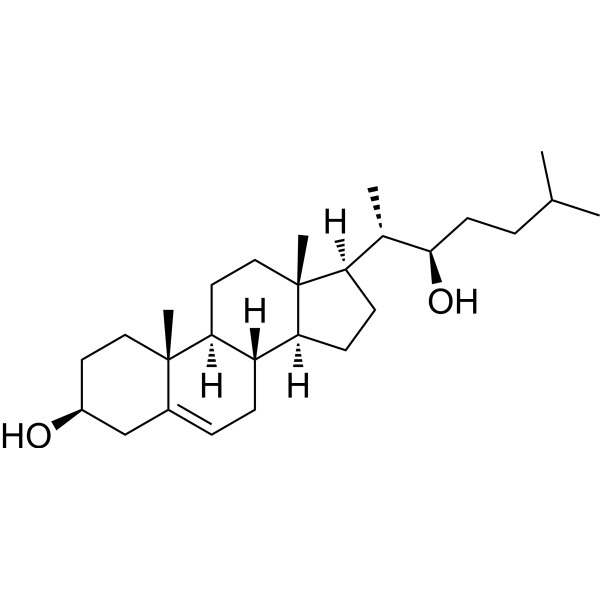 0 ImagesSynonyms: Narthesterol22 (R)-Hydroxycholesterol (Narthesterol) is a natural oxysterol, acting as a LXRα agonist that inhibits cancer cell proliferation. 22 (R)-Hydroxycholesterol activates LXRα-mediated upregulation of downstream ABCA1 expression, enhances apolipoprotein-dependent cholesterol efflux, reduces intracellular cholesterol content, and decreases the production of β-amyloid peptide. 22 (R)-Hydroxycholesterol induces the differentiation of human mesenchymal stem cells into functional dopaminergic neurons. 22 (R)-Hydroxycholesterol is applicable to research related to cancer, Alzheimer's disease, and Parkinson's disease.
-
TLC-2716
 0 ImagesCat. No.: HY-182014CAS No.: 2408041-54-1TLC-2716 is an orally available, gut- and liver-restricted inhibitor against LXRα and LXRβ, with EC50 values of 7 nM and 15 nM, respectively. TLC-2716 represses LXRα/β transcriptional activity, downregulates genes involved in lipogenesis, lipid absorption and lipoprotein metabolism, and preserves peripheral reverse cholesterol transport. TLC-2716 reduces lipid accumulation, suppresses inflammation and fibrotic gene expression, enhances triglyceride-rich lipoprotein clearance, and improves glucose homeostasis and insulin sensitivity. TLC-2716 lowers serum and hepatic triglycerides, plasma cholesterol and other atherogenic lipid profiles in experimental models and humanized liver mice. TLC-2716 can be used for the research of dyslipidemia and related cardiometabolic disorders.
-
Ginsenoside C-K hexapropionate ester
 0 ImagesGinsenoside C-K hexapropionate ester (Structure 2) is a selective agonist of LXRα, with no significant activation effect on LXRβ. Ginsenoside C-K hexapropionate ester upregulates the expression of downstream genes such as ABCA1 by activating LXRα, promoting reverse cholesterol transport, and reducing lipid deposition in macrophage-derived foam cells. It can be used in the research of atherosclerosis. Ginsenoside C-K hexapropionate ester is a derivative synthesized from ginsenoside Compound K, an active metabolite of Panax notoginseng saponins, by modification with propionic anhydride.
-
LXRα agonist 1
 0 ImagesCat. No.: HY-173393CAS No.: 1790089-97-2LXRα agonist 1 is a selective LXRα agonist, with EC50 values of 42 nM and 266 nM against purified LXRα and LXRβ, respectively. LXRα agonist 1 acts as a lipotoxicity inducer, triggering the production of toxic saturated fatty acids in tumor cells, and induces lipotoxicity-mediated cancer cell death when combined with the Raf inhibitor Sorafenib (HY-10201). LXRα agonist 1 can be used in the research of hepatocellular carcinoma.
-
27-Norcholestenoic acid
 0 ImagesCat. No.: HY-160126CAS No.: 2154373-60-927-Norcholestenoic acid is an inverse agonist of LXRβ and LXRα that decreases basal luciferase activity and inhibits agonist-induced transactivation. 27-Norcholestenoic acid induces conformational changes in the AF-2 domain that favor corepressor over coactivator recruitment, thereby destabilizing the active receptor conformation. 27-Norcholestenoic acid downregulates FASN and SREBP-1a/c gene expression.
-
Gypenoside LVI
 0 ImagesCat. No.: HY-N21887CAS No.: 105214-48-0Gypenoside LVI is an orally active dammarane-type triterpenoid compound found in Gynostemma pentaphyllum. Gypenoside LVI inhibits ERK and JNK phosphorylation, the NLRP3 inflammasome, and modulates M1 to M2 microglial polarization. Gypenoside LVI downregulates PCSK9 expression through a SREBP-independent pathway. Gypenoside LVI promotes cholesterol efflux via ABCG1 and SRB1, upregulates LXRα-mediated reverse cholesterol transport, and attenuates foam cell formation by reducing lipid accumulation and cholesterol uptake. Gypenoside LVI inhibits IL-6 and IL-1β secretion, reduces oxidative stress, neuroinflammation, microglial and astrocyte activation, and inhibits LPS-induced microglial proliferation. Gypenoside LVI can be used for research on atherosclerosis, hypercholesterolemia, depression, and non-small cell lung cancer.



