



V1 Receptor
V1 receptor signaling is mainly represented by V1aR and V1bR, two arginine vasopressin receptor subtypes that mediate physiological functions beyond renal V2R antidiuresis, including cardiovascular homeostasis, hormone secretion, and social behavior[1]. Mechanistically, V1aR is originally found in vascular smooth muscle, whereas V1bR is originally found in the anterior pituitary, providing an isoform-level distinction for experimental design[1]. In disease and behavioral models, male V1aR knockout mice show markedly reduced anxiety-like behavior and profound impairment in social recognition, while V1aR re-expression in the lateral septum rescues social recognition[2][3]. Compared with OTR, V1bR, and V2R, selective V1aR ligands remain important because receptor and peptide homology can limit subtype-specific interpretation[4]. For experimental applications,[D-Arg8]-inotocin acts as a stable competitive V1aR antagonist with 3,000-fold binding selectivity over OTR, V1bR, and V2R[4].
References:
- [1]. Koshimizu TA, et al. Vasopressin V1a and V1b receptors: from molecules to physiological systems. Physiol Rev. 2012 Oct;92(4):1813-64. [Content Brief]
- [2]. Bielsky IF, et al. Profound impairment in social recognition and reduction in anxiety-like behavior in vasopressin V1a receptor knockout mice. Neuropsychopharmacology. 2004 Mar;29(3):483-93. [Content Brief]
- [3]. Bielsky IF, et al. The V1a vasopressin receptor is necessary and sufficient for normal social recognition: a gene replacement study. Neuron. 2005 Aug 18;47(4):503-13. [Content Brief]
- [4]. Di Giglio MG, et al. Development of a human vasopressin V1a -receptor antagonist from an evolutionary-related insect neuropeptide. Sci Rep. 2017 Feb 1;7:41002. [Content Brief]
All Product Categories
-
V1 Receptor Related Products (3)
Related Products (3)

-
Lysipressin
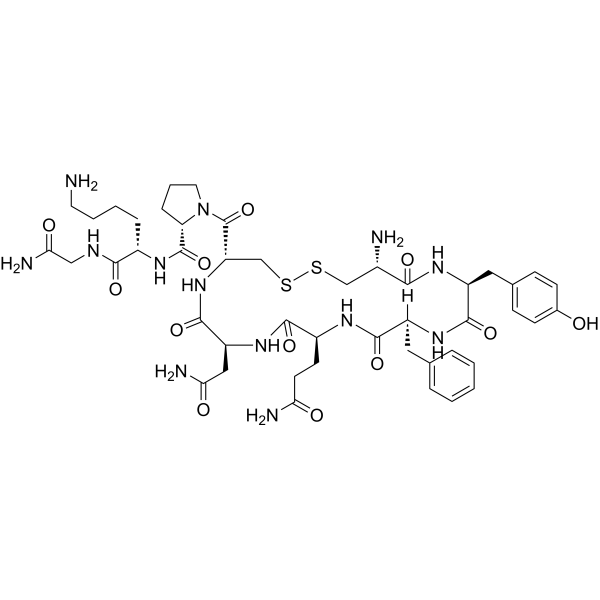 0 ImagesLysipressin (Lysine vasopressin ; [Lys8]-Vasopressin ) is a neurohypophyseal nonapeptide with dual cardiovascular regulatory activities of peripheral pressor action and central hypotensive action, and it also regulates pain perception in the body. Lysipressin is an Oxytocin Receptor agonist, with a Ki value of 10.2 nM for porcine OT receptor. Lysipressin stimulates contraction of rabbit bladder smooth muscle via V1-vasopressin receptor. The central hypotensive effect of Lysipressin depends on the sympathetic tone pathway. Lysipressin dose-dependently prolongs tail-flick latency in rats, producing a stable central antinociceptive effect. Lysipressin can be used in studies related to cardiovascular regulation, hypertension and pain.
-
Lysipressin acetate
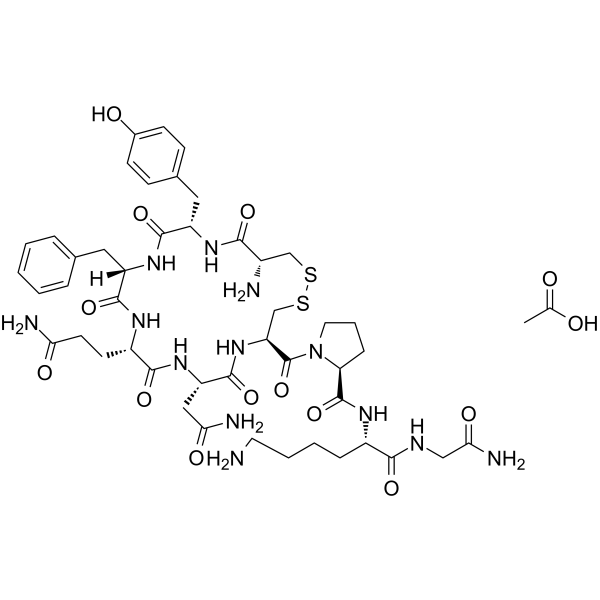 0 ImagesSynonyms: Lysine vasopressin acetate; [Lys8]-Vasopressin acetateLysipressin acetate (Lysine vasopressin acetate; [Lys8]-Vasopressin acetate) is a neurohypophyseal nonapeptide with dual cardiovascular regulatory activities of peripheral pressor action and central hypotensive action, and it also regulates pain perception in the body. Lysipressin acetate is an Oxytocin Receptor agonist, with a Ki value of 10.2 nM for porcine OT receptor. Lysipressin acetate stimulates contraction of rabbit bladder smooth muscle via V1-vasopressin receptor. The central hypotensive effect of Lysipressin acetate depends on the sympathetic tone pathway. Lysipressin acetate dose-dependently prolongs tail-flick latency in rats, producing a stable central antinociceptive effect. Lysipressin acetate can be used in studies related to cardiovascular regulation, hypertension and pain.
-
Lysipressin (Standard)
 0 ImagesSynonyms: Lysine vasopressin (Standard); [Lys8]-Vasopressin (Standard)Lysipressin (Standard) is the analytical standard of Lysipressin (HY-P0004). This product is intended for research and analytical applications. Lysipressin (Lysine vasopressin ; [Lys8]-Vasopressin ) is a neurohypophyseal nonapeptide with dual cardiovascular regulatory activities of peripheral pressor action and central hypotensive action, and it also regulates pain perception in the body. Lysipressin is an Oxytocin Receptor agonist, with a Ki value of 10.2 nM for porcine OT receptor. Lysipressin stimulates contraction of rabbit bladder smooth muscle via V1-vasopressin receptor. The central hypotensive effect of Lysipressin depends on the sympathetic tone pathway. Lysipressin dose-dependently prolongs tail-flick latency in rats, producing a stable central antinociceptive effect. Lysipressin can be used in studies related to cardiovascular regulation, hypertension and pain.



