



Fluorescent Dye
Fluorescence is a phenomenon of photoluminescence in luminescence. When an atom is irradiated by light, some electrons around the nucleus jump from their original orbitals to higher energy orbitals under the influence of light energy, i.e., from the ground state to the first or second excited single-line state, etc. Due to the instability of the first or second excited singlet state, the electron returns from the excited singlet state to the ground state accompanied by released energy, resulting in fluorescence.
Fluorescent dyes can be covalently bound or physically adsorbed in the structure of the substance. The fluorescence properties allow for the characterization, localization and quantitative analysis of the labeled object. Fluorescent dyes have shown great potential for the detection of proteins, nucleic acids, cells, and immunoassays, attributed to the advantages in non-radioactive contamination, simple experimental operation and easy observation.
Fluorescent dyes have penetrated many fields such as pharmacology, physiology, environmental science, and information science, as well as functional studies of proteins and drug screening.
All Product Categories
-
Fluorescent Dye Related Products (4894)
Related Products (4894)

-
Antibodies (4)
-
RB-PEG2000-N3
 0 ImagesCat. No.: HY-D2886CSynonyms: Rhodamine B-PEG2000-N3RB-PEG2000-N3 (Rhodamine B-PEG2000-N3) is a fluorescent dye composed of Rhodamine B (HY-Y0016), PEG and azide group (N3). RB-PEG2000-N3 is a click chemistry reagent, it contains an Azide group and can undergo copper-catalyzed azide-alkyne cycloaddition reaction (CuAAc) with molecules containing Alkyne groups. It can also undergo strain-promoted alkyne-azide cycloaddition (SPAAC) reactions with molecules containing DBCO or BCN groups (Ex/Em=546/610 nm).
-
TMR-NO-BG
 0 ImagesCat. No.: HY-D2966CAS No.: 1928762-04-2TMR-NO-BG is a hybrid probe (Ex/Em: 557 nm/571 nm). TMR-NO-BG covalently connects the tetramethylrhodamine (TMR) lactone NO sensing unit with the SNAP-tag reactive benzyl guanine (BG) for achieving subcellular-specific nitric oxide (NO) detection.
-
Cy3 labled Afovirsen sodium
 0 ImagesCat. No.: HY-177610DCy3 labled Afovirsen sodium is a Cy3 labled Afovirsen sodium.
-
LCP
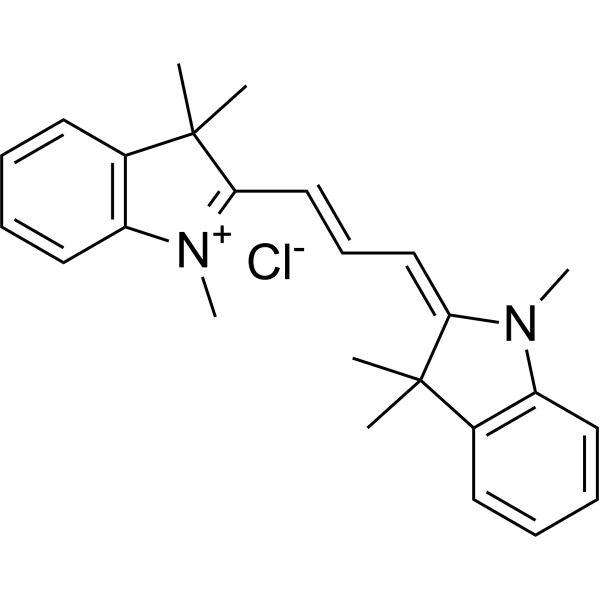
 0 ImagesCat. No.: HY-D3251LCP is a polar-responsive fluorescent probe for the cellular microenvironment. LCP responds to polarity changes in the cellular microenvironment via fluorescence resonance energy transfer, emitting blue fluorescence in low-polarity environments (Ex/Em = 420 nm/550 nm) and red fluorescence (Ex/Em = 500 nm/662 nm) in high-polarity environments. LCP enables dual-color visualization of dynamic changes in lysosomes and cytoplasmic membranes during cell apoptosis, and monitors cell viability through localization and emission color changes. LCP can be used in cancer research.
-
Direct blue 218
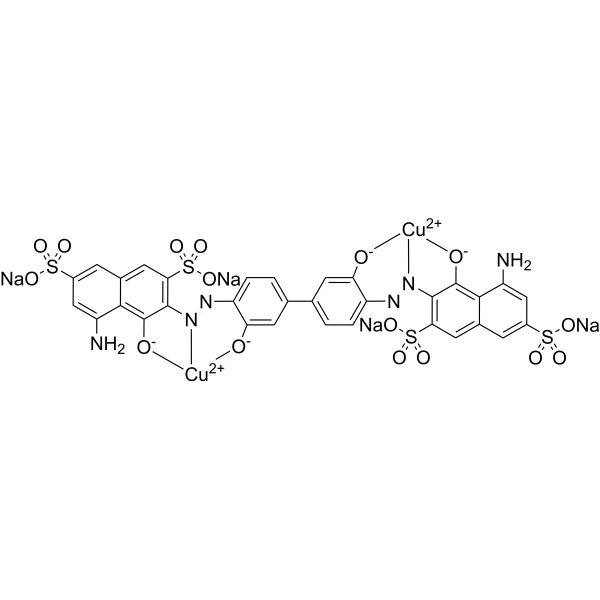 0 ImagesCat. No.: HY-D1035CAS No.: 28407-37-6Direct blue 218 is a good dyeing agent for cotton fabrics.
-
ATTO 488 alkyne
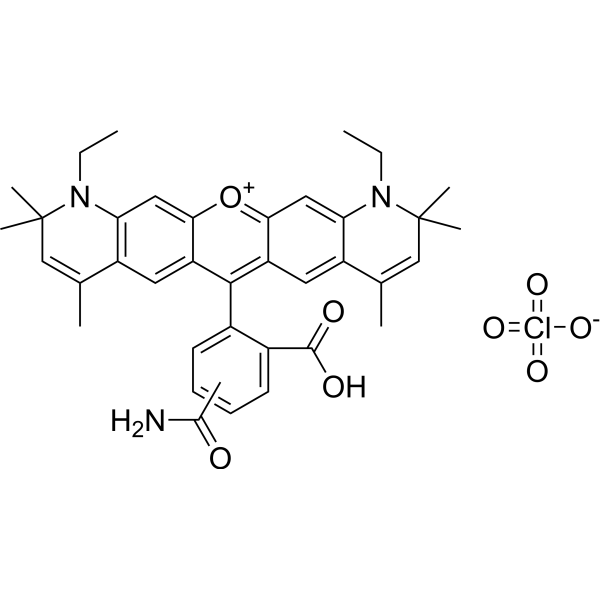
 0 ImagesCat. No.: HY-D2015ATTO 488 alkyne is a new fluorescent marker based on the Rhodamine structure. It has strong absorption, high fluorescence quantum yield, high thermal stability and photochemical stability, and is suitable for single molecule detection and high-resolution microscopy. ATTO 488 alkyne is an alkyne derivative of ATTO 488 and can be used to label proteins or antibodies.

-
Rhodamine B-Chitosan (MW 5000)
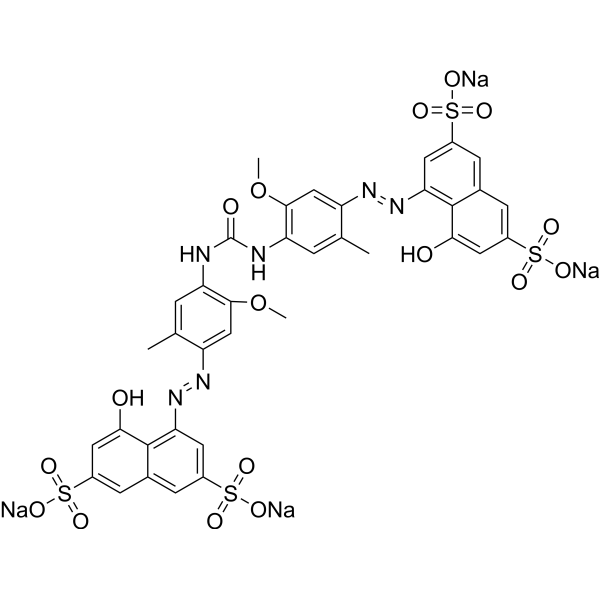
 0 ImagesCat. No.: HY-D3048ARhodamine B-Chitosan (MW 5000) is a Rhodamine B (HY-Y0016)-labeled chitosan with a molecular weight of 5,000. Rhodamine B-Chitosan (MW 5000) combines the polysaccharide properties of chitosan with the fluorescence properties of Rhodamine B, playing an important role in fields such as fluorescent labeling, cell imaging, and drug delivery research (Ex/Em = 546/610 nm).
-
TFAX 488,SE dilithium
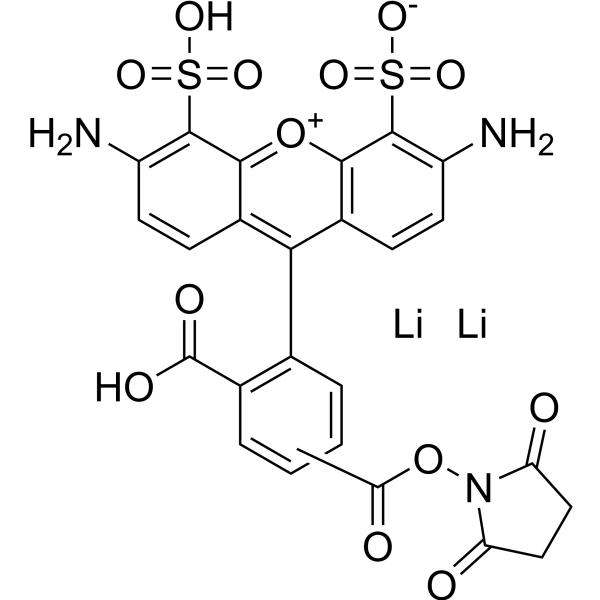 0 ImagesCat. No.: HY-D1114CAS No.: 222164-96-7TFAX 488,SE dilithium is a green fluorescent dye and exhibits pH-insensitivity over a very broad range (pH in the 4-10). TFAX 488,SE dilithium yields exceptionally bright, photostable conjugates with proteins or antibodies (such as goat anti-mouse IgG, streptavidin).
-
Cy 3 (Non-Sulfonated) potassium
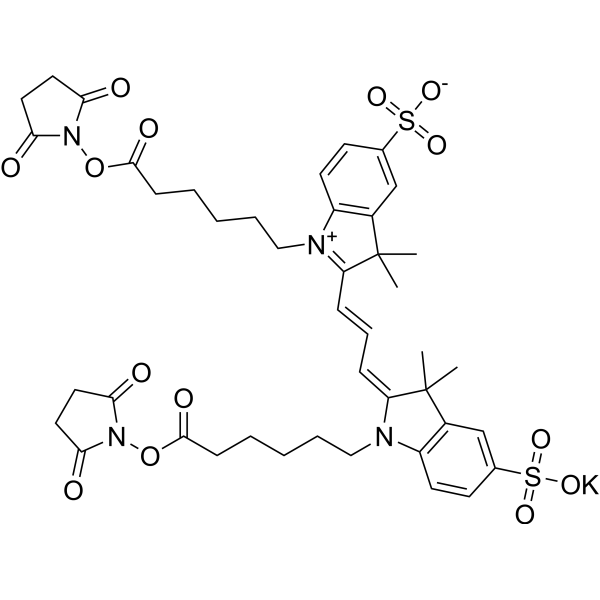 0 ImagesCat. No.: HY-D0968ACAS No.: 1311966-47-8Synonyms: Cyanine3 potassiumCy 3 Non-Sulfonated potassium (Cyanine3 potassium) is a cyanine (Cy) dye, and a fluorescent label with green channel for protein and nucleic acid. Cy 3 Non-Sulfonated potassium is a fluorescent photoproduct of Cyanine5 via photoconversion upon photoexcitation. Cy 3 Non-Sulfonated potassium can be used to high-density single-particle tracking in a living cell without using UV illumination and cell-toxic additives (Ex=470 nm; Em=515 nm and 565 nm nm).


-
Cy5-PEG5000-SH
 0 ImagesCat. No.: HY-D2531Cy5-PEG5000-SH is a fluorescent labeling reagent that combines Cy5 (HY-D0821) fluorescent dye, polyethylene glycol (PEG) and sulfhydryl (SH) derivatives, and is suitable for molecular coupling. SH is highly reactive and can react with a variety of functional groups (such as maleimide) to form stable thioether bonds.
-
CDr20
 0 ImagesCat. No.: HY-D3180CAS No.: 1201643-01-7CDr20 is a fluorescent chemical probe capable of crossing the blood-brain barrier. CDr20 undergoes glucuronidation catalyzed by the UDP-glucuronosyltransferase Ugt1a7c, which triggers a fluorescence turn-on response. CDr20 enables visualization of live microglial cells. CDr20 can be used for research on Alzheimer's disease, stroke, and autism.
-
Cy3 labled Givosiran sodium
 0 ImagesCat. No.: HY-132610ICy3 labled Givosiran sodium is a Cy3 labled Givosiran sodium.
-
ATTO 590 maleimide
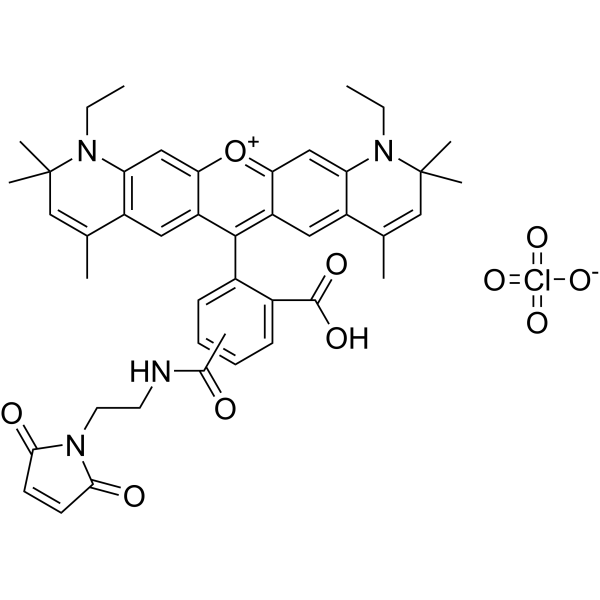 0 ImagesCat. No.: HY-D1933ATTO 590 maleimide is a new fluorescent marker based on the Rhodamine structure. It has strong absorption, high fluorescence quantum yield, high thermal stability and photochemical stability, and is suitable for single molecule detection and high-resolution microscopy. ATTO 590 maleimide is a maleimide derivative of ATTO 590, which can be used to label proteins or antibodies.
-
Pisum Sativum Agglutinin (Biotinylated)
 0 ImagesCat. No.: HY-NP0185Synonyms: PSA (Biotinylated)Pisum Sativum Agglutinin (PSA) Biotinylated is a plant lectin that can be used as a probe to specifically bind biomolecules (such as polysaccharides, peptides, etc.).Pisum Sativum Agglutinin (PSA) Biotinylated is a biological material or organic compound that can be used in life science research.




