



Fluorescent Dye
Fluorescence is a phenomenon of photoluminescence in luminescence. When an atom is irradiated by light, some electrons around the nucleus jump from their original orbitals to higher energy orbitals under the influence of light energy, i.e., from the ground state to the first or second excited single-line state, etc. Due to the instability of the first or second excited singlet state, the electron returns from the excited singlet state to the ground state accompanied by released energy, resulting in fluorescence.
Fluorescent dyes can be covalently bound or physically adsorbed in the structure of the substance. The fluorescence properties allow for the characterization, localization and quantitative analysis of the labeled object. Fluorescent dyes have shown great potential for the detection of proteins, nucleic acids, cells, and immunoassays, attributed to the advantages in non-radioactive contamination, simple experimental operation and easy observation.
Fluorescent dyes have penetrated many fields such as pharmacology, physiology, environmental science, and information science, as well as functional studies of proteins and drug screening.
All Product Categories
-
Fluorescent Dye Related Products (4894)
Related Products (4894)

-
Antibodies (4)
-
Kemptide, 5-FAM labeled
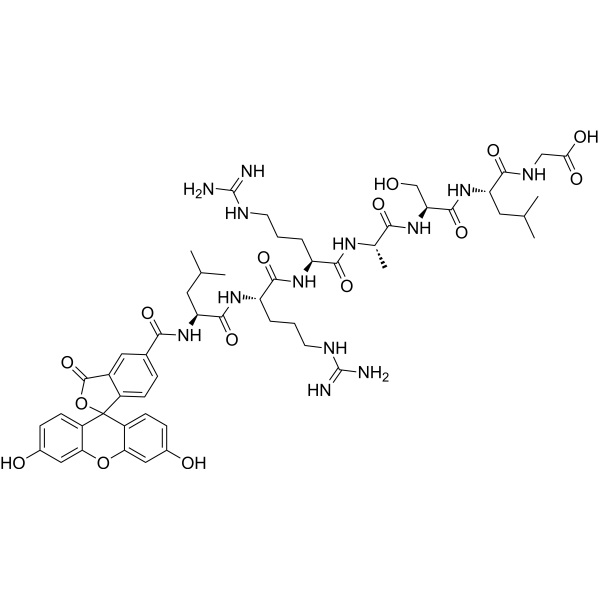 0 ImagesCat. No.: HY-P0248FCAS No.: 1161072-61-2
-
JF630-HTL
 0 ImagesCat. No.: HY-D3360JF630-HTL is a fluorogenic Janelia Fluor (JF) Si-rhodamine HaloTag ligand. JF630-HTL covalently labels HaloTag fusion proteins in living cells. JF630-HTL displays low fluorescence in the unbound state, but exhibits a marked fluorescence enhancement upon binding to HaloTag. JF630-HTL can be used for live-cell imaging applications.
-
FAM labled Elsunersen sodium
 0 ImagesCat. No.: HY-177629CFAM labled Elsunersen sodiumis a FAM labled Elsunersen sodium.
-
Rhodamine-PEG1000
 0 ImagesCat. No.: HY-D2892CRhodamine-PEG1000 a fluorescent PEG derivative composed of Rhodamine B (HY-Y0016) and PEG. Rhodamine-PEG1000 can be used for fluorescent labeling and imaging (Ex/Em=546/610 nm).
-
Datura Stramonium Lectin-AF647
 0 ImagesCat. No.: HY-NP065HSynonyms: DSL-AF647Datura Stramonium Lectin-AF647 (DSL-AF647) is a datura lectin (DSL) labeled with the AF647 fluorescent dye. Datura Stramonium Lectin is a dimeric glycoprotein that specifically recognizes and binds to glycan structures containing N-acetylglucosamine (GlcNAc) oligomers. Datura Stramonium Lectin-AF647 can be used for glycosyl studies on cell surfaces (Ex/Em = 650/665 nm).
-
FAM labled Olezarsen sodium
 0 ImagesCat. No.: HY-153491CFAM labled Olezarsen sodiumis a FAM labled Olezarsen sodium.
-
DHUCu-1
 0 ImagesCat. No.: HY-D3207CAS No.: 3037311-41-1DHUCu-1 is a lysosome-targeted NIR divalent copper ion probe with high water solubility. DHUCu-1 serves as a tool for investigating the physiological functions of Cu2+ and related diseases, such as Menke syndrome, Wilson's disease, and Alzheimer's disease.
-
Dolichos Biflorus Agglutinin (Rhodamine)
 0 ImagesCat. No.: HY-NP0154Synonyms: DBA (Rhodamine)Dolichos Biflorus Agglutinin (DBA) Rhodamine is a plant lectin that can be used as a probe to specifically bind biomolecules (such as polysaccharides, peptides, etc.).Dolichos Biflorus Agglutinin (DBA) Rhodamine is a biological material or organic compound that can be used in life science research.
-
pyCTZ TFA
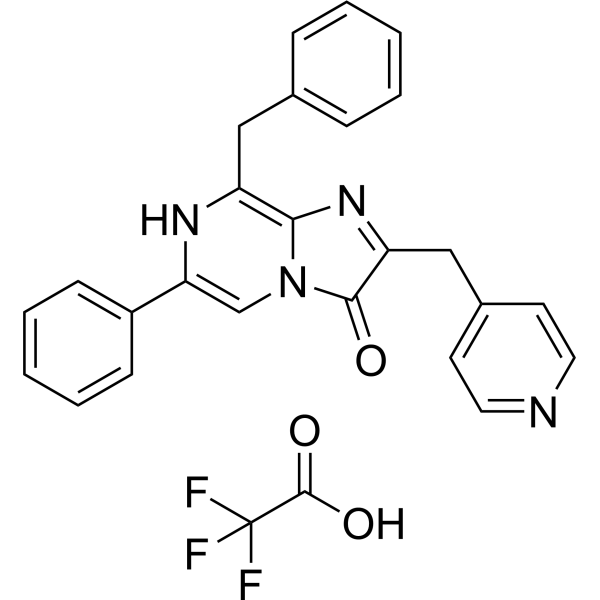 0 ImagesCat. No.: HY-135367ASynonyms: Pyridyl CTZ TFApyCTZ (Pyridyl CTZ) TFA, a pyridyl Coelenterazine (CTZ) analog, and is an ATP-independent pyridyl substrate of LumiLuc luciferase. pyCTZ TFA generates strong blue bioluminescence in the presence of luciferases. pyCTZ TFA can be used for aequorin-based calcium sensing.
-
Cy3 labled Egaptivon pegol sodium
 0 ImagesCat. No.: HY-147079ECy3 labled Egaptivon pegol sodium is a Cy3 labled Egaptivon pegol sodium.
-
Rhodamine B-Chitosan (MW 500000)
 0 ImagesCat. No.: HY-D3048IRhodamine B-Chitosan (MW 10000) is a Rhodamine B (HY-Y0016)-labeled chitosan with a molecular weight of 10,000. Rhodamine B-Chitosan (MW 10000) combines the polysaccharide properties of chitosan with the fluorescence properties of Rhodamine B, playing an important role in fields such as fluorescent labeling, cell imaging, and drug delivery research (Ex/Em = 546/610 nm).
-
Cy5.5-PEG10000-NH2
 0 ImagesCat. No.: HY-D2555Cy5.5-PEG10000-NH2 is a polyethylene glycol derivative containing Cy5.5 (HY-D0924) fluorescent dye and polyethylene glycol (PEG) and an amino group. The Cy5.5 fluorophore is commonly used in applications such as immunolabeling, nucleic acid labeling, fluorescence microscopy, and flow cytometry. Cy5.5 has an emission maximum around 710 nm. Cy5.5-PEG10000-NH2 can be used for fluorescence imaging, fluorescence tracing and fluorescence labeling.
-
Rhodamine B-Dextran chloride (MW 100000)
 0 ImagesCat. No.: HY-D3047ERhodamine B-Dextran (MW 100000) is a Rhodamine B (HY-Y0016)-labeled dextran with a molecular weight of 100,000. Rhodamine B-Chitosan (MW 100000) plays an important role in fluorescent labeling, cell imaging, vascular imaging, and drug delivery research (Ex/Em = 546/610 nm).
-
FAM labled SPC5001 sodium
 0 ImagesCat. No.: HY-148687DFAM labled SPC5001 sodiumis a FAM labled SPC5001 sodium.
-
4-Amino-3,6-disulfonaphthalic anhydride dipotassium
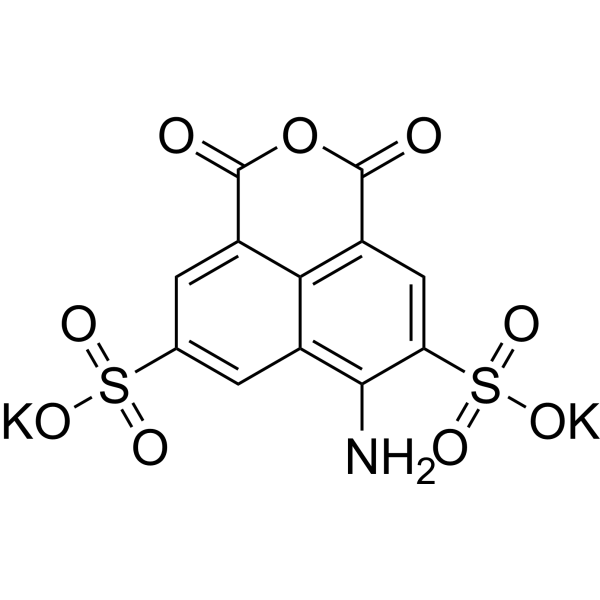 0 ImagesCat. No.: HY-W020030CAS No.: 79539-35-84-Amino-3,6-disulfonaphthalic anhydride dipotassium is a building block that can be used to systhese a useful dye for biological research purposes.
-
Procion Yellow H-E 4R
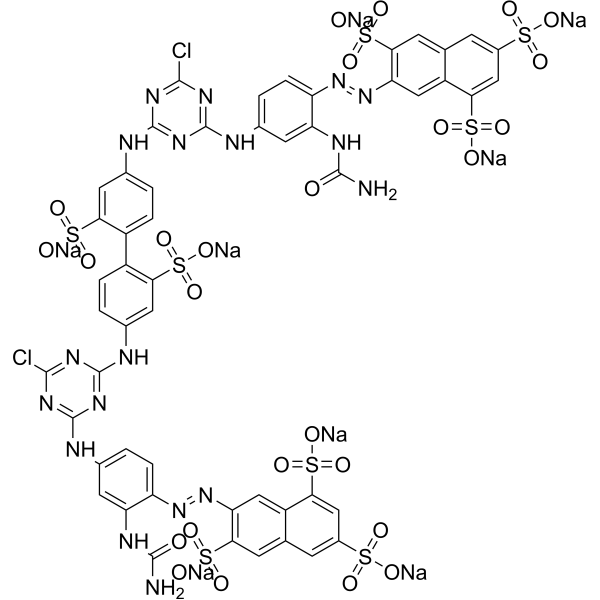 0 ImagesCat. No.: HY-D0624CAS No.: 68133-40-4Procion Yellow H-E 4R is a multifunctional dye. Dyes are important tools in biological experiments. They can help researchers observe and analyze cell structures, track biomolecules, evaluate cell functions, distinguish cell types, detect biomolecules, study tissue pathology and monitor microorganisms. Their applications range from basic scientific research to clinical A wide range of diagnostics. Dyes are also widely used in traditional fields such as textile dyeing, as well as in emerging fields such as functional textile processing, food pigments and dye-sensitized solar cells.
-
Dansyl ethylenediamine
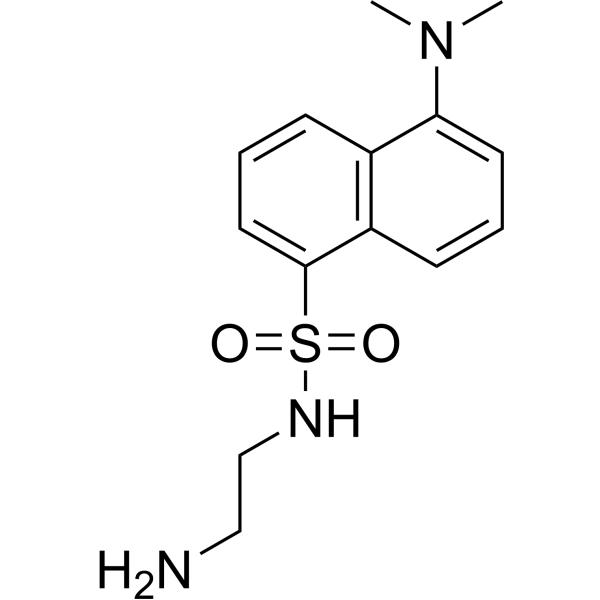 0 ImagesCat. No.: HY-W321446CAS No.: 35060-08-3Dansyl ethylenediamine is a fluorescent probe. Dansyl ethylenediamine can be used for synthesis of protein-imprinted polymers which is capable of specific transduction of protein binding events into fluorescent signal change.
-
Datura Stramonium Lectin
 0 ImagesCat. No.: HY-NP065Synonyms: DSLDatura Stramonium Lectin (DSL) is a plant lectin that can be used as a probe to specifically bind biomolecules (such as polysaccharides, peptides, etc.).Datura Stramonium Lectin (DSL) is a biological material or organic compound that can be used in life science research.
-
DiD
 0 ImagesCat. No.: HY-W559684CAS No.: 75539-51-4Synonyms: Cy5 DIC18DiD is a long-chain carbocyanine dye. Carbocyanine dyes are widely used as Di to label cells, organelles, liposomes, viruses and lipoproteins (Ex/Em = 633/665 nm) .
-
closed-HMRG
 0 Imagesclosed-HMRG is an HMRG (HY-D2379) with a closed spiro-ring structure. HMRG is a fluorescent dye, which serves as the fluorescent active product generated by enzyme-activated fluorescent probes targeting proteases and glycosidases. Its detection mechanism relies on the intramolecular spirocyclization equilibrium: HMRG itself exists in an open non-spirocyclic structure under physiological pH, which maintains a conjugated π system and produces strong fluorescence; whereas its probe precursors (such as Leu-HMRG, Ac-GlyPro-HMRG and βGal-HMRG) exist in a closed spirocyclic form and show no fluorescence due to the disruption of the π-conjugated system; when the target enzyme cleaves the substrate fragment linked to the probe precursor, the closed spirocyclic structure converts to the open structure of HMRG, restoring the conjugated system and generating a strong fluorescent signal. Its detection wavelength is Ex/Em = 501/524 nm.




