



TLK2
TLK2 (Tousled-like kinase 2) is a nuclear serine/threonine kinase that supports chromatin assembly, DNA replication, and genome stability through regulation of histone management pathways and chromatin-associated factors[1][2][3]. Mechanistically, TLK2 phosphorylates ASF1 family histone chaperones and promotes histone supply and nucleosome assembly, thereby coupling chromatin restoration to DNA synthesis and maintenance of replication fork integrity[1][4][5]. During the DNA damage response, TLK2 regulates ASF1A-dependent chromatin reassembly at damaged loci and is required for efficient recovery from G2 checkpoint arrest, linking chromatin restoration to cell-cycle re-entry after genotoxic stress[2]. In disease contexts, aberrant TLK2 activity has been associated with tumor progression, and genomic analyses identified recurrent TLK2 amplification in a subset of estrogen receptor-positive breast cancers where elevated expression correlates with aggressive clinical behavior and poor outcome[6]. Structural studies further demonstrate that TLK2 activation depends on coiled-coil-mediated dimerization and ordered autophosphorylation, providing a mechanistic framework for kinase regulation and therapeutic targeting[3]. Compared with the closely related isoform TLK1, which shares extensive kinase-domain homology and overlapping substrates, TLK2 exhibits distinct functions during recovery from DNA damage despite substantial functional overlap under unperturbed conditions[7]. For experimental applications, TLK2 inhibition suppresses growth of TLK2-high cancer models, and structural characterization has enabled evaluation of small-molecule inhibitor binding and rational inhibitor-development strategies[3][6].
References:
- [1]. Simon B, et al. Tousled-like kinase 2 targets ASF1 histone chaperones through client mimicry. Nat Commun. 2022 Feb 8;13(1):749. [Content Brief]
- [2]. Bruinsma W, et al. Tousled-like kinase 2 regulates recovery from a DNA damage-induced G2 arrest. EMBO Rep. 2016 May;17(5):659-70. [Content Brief]
- [3]. Mortuza GB, et al. Molecular basis of Tousled-Like Kinase 2 activation. Nat Commun. 2018 Jun 28;9(1):2535. [Content Brief]
- [4]. Lee SB, et al. Tousled-like kinases stabilize replication forks and show synthetic lethality with checkpoint and PARP inhibitors. Sci Adv. 2018 Aug 8;4(8):eaat4985. doi: 10.1126/sciadv.aat4985. PMID: 30101194; PMCID: PMC6082654. [Content Brief]
- [5]. Carrera P, et al. Tousled-like kinase functions with the chromatin assembly pathway regulating nuclear divisions. Genes Dev. 2003 Oct 15;17(20):2578-90. [Content Brief]
- [6]. Kim JA, et al. Comprehensive functional analysis of the tousled-like kinase 2 frequently amplified in aggressive luminal breast cancers. Nat Commun. 2016 Oct 3;7:12991. [Content Brief]
- [7]. West KL, et al. Autophosphorylation of the Tousled-like kinases TLK1 and TLK2 regulates recruitment to damaged chromatin via PCNA interaction. bioRxiv [Preprint]. 2024 Apr 26:2024.04.22.590659. doi: 10.1101/2024.04.22.590659. Update in: Nucleic Acids Res. 2025 Feb 08;53(4):gkae1279. doi: 10.1093/nar/gkae1279. PMID: 38712247; PMCID: PMC11071368. [Content Brief]
All Product Categories
-
TLK2 Related Products (2)
Related Products (2)

-
UNC-CA2-103
 0 ImagesUNC-CA2-103 is a TLK2 inhibitor with a human IC50 of 18 nM, and it exhibits high selectivity over TLK1 and the vast majority of other kinases. UNC-CA2-103 can be used in research related to breast cancer, glioblastoma and gastric cancer.
-
LSD1/TLK1-IN-1
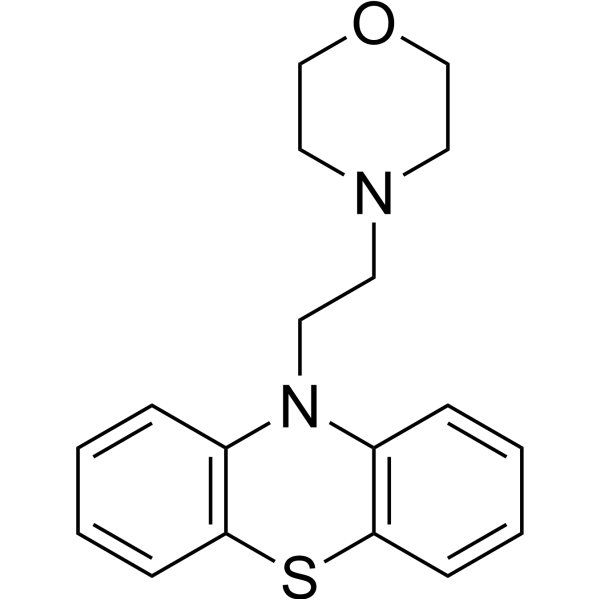 0 ImagesLSD1/TLK1-IN-1 is an orally active LSD1, TLK1, TLK2, TTK inhibitor with an LSD1 IC50 of 0.247 μM. LSD1/TLK1-IN-1 suppresses phosphorylation of Nek1 at T141 and Rad9 at S328, abrogates the TLK1>Nek1>ATR>Chk1 axis, protects H3K4me1/2 from demethylation, and does not affect LSD2, MAO-A, or MAO-B. LSD1/TLK1-IN-1 induces apoptosis, bypasses cell-cycle arrest, suppresses tumor growth, downregulates PD-L1 expression, enhances T-cell killing response, inhibits gastric cancer cell proliferation. LSD1/TLK1-IN-1 can be used for the research of prostate cancer and gastric cancer.



