



Urethane
Based on 4 publication(s) in Google Scholar
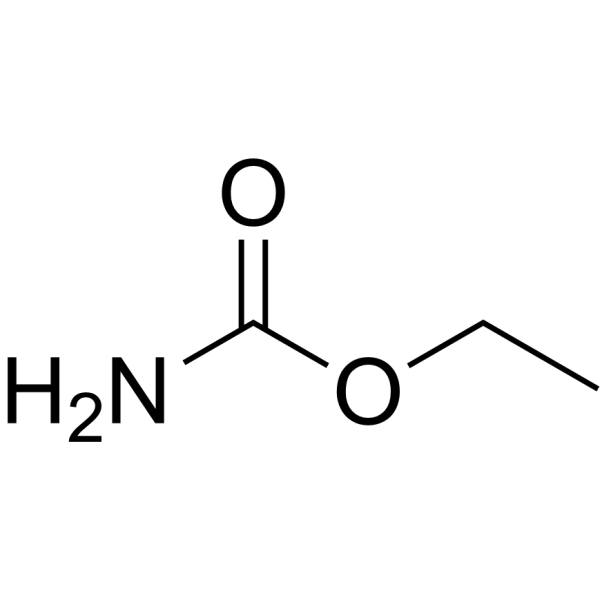
Urethane (Ethyl carbamate), the ethyl ester of carbamic acid, is a byproduct of fermentation found in various food products. Urethane has the ability to suppress bacterial, protozoal, sea urchin egg, and plant tissue growth in vitro.
For research use only. We do not sell to patients.
- Purity : 99.35%
- CAS No.: 51-79-6
- Formula: C3H7NO2
- Molecular Weight:89.09
-
Storage:Powder -20°C, 3 years , 4°C, 2 years ; In solvent -80°C, 2 years , -20°C, 1 year

To place orders, for customer services and technical support, please contact: MedChemExpress USA
Tel: 609-228-6898 E-mail: [email protected] [email protected]


-
 Biological Activity
-
Chemical Information
-
Solvent & Solubility
- Purity & Documentation
- References
-
 Help & FAQs


-

HY-B1207R
Urethane (Standard)Bacterial Inhibitor -
HY-B0522
AmpicillinBacterial Inhibitor -

HY-P0163
GramicidinAntimicrobial Peptide -

HY-B0522R
Ampicillin (Standard)Bacterial Inhibitor -
HY-W010629
2-ChloroacetamideHerbicide Agent -
HY-B1831A
Oritavancin diphosphateAntibiotic, ArlS Kinase Inhibitor -

HY-B0875R
Cefmenoxime hydrochloride (Standard)Antibiotic -

HY-W010629R
2-Chloroacetamide (Standard)Herbicide Agent -
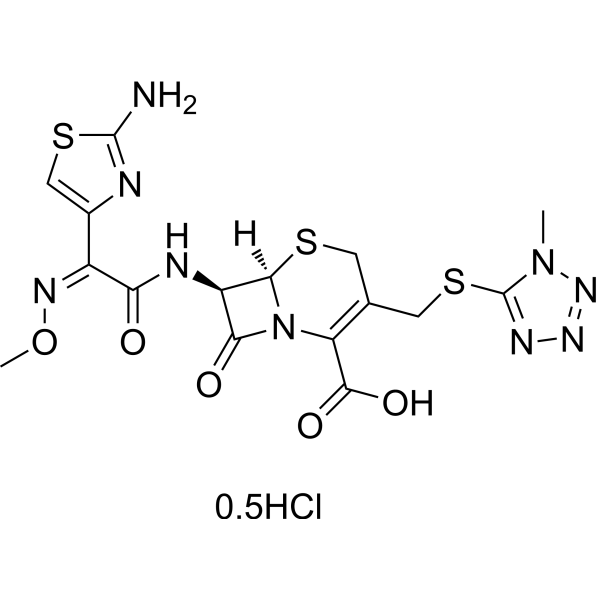
HY-B0875
Cefmenoxime hydrochlorideAntibiotic -

HY-B1831AR
Oritavancin diphosphate (Standard)Antibiotic, ArlS Kinase Inhibitor
Publications Citing Use of MedChemExpress (MCE) Urethane
MoreAll Parasite Isoforms
More

Biological Activity
Description
In Vitro
Urethane is a good clastogen in mammalian somatic cells in vivo, but it shows variable results with cells in vitro. Urethane efficiently induces sister chromatid exchanges in a variety of cells[2].
MedChemExpress (MCE) has not independently confirmed the accuracy of these methods. They are for reference only.
Induced Disease Models
Please do not refer to only one article to determine the experimental conditions. It is recommended to determine the optimal experimental conditions (animal strain, age, dosage, frequency and cycle, detection time and indicators, etc.) through preliminary experiments before the formal experiment.
Urethane can be used in animal modeling to create lung tumor models. Approximately 90% of Urethane is hydrolyzed to ethanol, ammonia, and carbon dioxide by hepatic microsomal esterases (carboxylesterases), while only 5% of Urethane is excreted unchanged. A very small amount of Urethane is converted by the cytochrome P450 enzyme CYP2E1 to ethylene urea, leading to the formation of an epoxide (ethylene urea epoxide). This epoxide covalently binds to DNA and may cause base misincorporation during DNA replication, thereby inducing point mutations[1][2].
Administration: 1 g/kg (in 100 μL saline)• i.p.• once per week for 16 weeks or every other day for a week[1]
(2) After mice were sacrificed, lungs were harvested, and the number of tumors and their diameter on the lung surface were measured. Serum was also collected after centrifugation[1].
Tumor changes: Urethane administration significantly increased the average number, size and diameter of tumors in PRDX4 Tg mice. Tumor apoptosis was suppressed and tumor proliferation was enhanced in Tg mice[1].
Histology analysis: Urethane administration increased microvascular permeability and macrophage infiltration in lung tumor of PRDX4 Tg mice[1].
Metabolic change: Urethane administration inhibited oxidative stress and decreased gene expressions of antioxidant enzymes (SOD1 and SOD2) in Tg mice[1].
MedChemExpress (MCE) has not independently confirmed the accuracy of these methods. They are for reference only.
Clinical Trial
| NCT Number | Sponsor | Condition | Start Date |
Phase

|
|---|---|---|---|---|
| NCT01329991 | Plexxikon| | 2011-05 | PHASE1 |


Chemical Information
-
CAS No. 51-79-6
-
Appearance Solid
-
Molecular Weight 89.09
-
Formula C3H7NO2
-
Color White to off-white
-
SMILES
NC(OCC)=O
-
Synonyms
Ethyl carbamate; Carbamic acid ethyl ester; Ethylurethane
-
Structure Classification
-
Initial Source
a byproduct of fermentation
-
Shipping
Room temperature in continental US; may vary elsewhere.
-
Storage
Powder -20°C 3 years 4°C 2 years In solvent -80°C 2 years -20°C 1 year


Publications (4)
-
Journal Impact Factor
-
Most Recent
-
Sci Adv
2023 Jul 21;9(29):eadh4054. PMID: 37478191 -
ACS Omega
Matrix Stiffness Modulates Fibroblast Paracrine Signaling to Enhance Autophagy in Keratinocytes: Implications for Wound Healing. [Abstract]2026 Mar 12;11(11):17605-17616. PMID: 41908360 -
Antimicrob Agents Chemother
Impact of hepatic impairment and renal failure on the pharmacokinetics of linezolid and its metabolites: contribution of hepatic metabolism and renal excretion. [Abstract]2025 May 7;69(5):e0189224. PMID: 40227039 -
Dev Comp Immunol
2023 Dec:149:104904. PMID: 37543221


Solvent & Solubility
In Vitro:
DMSO : 100 mg/mL (1122.46 mM; Need ultrasonic; Hygroscopic DMSO has a significant impact on the solubility of product, please use newly opened DMSO)
Please refer to the solubility information to select the appropriate solvent. Once prepared, please aliquot and store the solution to prevent product inactivation from repeated freeze-thaw cycles.
Storage method and period of stock solution: -80°C, 2 years; -20°C, 1 year. When stored at -80°C, please use it within 2 years. When stored at -20°C, please use it within 1 year.
Please refer to the solubility information to select the appropriate solvent. Once prepared, please aliquot and store the solution to prevent product inactivation from repeated freeze-thaw cycles.
Storage method and period of stock solution: -80°C, 2 years; -20°C, 1 year. When stored at -80°C, please use it within 2 years. When stored at -20°C, please use it within 1 year.
Concentration (start) × Volume (start) = Concentration (final) × Volume (final)
In Vivo:
Select the appropriate dissolution method based on your experimental animal and administration route.
- For the following dissolution methods, please ensure to first prepare a clear stock solution using an In Vitro approach and then sequentially add co-solvents:
- To ensure reliable experimental results, the clarified stock solution can be appropriately stored based on storage conditions. As for the working solution for In Vivo experiments, it is recommended to prepare freshly and use it on the same day.
- The percentages shown for the solvents indicate their volumetric ratio in the final prepared solution. If precipitation or phase separation occurs during preparation, heat and/or sonication can be used to aid dissolution.
Add each solvent one by one: 10% DMSO 40% PEG300 5% Tween-80 45% Saline
Solubility: ≥ 2.08 mg/mL (23.35 mM); Clear solution
This protocol yields a clear solution of ≥ 2.08 mg/mL (saturation unknown).
Taking 1 mL working solution as an example, add 100 μL DMSO stock solution (20.8 mg/mL) to 400 μL PEG300, and mix evenly; then add 50 μL Tween-80 and mix evenly; then add 450 μL Saline to adjust the volume to 1 mL.
Preparation of Saline: Dissolve 0.9 g sodium chloride in ddH₂O and dilute to 100 mL to obtain a clear Saline solution.
Add each solvent one by one: 10% DMSO 90% (20% SBE-β-CD in Saline)
Solubility: ≥ 2.08 mg/mL (23.35 mM); Clear solution
This protocol yields a clear solution of ≥ 2.08 mg/mL (saturation unknown).
Taking 1 mL working solution as an example, add 100 μL DMSO stock solution (20.8 mg/mL) to 900 μL 20% SBE-β-CD in Saline, and mix evenly.
Preparation of 20% SBE-β-CD in Saline (4°C, storage for one week): 2 g SBE-β-CD powder is dissolved in 10 mL Saline, completely dissolve until clear.
For the following dissolution methods, please prepare the working solution directly:
It is recommended to prepare fresh solutions and use them promptly within a short period of time.
The percentages shown for the solvents indicate their volumetric ratio in the final prepared solution. If precipitation or phase separation occurs during preparation, heat and/or sonication can be used to aid dissolution.
Add each solvent one by one: PBS
Solubility: 50 mg/mL (561.23 mM); Clear solution; Need ultrasonic
In Vivo Dissolution Calculator
Please enter the basic information of animal experiments:
-
-
-
-
Recommended: Prepare an additional quantity of animals to account for potential losses during experiments.
Please enter your animal formula composition:
-
%DMSO +
Recommended: Keep the proportion of DMSO in working solution below 2% if your animal is weak.
-
%+
-
+%Tween-80 + +
-
%Saline +
The co-solvents required include: DMSO, . All of co-solvents are available by MedChemExpress (MCE). , Tween 80. All of co-solvents are available by MedChemExpress (MCE).
Working solution concentration: 0.22 mg/mL
Method for preparing stock solution: mg drug dissolved in μL DMSO. Stock solution concentration: mg/mL.
1. Take μL DMSO stock solution;
2. Add μL .
μL , mix evenly;
3. Then add μL Tween 80, mix evenly;
4. Then add μL
Please ensure that the stock solution in the first step is dissolved to a clear state, and add co-solvents in sequence. You can use ultrasonic heating (ultrasonic cleaner, recommended frequency 20-40 kHz), vortexing, etc. to assist dissolution.


Purity & Documentation
-
Data Sheet (277 KB)
-
SDS (617 KB)
- English - EN (617 KB)
- Français - FR (617 KB)
- Deutsch - DE (617 KB)
- Norwegian - NO (617 KB)
- Español - ES (617 KB)
- Swedish - SV (617 KB)
- Italian - IT (617 KB)
- Korean - KR (617 KB)
- Portuguese - PT (617 KB)
-
Handling Instructions (2659 KB)
References
[1]. Zheng J, et al. Overexpression of PRDX4 Modulates Tumor Microenvironment and Promotes Urethane-Induced Lung Tumorigenesis. Oxid Med Cell Longev. 2020 Dec 28;2020:8262730. [Content Brief]
[2]. Sozio F, et al. Urethane-induced lung carcinogenesis. Methods Cell Biol. 2021;163:45-57. [Content Brief]
[3]. Gurley KE, et al. Induction of Lung Tumors in Mice with Urethane. Cold Spring Harb Protoc. 2015 Sep 1;2015(9):pdb.prot077446. [Content Brief]
[4]. K J Field, et al. Hazards of urethane (ethyl carbamate): a review of the literature. Lab Anim. 1988 Jul;22(3):255-62. [Content Brief]
[5]. R E Sotomayor, et al. Mutagenicity, metabolism, and DNA interactions of urethane. Toxicol Ind Health. 1990 Jan;6(1):71-108. [Content Brief]


Complete Stock Solution Preparation Table
Please refer to the solubility information to select the appropriate solvent. Once prepared, please aliquot and store the solution to prevent product inactivation from repeated freeze-thaw cycles.
Storage method and period of stock solution: -80°C, 2 years; -20°C, 1 year. When stored at -80°C, please use it within 2 years. When stored at -20°C, please use it within 1 year.
| Optional Solvent | Concentration Solvent Mass | 1 mg | 5 mg | 10 mg | 25 mg |
|---|---|---|---|---|---|
| DMSO | 1 mM | 11.2246 mL | 56.1230 mL | 112.2460 mL | 280.6151 mL |
| 5 mM | 2.2449 mL | 11.2246 mL | 22.4492 mL | 56.1230 mL | |
| 10 mM | 1.1225 mL | 5.6123 mL | 11.2246 mL | 28.0615 mL | |
| 15 mM | 0.7483 mL | 3.7415 mL | 7.4831 mL | 18.7077 mL | |
| 20 mM | 0.5612 mL | 2.8062 mL | 5.6123 mL | 14.0308 mL | |
| 25 mM | 0.4490 mL | 2.2449 mL | 4.4898 mL | 11.2246 mL | |
| 30 mM | 0.3742 mL | 1.8708 mL | 3.7415 mL | 9.3538 mL | |
| 40 mM | 0.2806 mL | 1.4031 mL | 2.8062 mL | 7.0154 mL | |
| 50 mM | 0.2245 mL | 1.1225 mL | 2.2449 mL | 5.6123 mL | |
| 60 mM | 0.1871 mL | 0.9354 mL | 1.8708 mL | 4.6769 mL | |
| 80 mM | 0.1403 mL | 0.7015 mL | 1.4031 mL | 3.5077 mL | |
| 100 mM | 0.1122 mL | 0.5612 mL | 1.1225 mL | 2.8062 mL |


Urethane Related Classifications
HY-B1207 Related Classifications
 Powered by Bioz
Keywords