



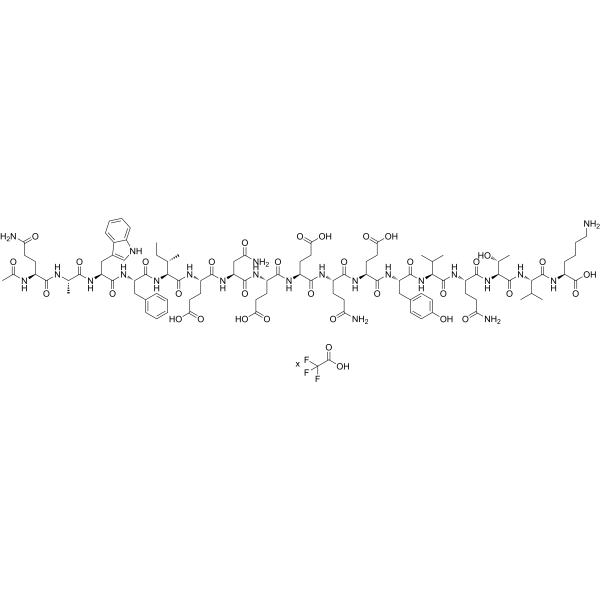
Ac9-25 TFA
Ac9-25 TFA, a N-terminal peptide of Annexin I, acts as a formyl peptide receptor (FPR) agonist and activates the neutrophil NADPH oxidase through FPR.
Nur für Forschungszwecke. Wir verkaufen nicht an Patienten.
- Formel: C99H143N23O33·xC2HF3O2
- Molecular Weight:2183.33 (free acid)
-
Speicherung:
Please store the product under the recommended conditions in the Certificate of Analysis.

To place orders, for customer services and technical support, please contact: MedChemExpress USA
Tel: 609-228-6898 E-mail: [email protected] [email protected]


-
 Biologische Aktivität
-
Chemical Information
- Protokoll
- Reinheit & Dokumentation
- Verweise
-
 Help & FAQs




Biologische Aktivität
Beschreibung


Chemical Information
-
Molecular Weight 2183.33 (free acid)
-
Formel C99H143N23O33·xC2HF3O2
-
Sequence
Ac-Gln-Ala-Trp-Phe-Ile-Glu-Asn-Glu-Glu-Gln-Glu-Tyr-Val-Gln-Thr-Val-Lys
-
Sequence Shortening
Ac-QAWFIENEEQEYVQTVK
-
Versand
Room temperature in continental US; may vary elsewhere.
-
Speicherung
Please store the product under the recommended conditions in the Certificate of Analysis.


Reinheit & Dokumentation
Verweise
[1]. Walther A, et al. A novel ligand of the formyl peptide receptor: annexin I regulates neutrophil extravasation by interacting with the FPR. Mol Cell. 2000;5(5):831-840. [Content Brief]
[2]. Karlsson J, et al. Neutrophil NADPH-oxidase activation by an annexin AI peptide is transduced by the formyl peptide receptor (FPR), whereas an inhibitory signal is generated independently of the FPR family receptors. J Leukoc Biol. 2005;78(3):762-771. [Content Brief]

Calculators
Konzentration (Stammlösung) × Volumen (Stammlösung) = Konzentration (Ziellösung) × Volumen (Ziellösung)


Ac9-25 TFA Related Classifications
HY-P1118A Related Classifications
 Powered by Bioz