



ATF2 Antibody (YA606)
(Synonyms: Activating transcription factor 2 antibody; Activating transcription factor 2 splice variant ATF2 var2 antibody; ATF 2 antibody; Atf-2 antibody; Atf2 antibody; ATF2 protein antibody; ATF2_HUMAN antibody; cAMP Response Element Binding Protein 2 antibody; cAMP response element binding protein CRE BP1 antibody; cAMP response element-binding protein CRE-BP1 antibody; cAMP responsive element binding protein 2, formerly antibody; cAMP-dependent transcription factor ATF-2 antibody; cAMP-responsive element-binding protein 2 antibody; CRE BP1 antibody; CRE-BP antibody; CREB 2 antibody; CREB-2 antibody; CREB2 antibody; CREBP1 antibody; Cyclic AMP dependent transcription factor ATF 2 antibody; Cyclic AMP-dependent transcription factor ATF-2 antibody; Cyclic AMP-responsive element-binding protein 2 antibody; D130078H02Rik antibody; D18875 antibody; HB 16 antibody; HB16 antibody; Histone acetyltransferase ATF2 antibody; MGC105211 antibody; MGC105222 antibody; MGC111558 antibody; MGC142504 antibody; mXBP antibody; MXBP protein antibody; Tg(Gzma-Klra1)7Wum antibody; TREB 7 antibody; TREB7 antibody)
Based on 1 Customer Validation
ATF2 Antibody (YA606) is a Rabbit-derived and non-conjugated IgG monoclonal antibody, targeting to ATF2.
-
Host:
Rabbit
-
Isotype:
IgG
-
Application:
WB
-
Reactivity :
Human, Mouse, Rat
-
Formulation:
Supplied in 50 mM Tris-Glycine (pH 7.4), 0.15 M NaCl, 40% Glycerol and 0.05% BSA. Preservative: 0.01% Sodium azide
-
Conjugation:
Non-conjugated


To place orders, for customer services and technical support, please contact: MedChemExpress USA
Tel: 609-228-6898 E-mail: [email protected] [email protected]





Applications
| Application |
WB

WB: Western Blot
|
|---|---|
| Dilution Ratio | 1:500-1:1000 |


Product Details
ATF2 Antibody (YA606) is a Rabbit-derived and non-conjugated IgG monoclonal antibody, targeting to ATF2.
-
Host Rabbit

-
Clonality Recombinant,Monoclonal

-
Species ReactivityHuman, Mouse, Rat
-
Observed Molecular WeightObserved band size: 70 kDa
Note: Due to possible protein modifications or aggregation, the molecular weight should be confirmed by actual measurement, and the predicted value is for reference only.

-
Calculated Molecular Weight Predicted band size: 52 kDa

Entrez Gene: 1386 Human ; 11909 Mouse ; 81647 Rat
SwissProt: P15336 Human ; P16951 Mouse ; Q00969 Rat
OMIM: 123811 Human
Synthetic peptide corresponding to Mouse ATF2.The exact sequence is proprietary to MCE.
Endogenous
affinity purified
Non-conjugated
Unmodified
IgG


Product Properties
-
Appearance
Solution
-
Formulation
Supplied in 50 mM Tris-Glycine (pH 7.4), 0.15 M NaCl, 40% Glycerol and 0.05% BSA. Preservative: 0.01% Sodium azide
-
Concentration
Batch-dependent, Please check the COA for the concentration of each lot. Check Lot Concentration
-
Storage & Stability
Stored at -20°C for 1 year. Avoid repeated freeze / thaw cycles.
-
Shipping
Shipping with blue ice.


Verification Images
-
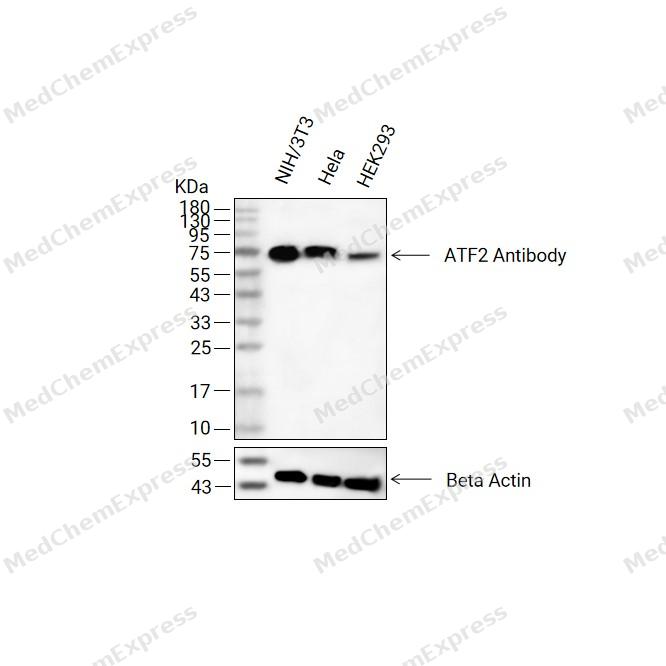 Western blot analysis of extracts from NIH/3T3(lane 2(20ug), Hela(lane 3(20ug) and HEK293(lane 4(20ug) using ATF2 Antibody (HY-P80552) Rabbit mAb. Proteins were transferred to a PVDF membrane and blocked with 5% non-fat milk in TBST for 2 hour at room temperature. The primary antibody (1/1000) and Loading control antibody (Beta Actin, HY-P83730, 1/10000) was used in 5% non-fat milk in TBST at 4°C overnight. Goat Anti-Mouse/Rabbit IgG-HRP Secondary Antibody (1/10000) was used for 1 hour at room temperature.


Background
-
Function
ATF2 transcriptional activator which regulates the transcription of various genes, including those involved in anti-apoptosis, cell growth, and DNA damage response. Dependent on its binding partner, binds to CRE (cAMP response element) consensus sequences (5'-TGACGTCA-3') or to AP-1 (activator protein 1) consensus sequences (5'-TGACTCA-3'). In the nucleus, contributes to global transcription and the DNA damage response, in addition to specific transcriptional activities that are related to cell development, proliferation and death. In the cytoplasm, interacts with and perturbs HK1- and VDAC1-containing complexes at the mitochondrial outer membrane, thereby impairing mitochondrial membrane potential, inducing mitochondrial leakage and promoting cell death. The phosphorylated form (mediated by ATM) plays a role in the DNA damage response and is involved in the ionizing radiation (IR)-induced S phase checkpoint control and in the recruitment of the MRN complex into the IR-induced foci (IRIF). Exhibits histone acetyltransferase (HAT) activity which specifically acetylates histones H2B and H4 in vitro. In concert with CUL3 and RBX1, promotes the degradation of KAT5 thereby attenuating its ability to acetylate and activate ATM. Can elicit oncogenic or tumor suppressor activities depending on the tissue or cell type
-
Subcellular Localization
Nucleus; Cytoplasm; Mitochondrion outer membrane
-
Isoforms & Post-Translational Modification
P16951 has 3 isomers: P16951-1: 52298 Da (predicted); P16951-2: 42345 Da (predicted); P16951-3: 48002 Da (predicted).
Phosphorylation of Thr-51 by MAPK14 and MAPK11, and at Thr-53 by MAPK1/ERK2, MAPK3/ERK1, MAPK11, MAPK12 and MAPK14 in response to external stimulus like insulin causes increased transcriptional activity. Phosphorylated by PLK3 following hyperosmotic stress. Also phosphorylated and activated by JNK and CaMK4. ATM-mediated phosphorylation at Ser-472 and Ser-480 stimulates its function in DNA damage response. Phosphorylation at Ser-44, Thr-55 and Ser-103 activates its transcriptional activity. Phosphorylation at Thr-51 or Thr-53 enhances acetylation of histones H2B and H4 -
Subunit
Binds DNA as a dimer and can form a homodimer in the absence of DNA. Can form a heterodimer with JUN. Heterodimerization is essential for its transcriptional activity. Interacts with SMAD3 and SMAD4. Interacts with the HK1/VDAC1 complex. Interacts with NBN, MRE11, XPO1, KAT5 and CUL3 (By similarity). Binds through its N-terminal region to UTF1 which acts as a coactivator of ATF2 transcriptional activity
-
SwissProt ID
-
Synonyms
Activating transcription factor 2 antibody; Activating transcription factor 2 splice variant ATF2 var2 antibody; ATF 2 antibody; Atf-2 antibody; Atf2 antibody; ATF2 protein antibody; ATF2_HUMAN antibody; cAMP Response Element Binding Protein 2 antibody; cAMP response element binding protein CRE BP1 antibody; cAMP response element-binding protein CRE-BP1 antibody; cAMP responsive element binding protein 2, formerly antibody; cAMP-dependent transcription factor ATF-2 antibody; cAMP-responsive element-binding protein 2 antibody; CRE BP1 antibody; CRE-BP antibody; CREB 2 antibody; CREB-2 antibody; CREB2 antibody; CREBP1 antibody; Cyclic AMP dependent transcription factor ATF 2 antibody; Cyclic AMP-dependent transcription factor ATF-2 antibody; Cyclic AMP-responsive element-binding protein 2 antibody; D130078H02Rik antibody; D18875 antibody; HB 16 antibody; HB16 antibody; Histone acetyltransferase ATF2 antibody; MGC105211 antibody; MGC105222 antibody; MGC111558 antibody; MGC142504 antibody; mXBP antibody; MXBP protein antibody; Tg(Gzma-Klra1)7Wum antibody; TREB 7 antibody; TREB7 antibody
-
Research Field
Epigenetics and Nuclear Signaling


Documentation
-
Data Sheet (234 KB)
-
SDS (254 KB)
- English - EN (254 KB)
- Français - FR (254 KB)
- Deutsch - DE (254 KB)
- Norwegian - NO (254 KB)
- Español - ES (254 KB)
- Swedish - SV (254 KB)
- Italian - IT (254 KB)
- Korean - KR (254 KB)
- Portuguese - PT (254 KB)
-
User Guide for Antibodies (1077 KB)

 Powered by Bioz
