



phospholipase A2 Antibody (YA2918)
(Synonyms: MOM1; PLA2; PLA2B; PLA2L; PLA2S; PLAS1; sPLA2)
Based on 1 Customer Validation
phospholipase A2 Antibody (YA2918) is a Rabbit-derived and non-conjugated IgG monoclonal antibody, targeting to phospholipase A2.
-
Host:
Rabbit
-
Isotype:
IgG
-
Application:
WB
-
Reactivity :
Human, Mouse, Rat
-
Formulation:
Supplied in 50mM Tris-Glycine(pH 7.4), 0.15M NaCl, 40%Glycerol, 0.01% sodium azide and 0.05% BSA.s
-
Conjugation:
Non-conjugated


To place orders, for customer services and technical support, please contact: MedChemExpress USA
Tel: 609-228-6898 E-mail: [email protected] [email protected]





Applications
| Application |
WB

WB: Western Blot
|
|---|---|
| Dilution Ratio | 1:500-1:1000 |


Product Details
phospholipase A2 Antibody (YA2918) is a Rabbit-derived and non-conjugated IgG monoclonal antibody, targeting to phospholipase A2.
-
Host Rabbit

-
Clonality Recombinant,Monoclonal

-
Species ReactivityHuman, Mouse, Rat
-
Observed Molecular WeightObserved band size: 16 kDa
Note: Due to possible protein modifications or aggregation, the molecular weight should be confirmed by actual measurement, and the predicted value is for reference only.

-
Calculated Molecular Weight Predicted band size: 16 kDa

A synthesized peptide derived from human PLA2G2A aa105-144/144.
Endogenous
Affinity Purified
Non-conjugated
Unmodified
IgG


Product Properties
-
Appearance
Solution
-
Formulation
Supplied in 50mM Tris-Glycine(pH 7.4), 0.15M NaCl, 40%Glycerol, 0.01% sodium azide and 0.05% BSA.s
-
Concentration
Batch-dependent, Please check the COA for the concentration of each lot. Check Lot Concentration
-
Storage & Stability
Stored at -20°C for 1 year. Avoid repeated freeze / thaw cycles.
-
Shipping
Shipping with blue ice.


Verification Images
-
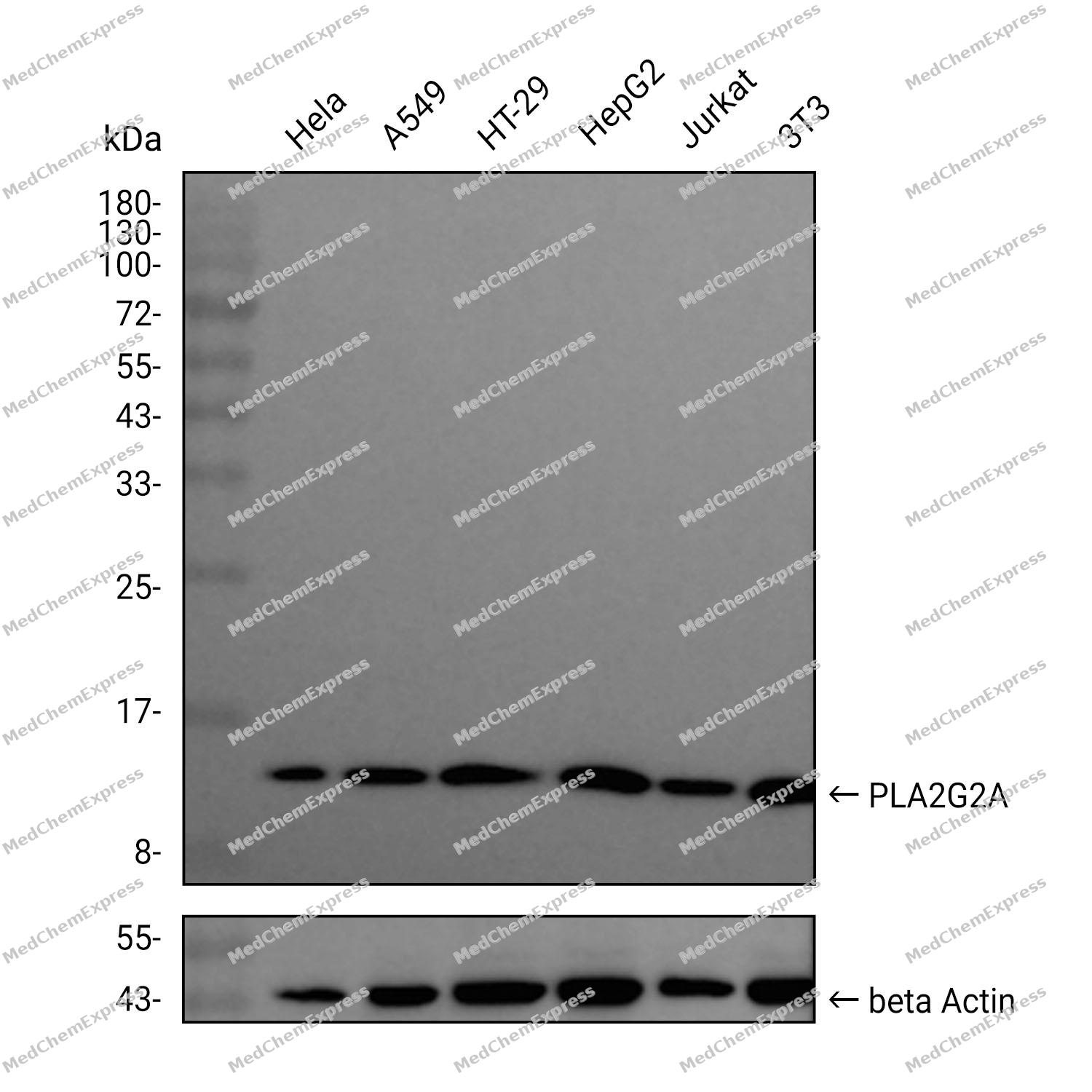 Western blot analysis was performed on extracts from Hela (lane 1, 15 μg), A549 (lane 2, 15 μg), HT-29 (lane 3, 15 μg), HepG2 (lane 4, 15 μg), Jurkat (lane 5, 15 μg), and 3T3 (lane 6, 15 μg) using PLA2G2A Rabbit mAb.Proteins were transferred to a PVDF membrane and blocked with 5% non-fat milk in TBST at 4°C overnight.The primary antibody (1:1000 dilution) and the loading control antibody (beta-Actin, HY-P80438, 1:20000 dilution) were incubated in 5% non-fat milk in TBST for 1 hour at 37°C.Goat Anti-Rabbit IgG-HRP Secondary Antibody (1:20000 dilution) was then applied for 40 minutes at 37°C.
 -
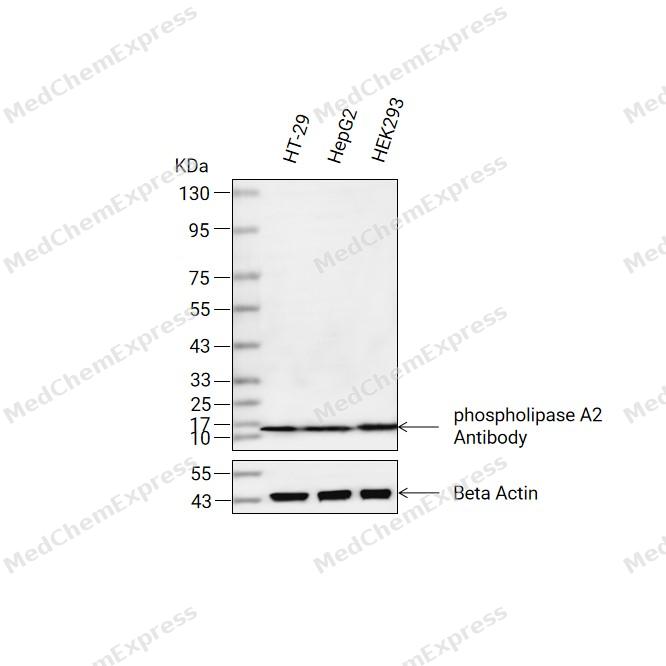 Western blot analysis of extracts from HT-29(lane 2(20ug) , HepG2(lane 3(20ug) and HEK293(lane 4(20ug) using phospholipase A2 Antibody (HY-P83173) Rabbit mAb. Proteins were transferred to a PVDF membrane and blocked with 5% non-fat milk in TBST for 2 hour at room temperature. The primary antibody (1/1000) and Loading control antibody (Beta Actin, HY-P83730, 1/10000) was used in 5% non-fat milk in TBST at 4°C overnight. Goat Anti-Mouse/Rabbit IgG-HRP Secondary Antibody (1/10000) was used for 1 hour at room temperature.


Background
-
Function
phospholipase A2 is a Secretory calcium-dependent phospholipase A2 that primarily targets extracellular phospholipids with implications in host antimicrobial defense, inflammatory response and tissue regeneration. Hydrolyzes the ester bond of the fatty acyl group attached at sn-2 position of phospholipids (phospholipase A2 activity) with preference for phosphatidylethanolamines and phosphatidylglycerols over phosphatidylcholines. Contributes to lipid remodeling of cellular membranes and generation of lipid mediators involved in pathogen clearance. Displays bactericidal activity against Gram-positive bacteria by directly hydrolyzing phospholipids of the bacterial membrane. Upon sterile inflammation, targets membrane phospholipids of extracellular mitochondria released from activated platelets, generating free unsaturated fatty acids such as arachidonate that is used by neighboring leukocytes to synthesize inflammatory eicosanoids such as leukotrienes. Simultaneously, by compromising mitochondrial membrane integrity, promotes the release in circulation of potent damage-associated molecular pattern molecules that activate the innate immune response. Plays a stem cell regulator role in the intestinal crypt. Within intracellular compartment mediates Paneth cell differentiation and its stem cell supporting functions by inhibiting Wnt signaling pathway in intestinal stem cell (ICS). Secreted in the intestinal lumen upon inflammation, acts in an autocrine way and promotes prostaglandin E2 synthesis that stimulates Wnt signaling pathway in ICS cells and tissue regeneration. May play a role in the biosynthesis of N-acyl ethanolamines that regulate energy metabolism and inflammation. Hydrolyzes N-acyl phosphatidylethanolamines to N-acyl lysophosphatidylethanolamines, which are further cleaved by a lysophospholipase D to release N-acyl ethanolamines. Independent of its catalytic activity, acts as a ligand for integrins. Binds to and activates integrins ITGAV:ITGB3, ITGA4:ITGB1 and ITGA5:ITGB1. Binds to a site (site 2) which is distinct from the classical ligand-binding site (site 1) and induces integrin conformational changes and enhanced ligand binding to site 1. Induces cell proliferation in an integrin-dependent manner[1][2][3][4][5][6][7][8][9].
-
Subcellular Localization
Secreted; Cell membrane; Peripheral membrane protein; Mitochondrion outer membrane; Peripheral membrane protein
-
Expression
Tissue_specificity:This gene is expressed in a variety of tissues, including the heart, kidneys, liver, lungs, pancreas, placenta, skeletal muscle, prostate, ovary, colon, and small intestine. It has not been detected in lymphatic organs and brain tissue (PubMed:10455175, PubMed:10681567) . It is also expressed in platelets (protein level) (PubMed:25082876) . -
SwissProt ID
-
Synonyms
MOM1; PLA2; PLA2B; PLA2L; PLA2S; PLAS1; sPLA2
-
Research Field
Signal Transduction


Documentation
-
Data Sheet (262 KB)
-
SDS (251 KB)
- English - EN (251 KB)
- Français - FR (251 KB)
- Deutsch - DE (251 KB)
- Norwegian - NO (251 KB)
- Español - ES (251 KB)
- Swedish - SV (251 KB)
- Italian - IT (251 KB)
- Korean - KR (251 KB)
- Portuguese - PT (251 KB)
-
User Guide for Antibodies (1077 KB)
References
[1]. Ishizaki J, et al. Cloning and characterization of novel mouse and human secretory phospholipase A(2)s. J Biol Chem. 1999 Aug 27;274(35):24973-9. [Content Brief]
[2]. Suzuki N, et al. Structures, enzymatic properties, and expression of novel human and mouse secretory phospholipase A(2)s. J Biol Chem. 2000 Feb 25;275(8):5785-93. [Content Brief]
[3]. Kramer RM, et al. Structure and properties of a human non-pancreatic phospholipase A2. J Biol Chem. 1989 Apr 5;264(10):5768-75. [Content Brief]
[4]. Laine VJ, et al. Protection by group II phospholipase A2 against Staphylococcus aureus. J Immunol. 1999 Jun 15;162(12):7402-8. [Content Brief]
[5]. Koduri RS, et al. Bactericidal properties of human and murine groups I, II, V, X, and XII secreted phospholipases A(2). J Biol Chem. 2002 Feb 22;277(8):5849-57. [Content Brief]
[6]. Boudreau LH, et al. Platelets release mitochondria serving as substrate for bactericidal group IIA-secreted phospholipase A2 to promote inflammation. Blood. 2014 Oct 2;124(14):2173-83. [Content Brief]
[7]. Sun YX, et al. Biosynthesis of anandamide and N-palmitoylethanolamine by sequential actions of phospholipase A2 and lysophospholipase D. Biochem J. 2004 Jun 15;380(Pt 3):749-56. [Content Brief]
[8]. Saegusa J, et al. Pro-inflammatory secretory phospholipase A2 type IIA binds to integrins alphavbeta3 and alpha4beta1 and induces proliferation of monocytic cells in an integrin-dependent manner. J Biol Chem. 2008 Sep 19;283(38):26107-15. [Content Brief]
[9]. Fujita M, et al. Proinflammatory secreted phospholipase A2 type IIA (sPLA-IIA) induces integrin activation through direct binding to a newly identified binding site (site 2) in integrins αvβ3, α4β1, and α5β1. J Biol Chem. 2015 Jan 2;290(1):259-71. [Content Brief]

 Powered by Bioz
