



VEGFA Antibody (YA013)
(Synonyms: VEGFA; VEGF; Vascular endothelial growth factor A; VEGF-A; Vascular permeability factor; VPF)Based on 6 publication(s) in Google Scholar
VEGFA Antibody (YA013) is a Rabbit-derived and non-conjugated IgG monoclonal antibody, targeting to VEGFA.
-
Host:
Rabbit
-
Isotype:
IgG
-
Application:
WB
-
Reactivity :
Human, Mouse, Rat
-
Formulation:
Supplied in 50 mM Tris-Glycine (pH 7.4), 0.15 M NaCl, 40% Glycerol and 0.05% BSA. Preservative: 0.01% Sodium azide
-
Conjugation:
Non-conjugated

To place orders, for customer services and technical support, please contact: MedChemExpress USA
Tel: 609-228-6898 E-mail: [email protected] [email protected]



-
HY-108496
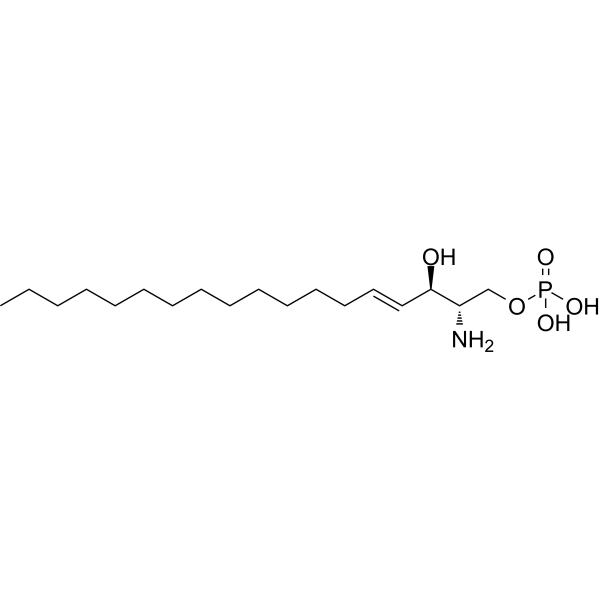
Sphingosine-1-phosphateS1PR Agonist -

HY-P80704
HIF1 alpha Antibody -
HY-P81643
VEGF Receptor 2 Antibody -
HY-P80450
GPX4 Antibody (YA399) -
HY-P81227
Collagen I Antibody -
HY-P80788
Phospho-AKT1 (Ser473) Antibody (YA228) -
HY-P80927
VCAM1 Antibody (YA017) -
HY-P80928
VEGF Receptor 1 Antibody (YA015) -
HY-P80447
CD31 Antibody (YA541)
Publications Citing Use of MedChemExpress (MCE) VEGFA Antibody (YA013)
More
 6 Publications Citing Use of MCE VEGFA Antibody (YA013) (3)
-
IHC

-
IHC

-
WB


Applications
| Application |
WB

WB: Western Blot
|
|---|---|
| Dilution Ratio | 1:500-1:1000 |


Product Details
VEGFA Antibody (YA013) is a Rabbit-derived and non-conjugated IgG monoclonal antibody, targeting to VEGFA.
-
Host Rabbit

-
Clonality Recombinant,Monoclonal

-
Species ReactivityHuman, Mouse, Rat
-
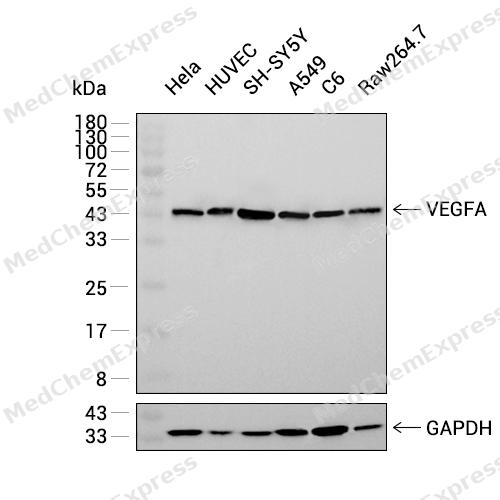
Observed Molecular WeightObserved band size: 25-50 kDa;
Note: Due to possible protein modifications or aggregation, the molecular weight should be confirmed by actual measurement, and the predicted value is for reference only.

-
Calculated Molecular Weight Predicted band size: 27 kDa

Entrez Gene: 7422 Human ; 22339 Mouse ; 83785 Rat
SwissProt: P15692 Human ; Q96KJ0 Human ; Q00731 Mouse ; P16612 Rat
OMIM: 603933 Human
Synthetic peptide corresponding to Human VEGFA aa39-52 and aa139-154.
Endogenous
affinity purified
Non-conjugated
Unmodified
IgG


Product Properties
-
Appearance
Solution
-
Formulation
Supplied in 50 mM Tris-Glycine (pH 7.4), 0.15 M NaCl, 40% Glycerol and 0.05% BSA. Preservative: 0.01% Sodium azide
-
Concentration
Batch-dependent, Please check the COA for the concentration of each lot. Check Lot Concentration
-
Storage & Stability
Stored at -20°C for 1 year. Avoid repeated freeze / thaw cycles.
-
Shipping
Shipping with blue ice.


Publications (6)
-
Journal Impact Factor
-
Most Recent
-
J Nanobiotechnology
A core-shell microneedle platform for the spatiotemporal codelivery of dual-agent therapeutics precisely orchestrates diabetic wound healing. [Abstract]2026 Mar 17;24(1):389. PMID: 41845345 -
Adv Sci (Weinh)
Micro-Organ Chip Deciphers Tumor-Derived G-CSF as Remote Commander of Lung Pre-Metastatic Niche via VEGFA-KDR Cascade. [Abstract]2025 Nov 22:e18584. PMID: 41275332
VEGFA Antibody (YA013) purchased from MedChemExpress. Usage Cited in: Adv Sci (Weinh). 2025 Nov 22:e18584. [Abstract]
Representative immunohistochemical images of VEGF (VEGFA Antibody (YA013), 1:500) in wound tissues of different groups.
VEGFA Antibody (YA013) purchased from MedChemExpress. Usage Cited in: Adv Sci (Weinh). 2025 Nov 22:e18584. [Abstract]
IF and IHC of in vivo lung sections from VEGFA (VEGFA Antibody (YA013), 1:150)-infused mice showing CD31, KDR, and VEGFA expression, and marker-positive area quantification. (Scale bars: 60 µm (IF), 40 µm (IHC).
-
Respir Res
Activation of LXR signaling ameliorates apoptosis of alveolar epithelial cells in Bronchopulmonary dysplasia. [Abstract]2024 Nov 7;25(1):399. PMID: 39511537
VEGFA Antibody (YA013) purchased from MedChemExpress. Usage Cited in: Respir Res. 2024 Nov 7;25(1):399. [Abstract]
The relative protein levels of CD31, VEGFA (VEGFA Antibody (YA013), 1:500), SFTPC, α-SMA and GAPDH were determined by western blot analysis, with quantification shown as histograms. n=4/group.
-
Clin Transl Oncol
Apigenin 7-glucoside reprograms tumor metabolism and enhances immunotherapy efficacy in colorectal cancer via DLX5. [Abstract]2026 Feb 25. PMID: 41739401


Verification Images
-
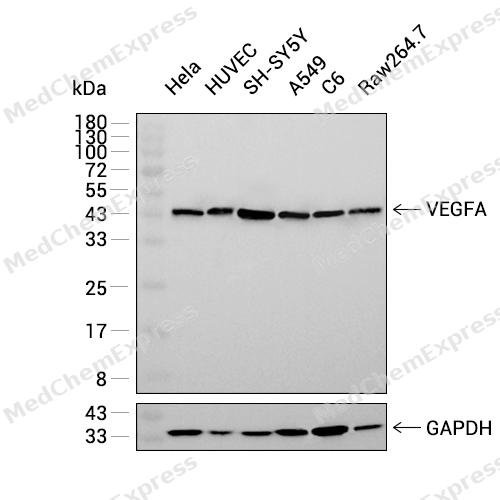 Western blot analysis was performed on extracts from HeLa (lane 1, 20 μg), HUVEC (lane 2, 20 μg), SH-SY5Y (lane 3, 20 μg), A549 (lane 4, 20 μg), C6 (lane 5, 20 μg), and RAW264.7 (lane 6, 20 μg) using VEGFA Rabbit mAb.Proteins were transferred to a PVDF membrane and blocked with 5% non - fat milk in TBST at 4°C overnight.The primary antibody (1:1000 dilution) and the loading control antibody (GAPDH, HY-P2804, 1:5000 dilution) were incubated in 5% non-fat milk in TBST for 1 hour at 37°C.Goat Anti - Rabbit IgG - HRP Secondary Antibody (1:20000 dilution) was then applied for 40 minutes at 37°C.


Background
-
Function
VEGFA participates in the induction of key genes involved in the response to hypoxia and in the induction of angiogenesis such as HIF1A. Involved in protecting cells from hypoxia-mediated cell death; Growth factor active in angiogenesis, vasculogenesis and endothelial cell growth. Induces endothelial cell proliferation, promotes cell migration, inhibits apoptosis and induces permeabilization of blood vessels. Binds to the FLT1/VEGFR1 and KDR/VEGFR2 receptors, heparan sulfate and heparin. Binds to the NRP1/neuropilin-1 receptor. Binding to NRP1 initiates a signaling pathway needed for motor neuron axon guidance and cell body migration, including for the caudal migration of facial motor neurons from rhombomere 4 to rhombomere 6 during embryonic development. Also binds the DEAR/FBXW7-AS1 receptor; Binds to the KDR receptor but does not activate downstream signaling pathways, does not activate angiogenesis and inhibits tumor growth[1][2][3].
-
Subcellular Localization
Cytoplasm; Nucleus; Secreted; Endoplasmic reticulum; Golgi apparatus; Secreted, extracellular space, extracellular matrix; Secreted; Secreted; Secreted
-
Expression
Tissue_specificity:Higher expression in pituitary tumors than in the pituitary gland; widespread expression; widespread expression; widespread expression; not widely expressed; not widely expressed
Induction:By hypoxia. Regulated by growth factors, cytokines, gonadotropins, nitric oxide, hypoglycemia and oncogenic mutations -
Isoforms & Post-Translational Modification
P15692 has 17 isomers: P15692-13: 43597 Da (predicted); P15692-1: 27042 Da (predicted); P15692-2: 25173 Da (predicted); P15692-3: 24422 Da (predicted); P15692-4: 22314 Da (predicted); P15692-5: 20218 Da (predicted); P15692-6: 20064 Da (predicted); P15692-8: 22259 Da (predicted); P15692-9: 17219 Da (predicted); P15692-10: 15981 Da (predicted); P15692-11: 40738 Da (predicted); P15692-12: 35643 Da (predicted); P15692-14: 45467 Da (predicted); P15692-15: 40683 Da (predicted); P15692-16: 42846 Da (predicted); P15692-17: 38642 Da (predicted); P15692-18: 34406 Da (predicted).
Produced by use of an alternative upstream CUG codon and post-translationally processed into the N-terminal N-VEGF form and the C-terminal secreted VEGFA form -
Subunit
Homodimer; disulfide-linked (By similarity). Interacts with NRP1 (PubMed:26503042). Interacts with isoform 2 of BSG (PubMed:25825981)
-
SwissProt ID
-
Synonyms
VEGFA; VEGF; Vascular endothelial growth factor A; VEGF-A; Vascular permeability factor; VPF
-
Research Field
Cardiovascular
Documentation
-
Data Sheet (262 KB)
-
SDS (252 KB)
- English - EN (252 KB)
- Français - FR (252 KB)
- Deutsch - DE (252 KB)
- Norwegian - NO (252 KB)
- Español - ES (252 KB)
- Swedish - SV (252 KB)
- Italian - IT (252 KB)
- Korean - KR (252 KB)
- Portuguese - PT (252 KB)
-
User Guide for Antibodies (1077 KB)
References
[1]. Katsman M, et al. N-VEGF, the Autoregulatory Arm of VEGF-A. Cells. 2022 Apr 11;11(8):. [Content Brief]
[2]. Lee JW, et al. KAI1(CD82) is a key molecule to control angiogenesis and switch angiogenic milieu to quiescent state. J Hematol Oncol. 2021 Sep 16;14(1):148. [Content Brief]
[3]. Glorioso N, et al. Association of ATP1A1 and dear single-nucleotide polymorphism haplotypes with essential hypertension: sex-specific and haplotype-specific effects. Circ Res. 2007 May 25;100(10):1522-9. [Content Brief]

 Powered by Bioz
