



Bexlosteride
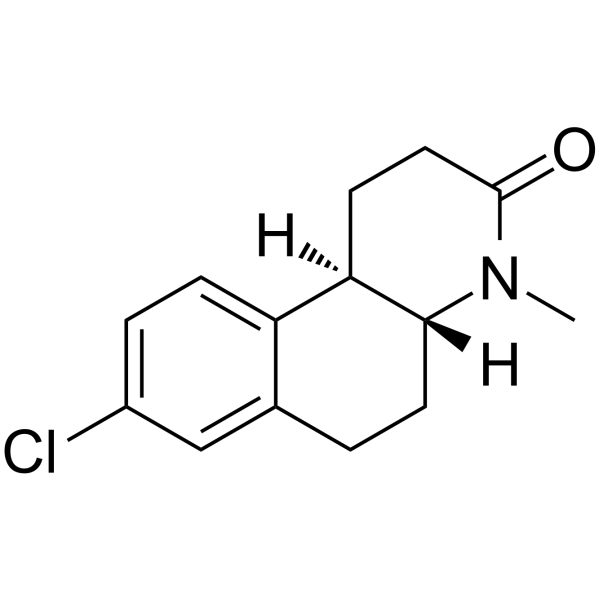
Bexlosteride (LY300502) is a benzoquinolinone human type I 5α-reductase inhibitor. Bexlosteride shows metabolic inhibitory, antiproliferative, and antisecretory effects in LNCaP human prostatic adenocarcinoma cell cultures. Bexlosteride can be used for the research of prostatic cancer.
Nur für Forschungszwecke. Wir verkaufen nicht an Patienten.
- CAS. Nr.: 148905-78-6
- Formel: C14H16ClNO
- Molecular Weight:249.74
-
Speicherung:
Please store the product under the recommended conditions in the Certificate of Analysis.

To place orders, for customer services and technical support, please contact: MedChemExpress USA
Tel: 609-228-6898 E-mail: [email protected] [email protected]


-
 Biologische Aktivität
-
Chemical Information
- Protokoll
- Reinheit & Dokumentation
- Verweise
-
 Help & FAQs




Biologische Aktivität
Beschreibung
IC50 & Target
human type I 5α-reductase[1]
In Vitro
Bexlosteride concentration-dependently inhibits reductive metabolism of [3H-T] in the LNCaP cells, with an IC50 of 5.77 nM[1].
Bexlosteride significantly antagonizes Testosterone-induced stimulation of LNCaP cellular proliferation at concentrations greater than 10 nM, and at 1000 nM completely blocks the mitogenic effects of Testosterone on LNCaP cells[1].
Bexlosteride significantly antagonizes Testosterone -induced PSA secretion at a concentration equal to or greater than 30 nM[1].
MedChemExpress (MCE) has not independently confirmed the accuracy of these methods. They are for reference only. Further protocols information, click here.


Chemical Information
-
CAS. Nr. 148905-78-6
-
Molecular Weight 249.74
-
Formel C14H16ClNO
-
SMILES
CN1[C@@]2([H])[C@@](CCC1=O)([H])C3=CC=C(Cl)C=C3CC2
-
Synonyms
LY300502
-
Versand
Room temperature in continental US; may vary elsewhere.
-
Speicherung
Please store the product under the recommended conditions in the Certificate of Analysis.

Protokoll
-
Cell Viability Determination by MTT Colorimetric Assay
The following protocol uses the MTT colorimetric assay as a classic literature-established method for assessing cell viability/metabolic activity in cultured mammalian cells. MTT[3-(4,5-dimethylthiazol-2-yl)-2,5-diphenyltetrazolium bromide] is reduced by metabolically active cells to a colored formazan product; the amount of formazan is quantified spectrophotometrically and provides an indirect measure of metabolically active viable cells. Importantly, MTT reduction reflects cellular oxidoreductase/metabolic activity rather than an absolute direct count of living cells, so changes in cellular metabolism can alter the signal independently of cell number.


Reinheit & Dokumentation
Verweise
[1]. Sutkowski DM, et, al. Responses of LNCaP prostatic adenocarcinoma cell cultures to LY300502, a benzoquinolinone human type I 5alpha-reductase inhibitor. Prostate Suppl. 1996;6:62-6. [Content Brief]
[2]. Farid NA, et, al. Stereoselective disposition of the enantiomers of the benzoquinolinone LY191704, a human type I 5 alpha-reductase inhibitor. Differences between rats and dogs. Drug Metab Dispos. 1996 Oct;24(10):1162-5. [Content Brief]

Calculators
Konzentration (Stammlösung) × Volumen (Stammlösung) = Konzentration (Ziellösung) × Volumen (Ziellösung)


Bexlosteride Related Classifications
HY-118091A Related Classifications
 Powered by Bioz