



Anticancer agent 94
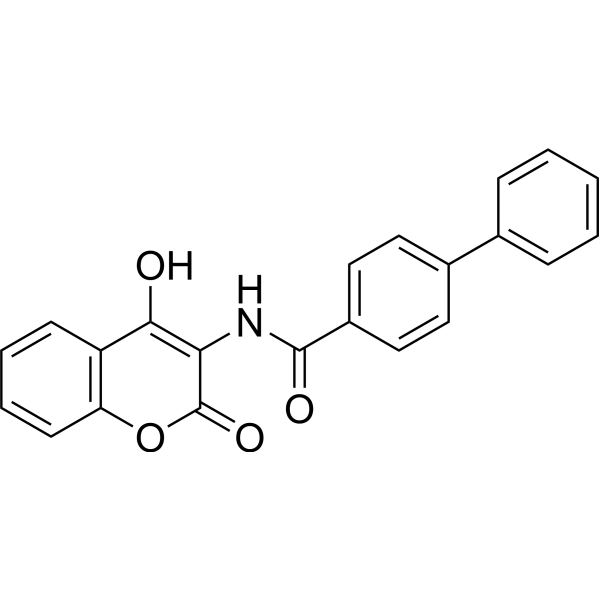
Anticancer agent 94 is a 4-Hydroxycoumarin derivative. Anticancer agent 94 can inhibit invasion and migration of lung cancer cells by modulating expression of epithelial-mesenchymal transition (EMT) effectors.
For research use only. We do not sell to patients.
- Formula: C22H15NO4
- Molecular Weight:357.36
-
Storage:
Please store the product under the recommended conditions in the Certificate of Analysis.

To place orders, for customer services and technical support, please contact: MedChemExpress USA
Tel: 609-228-6898 E-mail: [email protected] [email protected]


-
 Biological Activity
-
Chemical Information
- Protocols
- Purity & Documentation
- References
-
 Help & FAQs




Biological Activity
Description
In Vitro
Anticancer agent 94 (compound 4i) (5-15 μM; 24 h) significantly inhibits A549 cell invasion by ~ 40%[1].
Anticancer agent 94 (15 μM; 24-72 h) significantly inhibits A549 cell migration[1].
Anticancer agent 94 (5-15 μM; 4 h) inhibits lung cancer cell motility by downregulating EMT markers[1].
MedChemExpress (MCE) has not independently confirmed the accuracy of these methods. They are for reference only. Further protocols information, click here.
-
Cell Line:A549 cells
-
Concentration:5, 10, 15 μM
-
Incubation Time:24 hours
-
Result:Significantly increased the expression of E-cadherin.
Downregulated the expression of N-cadherin.


Chemical Information
-
Molecular Weight 357.36
-
Formula C22H15NO4
-
SMILES
O=C(C1=CC=C(C2=CC=CC=C2)C=C1)NC(C3=O)=C(O)C4=C(O3)C=CC=C4
-
Shipping
Room temperature in continental US; may vary elsewhere.
-
Storage
Please store the product under the recommended conditions in the Certificate of Analysis.

Protocols
-
RNA extraction experimental
By lysing cells, releasing RNA, and removing impurities such as proteins and DNA, high-purity RNA products are finally obtained. The commonly used traditional method is the guanidine isothiocyanate/phenol/chloroform method (Trizol), which is suitable for a variety of animal materials including animal tissues, microorganisms, cultured cells, etc., and most plant materials.
-
Cell migration
Cell migration is a method that plays an important role in wound healing, cell differentiation, embryonic development, etc.
-
Cell invasion
Cell invasion is the ability of cells to migrate from one area to another via the extracellular matrix. Cell invasion is the response of normal and cancer cells to chemical and mechanical stimuli. Before migrating to a new region, the extracellular matrix is degraded by proteases within the cell. Cell invasion often occurs during wound repair, vascularization and inflammation, abnormal tissue invasion, and tumor cell metastasis.


Purity & Documentation
References

Calculators
Concentration (start) × Volume (start) = Concentration (final) × Volume (final)


Anticancer agent 94 Related Classifications
HY-152085 Related Classifications
 Powered by Bioz