



Auramine O

Based on 1 Customer Validation
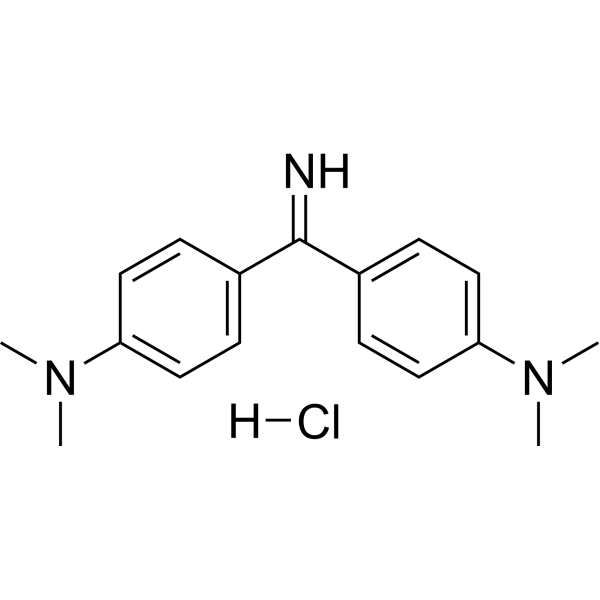
Auramine O is a yellow fluorescent dye. Auramine O is used to detect amyloid fibrils. Auramine O promotes lung malignancy. Auramine O is also used to determine algal cell viability and stain acid-fast bacteria.
For research use only. We do not sell to patients.
- Purity : 83.12%
- CAS No.: 2465-27-2
- Formula: C17H22ClN3
- Molecular Weight:303.84
-
Storage:
RT, sealed storage, away from moisture and light.
In solvent -80°C, 1 year , -20°C, 6 months

To place orders, for customer services and technical support, please contact: MedChemExpress USA
Tel: 609-228-6898 E-mail: [email protected] [email protected]


-
 Biological Activity
-
Chemical Information
-
Solvent & Solubility
- Protocols
- Purity & Documentation
- References
-
 Help & FAQs


-
HY-D0914
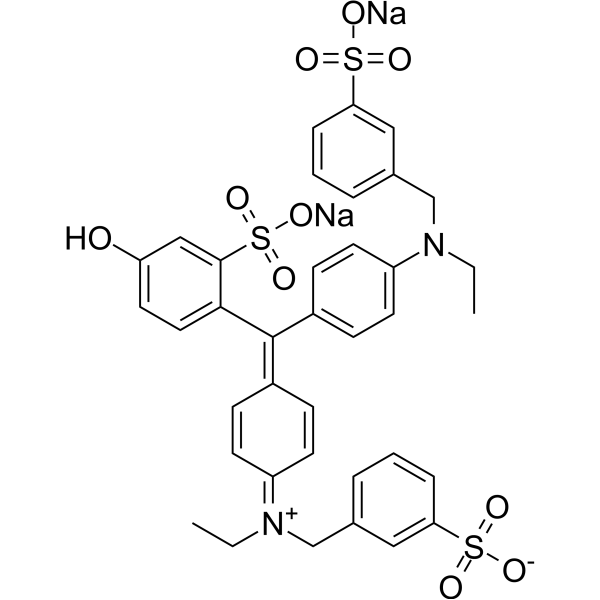
Fast Green FCFSea Green Triarylmethane Food Dye -
HY-D0932
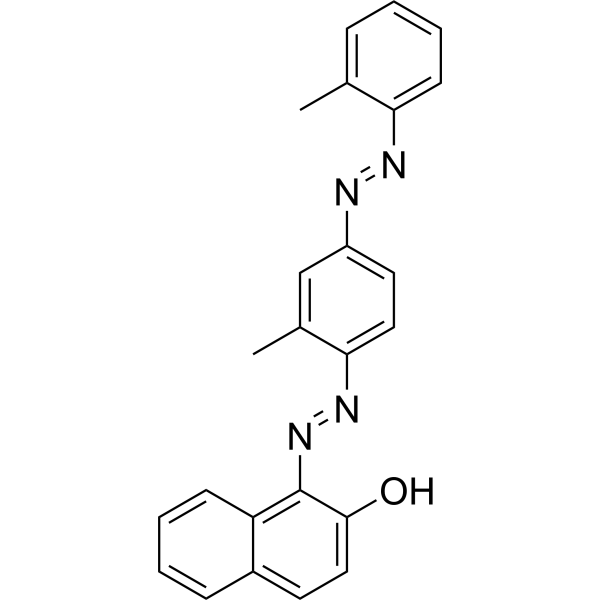
Sudan IVDisazo Dye -
HY-116215
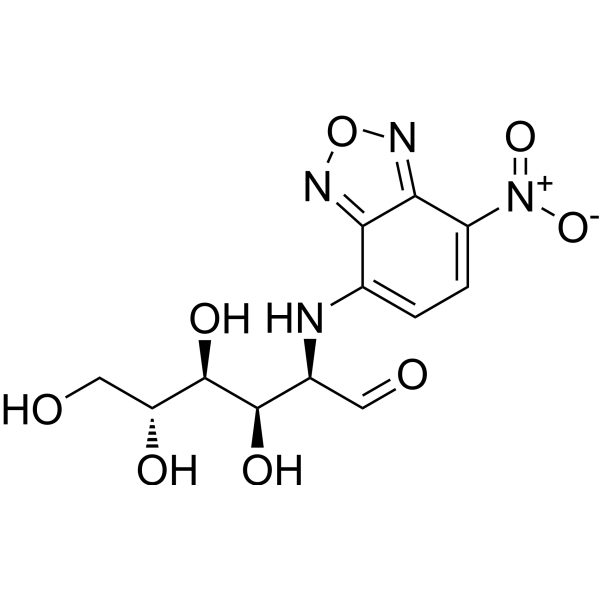
2-NBDGFluorescent Indicator -

HY-D0932R
Sudan IV (Standard)Standard of Sudan IV -
HY-D1168
Oil Red ODiazol Dye -
HY-D0259
Erythrosine BFluorescent Dyes -
HY-15534
JC-1Mitochondrial Membrane Potential Probe -
HY-111391
Resazurin sodiumBacterial Inhibitor -

HY-DY1019
2-NBDG (solution)Fluorescent Indicator -
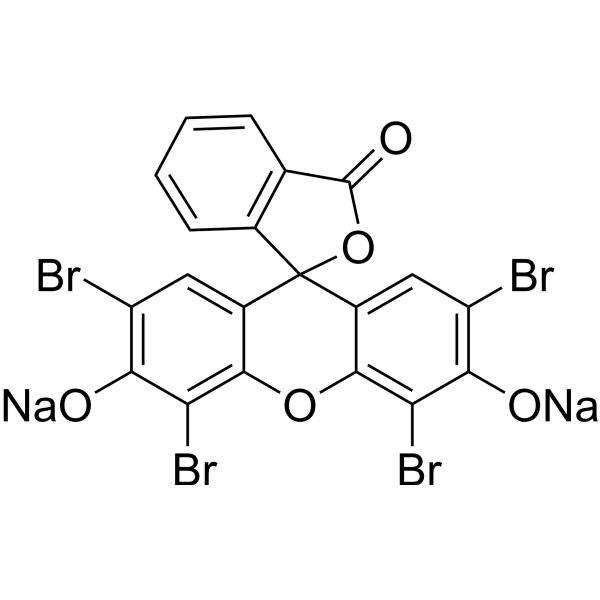
HY-D0505A
Eosin Y disodiumDye Molecule -
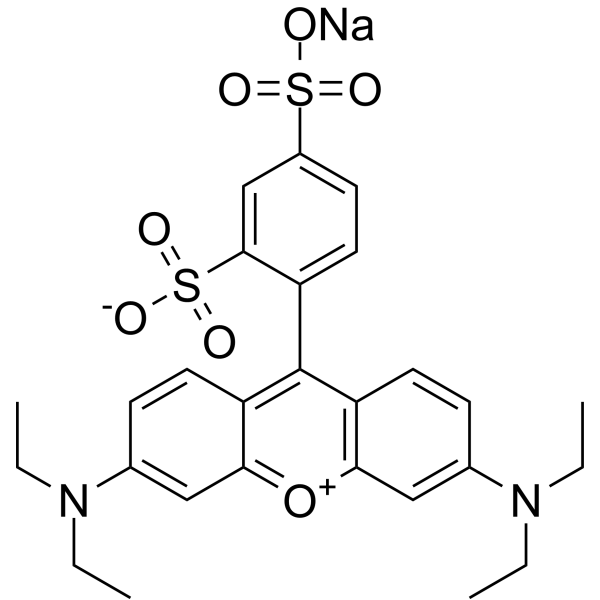
HY-D0974
Sulforhodamine B sodium saltFluorescent Dye -

HY-DY1003
JC-1 (solution)Mitochondrial Membrane Potential Probe


Biological Activity
Description
In Vitro
Guidelines (Following is our recommended protocol. This protocol only provides a guideline, and should be modified according to your specific needs).
Auramine O staining of Tuberculosis bacilli[3]
1. Place the slide on a staining rack and stain with Auramine O solution for 20 min
2. Rinse the slide with water and soak it in 0.5% acid alcohol for 3 min
3. Rinse with water and counterstain with 1% KMnO4 solution for 1 min
4. Check the staining effect with an LED microscope with at least 40 fields of view
Note: Tuberculosis bacilli appear as yellow luminescent organisms in a dark field of view
MedChemExpress (MCE) has not independently confirmed the accuracy of these methods. They are for reference only. Further protocols information, click here.
Clinical Trial
| NCT Number | Sponsor | Condition | Start Date |
Phase

|
|---|---|---|---|---|
| NCT01329991 | Plexxikon| | 2011-05 | PHASE1 |


Chemical Information
-
CAS No. 2465-27-2
-
Appearance Solid
-
Molecular Weight 303.84
-
Formula C17H22ClN3
-
Color Light yellow to yellow
-
SMILES
N=C(C1=CC=C(N(C)C)C=C1)C2=CC=C(N(C)C)C=C2.[H]Cl
-
Shipping
Room temperature in continental US; may vary elsewhere.
-
Storage
RT, sealed storage, away from moisture and light
In solvent -80°C 1 year -20°C 6 months


Solvent & Solubility
In Vitro:
DMSO : 16.67 mg/mL (54.86 mM; ultrasonic and warming and heat to 60°C; Hygroscopic DMSO has a significant impact on the solubility of product, please use newly opened DMSO)
Please refer to the solubility information to select the appropriate solvent. Once prepared, please aliquot and store the solution to prevent product inactivation from repeated freeze-thaw cycles.
Storage method and period of stock solution: -80°C, 1 year; -20°C, 6 months. When stored at -80°C, please use it within 1 year. When stored at -20°C, please use it within 6 months.
Please refer to the solubility information to select the appropriate solvent. Once prepared, please aliquot and store the solution to prevent product inactivation from repeated freeze-thaw cycles.
Storage method and period of stock solution: -80°C, 1 year; -20°C, 6 months. When stored at -80°C, please use it within 1 year. When stored at -20°C, please use it within 6 months.
Concentration (start) × Volume (start) = Concentration (final) × Volume (final)

Protocols
-
Cell Cytotoxicity Assay
Cytotoxicity assays are usually based on the assessment of cell membrane damage, which can also be indirectly detected by measuring cell viability. Detection methods include MTT assay, CKK-8 assay, LDH assay and ATP assay, etc.
-
Mammalian live/dead viability and cytotoxicity staining
Live/dead viability and cytotoxicity staining assays are based on the simultaneous detection of intracellular esterase activity in metabolically active (viable) cells and membrane integrity loss in non-viable cells. In commonly used dual-staining approaches, membrane-permeant fluorogenic substrates are converted by intracellular esterases into fluorescent products in live cells, while impermeant DNA-binding dyes selectively enter cells with compromised plasma membranes and label nucleic acids in dead or dying cells, enabling discrimination between viable and non-viable populations by fluorescence microscopy or flow cytometry.
-
CCK-8/WST-8 Cell Proliferation Assay
The CCK-8/WST-8 assay is based on the reduction of the water-soluble tetrazolium salt WST-8 to a water-soluble formazan product by cellular dehydrogenases in metabolically active cells, where the generated formazan amount is proportional to the number of living cells and is quantified by measuring absorbance in the visible range, providing a colorimetric readout for cell viability and proliferation assessment. This class of tetrazolium-based assays improves upon earlier MTT-based systems by producing a water-soluble formazan, eliminating the need for organic solubilization steps and enabling direct spectrophotometric measurement in culture medium.
-
MTT Cell Proliferation Assay
The MTT assay is a colorimetric endpoint assay for estimating viable cell number, cell growth, cytotoxicity, or cell activation in cultured mammalian cells. Living cells reduce the yellow tetrazolium salt MTT into purple/blue formazan, while dead cells do not generate the same signal; the resulting color can be quantified with a multiwell spectrophotometer. MTT reduction is commonly interpreted as a readout of metabolic activity that often correlates with viable cell number, but it should not be treated as a direct cell-counting method unless the assay is optimized for the cell type and experimental condition. Studies show that MTT reduction can involve mitochondrial and non-mitochondrial reducing systems, and formazan may accumulate in intracellular lipid droplets rather than simply marking mitochondria.
-
Amyloid: Congo Red Amyloid Staining
Congo red amyloid staining is a histochemical method used to detect extracellular amyloid deposits in tissue sections based on the affinity of Congo red dye for β-pleated sheet-rich protein aggregates. When bound to amyloid, Congo red produces characteristic apple-green birefringence under polarized light microscopy, which is widely regarded as a diagnostic feature of amyloid deposition in histopathology. The diagnostic principle relies on the combination of dye binding (congophilia) and optical anisotropy under polarized illumination, which distinguishes amyloid from most non-amyloid eosinophilic extracellular deposits in routine histological evaluation. Amyloid identification by Congo red staining remains a cornerstone in diagnostic pathology despite the availability of adjunct methods such as immunohistochemistry and mass spectrometry, particularly because of its ability to localize deposits directly within tissue architecture. The specificity of Congo red-positive deposits is incre
-
Cell Viability Determination by MTT Colorimetric Assay
The following protocol uses the MTT colorimetric assay as a classic literature-established method for assessing cell viability/metabolic activity in cultured mammalian cells. MTT[3-(4,5-dimethylthiazol-2-yl)-2,5-diphenyltetrazolium bromide] is reduced by metabolically active cells to a colored formazan product; the amount of formazan is quantified spectrophotometrically and provides an indirect measure of metabolically active viable cells. Importantly, MTT reduction reflects cellular oxidoreductase/metabolic activity rather than an absolute direct count of living cells, so changes in cellular metabolism can alter the signal independently of cell number.


Purity & Documentation
-
Data Sheet (283 KB)
-
SDS (761 KB)
- English - EN (761 KB)
- Français - FR (761 KB)
- Deutsch - DE (761 KB)
- Norwegian - NO (761 KB)
- Español - ES (761 KB)
- Swedish - SV (761 KB)
- Italian - IT (761 KB)
- Korean - KR (761 KB)
- Portuguese - PT (761 KB)
-
Handling Instructions (2659 KB)
References
[1]. Kommareddi S, et al. Nontuberculous mycobacterial infections: comparison of the fluorescent auramine-O and Ziehl-Neelsen techniques in tissue diagnosis. Hum Pathol. 1984 Nov;15(11):1085-9. [Content Brief]
[3]. Gizaw N, et al. The yield of Auramine O staining using led microscopy with bleach treated sputum samples for detection of pulmonary tuberculosis at St. Peter tuberculosis specialized hospital, Addis Ababa, Ethiopia. J Clin Tuberc Other Mycobact Dis. 2019 Dec 12;18:100140. [Content Brief]
[4]. Amdursky N, et al. Auramine-O as a fluorescence marker for the detection of amyloid fibrils. J Phys Chem B. 2012 Nov 15;116(45):13389-95. [Content Brief]
[5]. Tung JC, et al. Auramine O, an incense smoke ingredient, promotes lung cancer malignancy. Environ Toxicol. 2017 Nov;32(11):2379-2391. [Content Brief]


Complete Stock Solution Preparation Table
Please refer to the solubility information to select the appropriate solvent. Once prepared, please aliquot and store the solution to prevent product inactivation from repeated freeze-thaw cycles.
Storage method and period of stock solution: -80°C, 1 year; -20°C, 6 months. When stored at -80°C, please use it within 1 year. When stored at -20°C, please use it within 6 months.
| Optional Solvent | Concentration Solvent Mass | 1 mg | 5 mg | 10 mg | 25 mg |
|---|---|---|---|---|---|
| DMSO | 1 mM | 3.2912 mL | 16.4560 mL | 32.9121 mL | 82.2801 mL |
| 5 mM | 0.6582 mL | 3.2912 mL | 6.5824 mL | 16.4560 mL | |
| 10 mM | 0.3291 mL | 1.6456 mL | 3.2912 mL | 8.2280 mL | |
| 15 mM | 0.2194 mL | 1.0971 mL | 2.1941 mL | 5.4853 mL | |
| 20 mM | 0.1646 mL | 0.8228 mL | 1.6456 mL | 4.1140 mL | |
| 25 mM | 0.1316 mL | 0.6582 mL | 1.3165 mL | 3.2912 mL | |
| 30 mM | 0.1097 mL | 0.5485 mL | 1.0971 mL | 2.7427 mL | |
| 40 mM | 0.0823 mL | 0.4114 mL | 0.8228 mL | 2.0570 mL | |
| 50 mM | 0.0658 mL | 0.3291 mL | 0.6582 mL | 1.6456 mL |


Auramine O Related Classifications
HY-D0933 Related Classifications
 Powered by Bioz