



Mitotane-d8
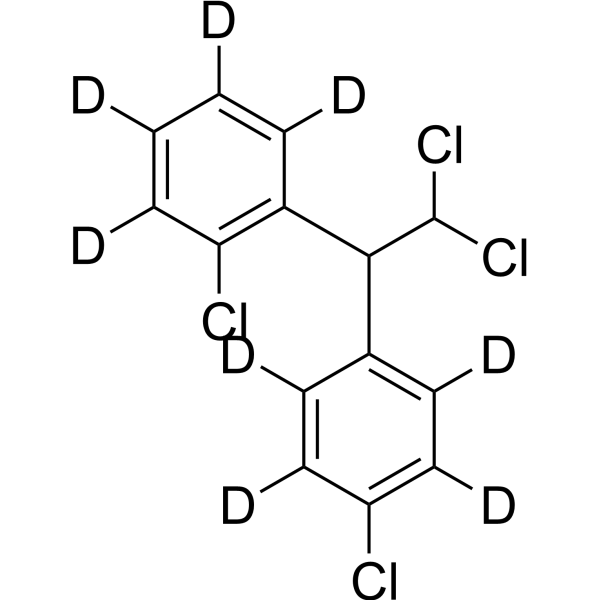
Mitotane-d8 is the deuterium labeled Mitotane. Mitotane (2,4′-DDD), an isomer of DDD and derivative of dichlorodiphenyltrichloroethane (DDT), is an antineoplastic agent, can be used to research adrenocortical carcinoma. Mitotane exert its adrenocorticolytic effect at least in part through lipotoxicity induced by intracellular free cholesterol (FC) accumulation. Mitotane can have direct pituitary effects on corticotroph cells. Mitotane can induce CYP3A4 gene expression via steroid and xenobiotic receptor (SXR) activation, and has agent-agent interactions.
Nos produits utilisent uniquement pour la recherche. Nous ne vendons pas aux patients.
- CAS No.: 2673270-14-7
- Formule: C14H2D8Cl4
- Masse moléculaire:328.09
-
Stockage:
Please store the product under the recommended conditions in the Certificate of Analysis.

To place orders, for customer services and technical support, please contact: MedChemExpress USA
Tel: 609-228-6898 E-mail: [email protected] [email protected]


-
 Activité biologique
-
Chemical Information
- Protocole
- Pureté et documentation
- Références
-
 Help & FAQs




Activité biologique
Description
In Vitro
Stable heavy isotopes of hydrogen, carbon, and other elements have been incorporated into drug molecules, largely as tracers for quantitation during the drug development process. Deuteration has gained attention because of its potential to affect the pharmacokinetic and metabolic profiles of drugs[1].
MedChemExpress (MCE) has not independently confirmed the accuracy of these methods. They are for reference only.
Application
1. This compound can be used as a tracer
2. This compound can be used as an internal standard for quantitative analysis by NMR, GC-MS, or LC-MS.


Chemical Information
-
CAS No. 2673270-14-7
-
Unlabeled CAS 53-19-0
-
Masse moléculaire 328.09
-
Formule C14H2D8Cl4
-
SMILES
ClC(Cl)C(C1=C([2H])C([2H])=C(C([2H])=C1[2H])Cl)C2=C(C([2H])=C([2H])C([2H])=C2[2H])Cl
-
Synonyms
2,4′-DDD-d8; o,p'-DDD-d8
-
Livraison
Room temperature in continental US; may vary elsewhere.
-
Stockage
Please store the product under the recommended conditions in the Certificate of Analysis.


Pureté et documentation
Références
[1]. Russak EM, et al. Impact of Deuterium Substitution on the Pharmacokinetics of Pharmaceuticals. Ann Pharmacother. 2019 Feb;53(2):211-216. [Content Brief]
[2]. Takeshita A, Igarashi-Migitaka J, Koibuchi N, Mitotane induces CYP3A4 expression via activation of the steroid and xenobiotic receptor. J Endocrinol. 2013 Feb 15;216(3):297-305. [Content Brief]
[3]. Doghman M, et al. Lack of long-lasting effects of mitotane adjuvant therapy in a mouse xenograft model of adrenocortical carcinoma. Mol Cell Endocrinol. 2013 Dec 5;381(1-2):66-9. [Content Brief]
[4]. Zatelli MC, et al. Therapeutic concentrations of mitotane (o,p'-DDD) inhibit thyrotroph cell viability and TSH expression and secretion in a mouse cell line model. Endocrinology. 2010 Jun;151(6):2453-61. [Content Brief]
[5]. Warde KM, et al. Mitotane Targets Lipid Droplets to Induce Lipolysis in Adrenocortical Carcinoma. Endocrinology. 2022 Sep 1;163(9):bqac102. [Content Brief]

Calculators
Concentration (start) × Volume (start) = Concentration (final) × Volume (final)


Mitotane-d8 Related Classifications
HY-13690S2 Related Classifications
 Powered by Bioz