



PSMA targeting peptide
Based on 1 publication(s) in Google Scholar
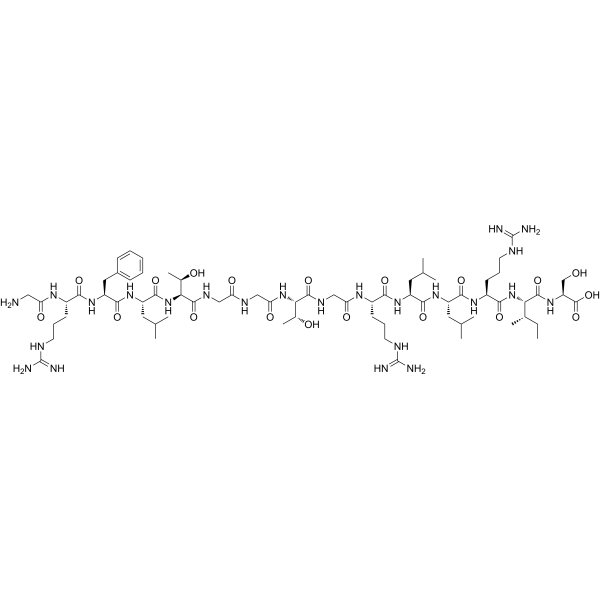
PSMA targeting peptide (PSMA-1) is a PSMA-binding peptide that selectively binds to the PSMA receptor on prostate cancer cells and acts as a peptide-based siRNA delivery system by complexing and releasing siRNA. PSMA targeting peptide can be used in research on prostate cancer.
Nos produits utilisent uniquement pour la recherche. Nous ne vendons pas aux patients.
- CAS No.: 2042750-71-8
- Formule: C70H122N24O19
- Masse moléculaire:1603.87
-
Stockage:
Please store the product under the recommended conditions in the Certificate of Analysis.

To place orders, for customer services and technical support, please contact: MedChemExpress USA
Tel: 609-228-6898 E-mail: [email protected] [email protected]


-
 Activité biologique
-
Chemical Information
- Protocole
- Pureté et documentation
- Références
-
 Help & FAQs


Publications Citing Use of MedChemExpress (MCE) PSMA targeting peptide
More

Activité biologique
Description
IC50 & Target
IC50: PSMA[1]
In Vitro
PSMA-1-R6 forms large, anionic, polydisperse complexes with siRNA, with a zeta potential of -2.16 mV, effective diameters of 1450 nm (aggregates) and 878 nm (individual particles), and a tendency to aggregate[1].
PSMA-1-R6 (5 min; 1 week), when complexed with siRNA, formed large, polydisperse aggregated particles with an average size 200-300 nm larger than that of the siRNA:Trans-IT X2 control complexes[1].
PSMA-1-R6 peptide (625 pmol; 48 h) failed to mediate functional siRNA delivery and GRP78 knockdown at both mRNA and protein levels in both LNCaP and PC3 cell lines[1].
MedChemExpress (MCE) has not independently confirmed the accuracy of these methods. They are for reference only. Further protocols information, click here.


Chemical Information
-
CAS No. 2042750-71-8
-
Masse moléculaire 1603.87
-
Formule C70H122N24O19
-
Synonyms
PSMA-1
-
Sequence
Gly-Arg-Phe-Leu-Thr-Gly-Gly-Thr-Gly-Arg-Leu-Leu-Arg-Ile-Ser
-
Sequence Shortening
GRFLTGGTGRLLRIS
-
Livraison
Room temperature in continental US; may vary elsewhere.
-
Stockage
Please store the product under the recommended conditions in the Certificate of Analysis.


Publications (1)
-
Journal Impact Factor
-
Most Recent
-
J Control Release
Targeting polyamine metabolism induces oxidative/carbonyl stress to reinvigorate antitumor immunity in prostate cancer. [Abstract]2025 Sep 30;388(Pt 1):114283. PMID: 41038348

Protocole
-
RNA interference technology
RNA interference (RNAi) is a cellular mechanism that inhibits gene expression by suppressing gene transcription or activating RNA degradation. This mechanism was discovered in plants in 1998 by Andrew Fire and Craig Mello. Today, this phenomenon can be observed in almost all eukaryotes, including protozoa, flies, nematodes, insects, parasites, and mammals.


Pureté et documentation
Références

Calculators
Concentration (start) × Volume (start) = Concentration (final) × Volume (final)


PSMA targeting peptide Related Classifications
HY-P10055 Related Classifications
 Powered by Bioz