



94088-85-4
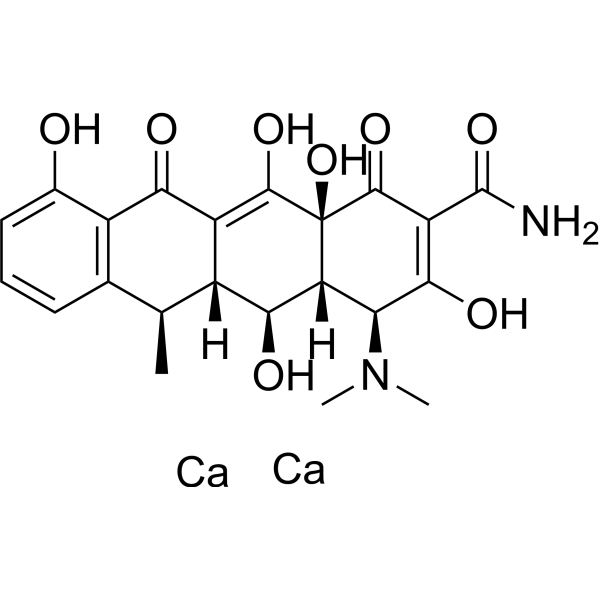
Chemical Structure
Doxycycline calcium
- CAS No.: 94088-85-4
- Formula:C22H24Ca2N2O8
- Molecular Weight:524.59
IUPAC Name: (4S,4aR,5S,5aR,6R,12aS)-4-(dimethylamino)-3,5,10,12,12a-pentahydroxy-6-methyl-1,11-dioxo-1,4,4a,5,5a,6,11,12a-octahydrotetracene-2-carboxamide, dicalcium salt
InChIKey: CEGLWWYOEXTDIB-QFWOMMJSSA-N
SMILES: O=C(C(C1=O)=C(O)[C@@H](N(C)C)[C@]2([H])[C@@H](O)[C@]3([H])[C@@H](C)C4=C(C(C3=C(O)[C@@]21O)=O)C(O)=CC=C4)N.[Ca].[Ca]
Biological Activity: Doxycycline calcium (Doxycycline (hydrochloride hemiethanolate hemihydrate); WC2031) is an orally active, broad-spectrum tetracycline antibiotic that also functions as an MMP inhibitor, exhibiting antibacterial, antiviral, antiparasitic, and antitumor activities. Doxycycline calcium can bind to the classical binding site (CBS) within the mRNA decoding center of the 30S small subunit of the bacterial 70S ribosome.Doxycycline calcium blocks bacterial protein synthesis and inhibits the degradation of the extracellular matrix through its interaction with zinc and calcium ions. Doxycycline calcium also inhibits mitochondrial biogenesis, translation, and the expression of respiratory chain proteins. Doxycycline calcium induces apoptosis, inhibits autophagy and EMT, downregulates stem cell markers, and activates the PI3K-AKT pathway, thereby effectively inhibiting the viability and proliferation of cancer cells such as breast cancer cells. Doxycycline calcium can disrupt transthyretin (TTR) amyloid fibrils. Doxycycline calcium also promotes the survival and self-renewal of embryonic stem cells and neural stem cells, and reduces the frequency of medium changes in culture. Doxycycline calcium can be used in research related to cancers—such as breast, prostate, and bladder cancer—as well as neurological disorders[1][2][3][4][5][6][7][8][9][10].
| Cat. No. | Product Name | Purity | Description | Pricing | |||||||||||||||||||
|---|---|---|---|---|---|---|---|---|---|---|---|---|---|---|---|---|---|---|---|---|---|---|---|
|
|
Doxycycline calcium | Doxycycline calcium (Doxycycline (hydrochloride hemiethanolate hemihydrate); WC2031) is an orally active, broad-spectrum tetracycline antibiotic that also functions as an MMP inhibitor, exhibiting antibacterial, antiviral, antiparasitic, and antitumor activities. Doxycycline calcium can bind to the classical binding site (CBS) within the mRNA decoding center of the 30S small subunit of the bacterial 70S ribosome.Doxycycline calcium blocks bacterial protein synthesis and inhibits the degradation of the extracellular matrix through its interaction with zinc and calcium ions. Doxycycline calcium also inhibits mitochondrial biogenesis, translation, and the expression of respiratory chain proteins. Doxycycline calcium induces apoptosis, inhibits autophagy and EMT, downregulates stem cell markers, and activates the PI3K-AKT pathway, thereby effectively inhibiting the viability and proliferation of cancer cells such as breast cancer cells. Doxycycline calcium can disrupt transthyretin (TTR) amyloid fibrils. Doxycycline calcium also promotes the survival and self-renewal of embryonic stem cells and neural stem cells, and reduces the frequency of medium changes in culture. Doxycycline calcium can be used in research related to cancers—such as breast, prostate, and bladder cancer—as well as neurological disorders. | |||||||||||||||||||||
|
loading...
/
|
|||||||||||||||||||||||
References
- [1]. El-Neweshy MS, et al. Experimental doxycycline overdose in rats causes cardiomyopathy. Int J Exp Pathol. 2013;94(2):109-114. [Content Brief]
- [2]. Zhang L, et al. Doxycycline inhibits the cancer stem cell phenotype and epithelial-to-mesenchymal transition in breast cancer. Cell Cycle. 2017;16(8):737-745. [Content Brief]
- [3]. Chang M Y, Rhee Y H, Yi S H, et al. Doxycycline enhances survival and self-renewal of human pluripotent stem cells[J]. Stem cell reports, 2014, 3(2): 353-364.
- [4]. Matsumoto T, et al. Doxycycline induces apoptosis via ER stress selectively to cells with a cancer stem cell-like properties: importance of stem cell plasticity[J]. Oncogenesis, 2017, 6(11): 397.
- [5]. Chang MY, et al. Doxycycline supplementation allows for the culture of human ESCs/iPSCs with media changes at 3-day intervals. Stem Cell Res. 2015;15(3):608-613. [Content Brief]
- [6]. Manfredsson FP, et al. Tight Long-term dynamic doxycycline responsive nigrostriatal GDNF using a single rAAV vector. Mol Ther. 2009 Nov;17(11):1857-67. [Content Brief] [Content Brief]
- [7]. Kistner A, et al. Doxycycline-mediated quantitative and tissue-specific control of gene expression in transgenic mice. Proc Natl Acad Sci U S A. 1996 Oct 1;93(20):10933-8. [Content Brief]
- [8]. Niv Y. Doxycycline in Eradication Therapy of Helicobacter pylori--a Systematic Review and Meta-Analysis. Digestion. 2016;93(2):167-73. [Content Brief]
- [9]. Cardoso I. Doxycycline disrupts transthyretin amyloid: evidence from studies in a FAP transgenic mice model. The FASEB Journal, 2006, 20: 234-239.
- [10]. https://pubmed.ncbi.nlm.nih.gov/42225615/



