



RIBI-529
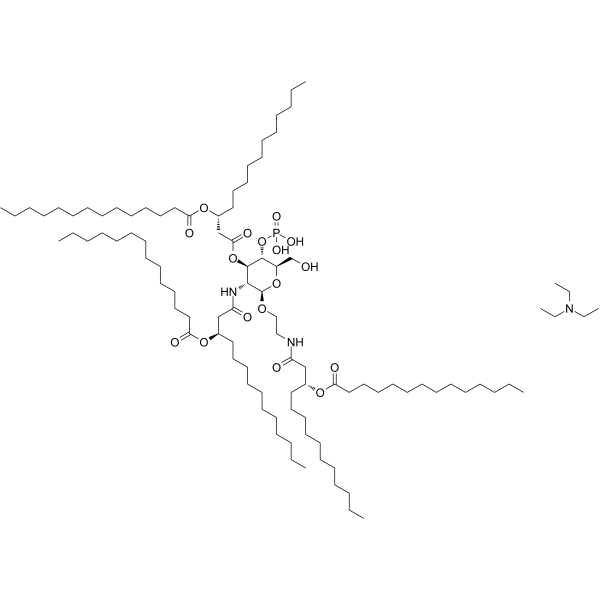
RIBI-529 (RC-529) is a fully synthetic, low-toxicity TLR4 agonist vaccine adjuvant. RIBI-529 upregulates cell surface co-stimulatory molecules, receptors, cytokines and chemokines, and activates the innate immune system. RIBI-529 enhances short-term CD4+ T cell clonal expansion, division, and ex vivo survival under growth factor withdrawal conditions. RIBI-529 enhances humoral and cell-mediated adaptive immune responses, induces non-specific resistance against viral and bacterial pathogens, and skews responses toward a Th1 type, accompanied by Th2 responses.
Nur für Forschungszwecke. Wir verkaufen nicht an Patienten.
- CAS. Nr.: 216014-46-9
- Formel: C98H190N3O17P
- Molecular Weight:1713.54
-
Speicherung:
Please store the product under the recommended conditions in the Certificate of Analysis.

To place orders, for customer services and technical support, please contact: MedChemExpress USA
Tel: 609-228-6898 E-mail: [email protected] [email protected]


-
 Biologische Aktivität
-
Chemical Information
- Protokoll
- Reinheit & Dokumentation
- Verweise
-
 Help & FAQs




Biologische Aktivität
Beschreibung
In Vitro
In Vivo
RIBI-529 (6.25-100 µg; s.c.; two doses) enhances humoral and cell-mediated immune responses to HBsAg in BALB/c mice, with peak antibody titers observed at 25 µg and robust CTL activity at 10 µg, shifting the immune response toward complement-fixing IgG2a antibodies[2].
MedChemExpress (MCE) has not independently confirmed the accuracy of these methods. They are for reference only.
-
Animal Model:B10.D2/nSnAi mice (specific pathogen-free)[1]
-
Dosage:1 μg, 3 μg, 10 μg, 30 μg, 100 μg
-
Administration:i.v.; single co-administration with OvaP
-
Result:Enhanced clonal expansion of CD4+/DO-11.10+ T cells to similar extents as LPS (HY-D1056) and MPL (HY-130320) at higher doses, with peak fold increases of 2-15 times above OvaP alone.
Increased the average number of CD4+/DO-11.10+ T cell divisions by 1-1.5 compared with OvaP alone, corresponding to a 4-12-fold increase in T cell yield.
Enhanced survival of activated CD4+/DO-11.10+ T cells during ex vivo growth factor withdrawal, resulting in ~20% cell viability after 20 hours of culture, compared with ~15% viability with OvaP alone.
-
Animal Model:B10.D2/nSnAi mice (specific pathogen-free)[1]
-
Dosage:30 μg (SAA testing); 1 μg, 3 μg, 10 μg, 30 μg, 100 μg (cytokine/chemokine testing)
-
Administration:i.v.; single injection (SAA testing); i.v.; single injection alone (cytokine/chemokine testing)
-
Result:Caused a 199-fold increase in serum SAA levels compared with vehicle control, and LPS is 50-fold more toxic than RIBI-529 when normalized to administered dose.
Resulted in an increase of 1000-1800 pg/mL IP-10 and 600-1000 pg/mL MCP-1 in serum, similar to levels induced by LPS and MPL.
-
Animal Model:B10.D2/nSnAi mice (specific pathogen-free)[1]
-
Dosage:10 μg
-
Administration:i.v.; two administrations: Day 0 and Day 21; co-administered with OvaP
-
Result:Resulted in a nearly twofold increase in the percentage of CD4+/DO-11.10+ T cells producing IFN-γ following recall challenge, compared with OvaP alone.
Induced a twofold increase in the total number of CD4+/DO-11.10+ T cells recovered post-challenge, compared with a 62-fold increase induced by 15 μg LPS.
-
Animal Model:BALB/c mice[2]
-
Dosage:6.25 µg (humoral response); 25 µg (peak antibody titers); 100 µg (humoral response); 10 µg (CTL activity)
-
Administration:s.c.; two doses
-
Result:Achieved total IgG end-point titer of 1,024,000, IgG1 end-point titer of 256,000, and IgG2a end-point titer of 1,024,000 at 6.25 µg.
Achieved total IgG end-point titer of 2,048,000, IgG1 end-point titer of 256,000, and IgG2a end-point titer of 2,048,000 at 25 µg.
Achieved total IgG end-point titer of 512,000, IgG1 end-point titer of 512,000, and IgG2a end-point titer of 256,000 at 100 µg.
Exhibited CTL specific killing of 78% at 50:1 effector:target ratio, 74% at 25:1, 52% at 12.5:1, and 29% at 6.25:1 at 10 µg.


Chemical Information
-
CAS. Nr. 216014-46-9
-
Molecular Weight 1713.54
-
Formel C98H190N3O17P
-
SMILES
CCN(CC)CC.CCCCCCCCCCCCCC(O[C@H](CCCCCCCCCCC)CC(O[C@@H]1[C@H]([C@@H](O[C@@H]([C@H]1OP(O)(O)=O)CO)OCCNC(C[C@@H](CCCCCCCCCCC)OC(CCCCCCCCCCCCC)=O)=O)NC(C[C@@H](CCCCCCCCCCC)OC(CCCCCCCCCCCCC)=O)=O)=O)=O
-
Synonyms
RC-529
-
Versand
Room temperature in continental US; may vary elsewhere.
-
Speicherung
Please store the product under the recommended conditions in the Certificate of Analysis.


Reinheit & Dokumentation
Verweise
[1]. Thompson BS, et al. The low-toxicity versions of LPS, MPL adjuvant and RC529, are efficient adjuvants for CD4+ T cells. Journal of leukocyte biology. 2005 Dec;78(6):1273-80. [Content Brief]
[2]. Evans JT, et al. Enhancement of antigen-specific immunity via the TLR4 ligands MPL adjuvant and Ribi.529. Expert review of vaccines. 2003 Apr;2(2):219-29. [Content Brief]

Calculators
Konzentration (Stammlösung) × Volumen (Stammlösung) = Konzentration (Ziellösung) × Volumen (Ziellösung)


RIBI-529 Related Classifications
HY-144002 Related Classifications
 Powered by Bioz