



Voxvoganan
Based on 1 publication(s) in Google Scholar
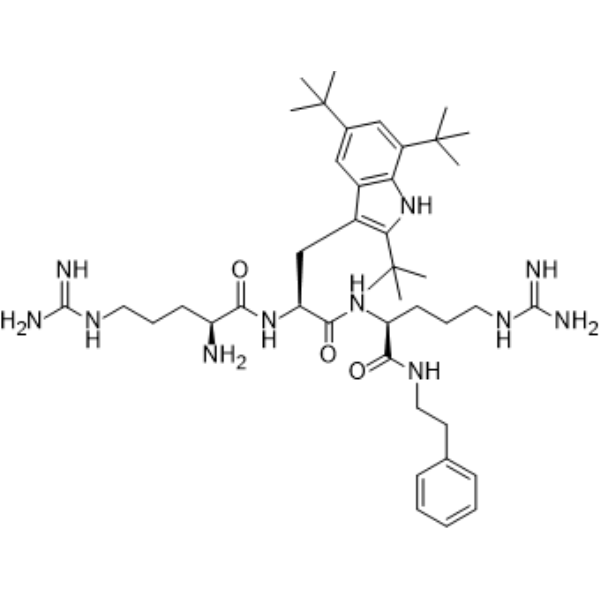
Voxvoganan (LTX-109), a topical antimicrobial, is highly effective against S. aureus with a MIC range of 2 to 4 μg/mL. Voxvoganan can be used for the research of bacterial skin infections, fungal infections and nasal decolonisation of MRSA.
Nur für Forschungszwecke. Wir verkaufen nicht an Patienten.
- CAS. Nr.: 1166254-80-3
- Formel: C43H69N11O3
- Molecular Weight:788.08
-
Speicherung:
Please store the product under the recommended conditions in the Certificate of Analysis.

To place orders, for customer services and technical support, please contact: MedChemExpress USA
Tel: 609-228-6898 E-mail: [email protected] [email protected]


-
 Biologische Aktivität
-
Chemical Information
- Protokoll
- Reinheit & Dokumentation
- Verweise
-
 Help & FAQs


Publications Citing Use of MedChemExpress (MCE) Voxvoganan
More

Biologische Aktivität
Beschreibung
Cellular Effect
|
Cell Line

|
Type | Value | Description | References |
|---|---|---|---|---|
| Erythrocyte | EC50 |
222 μM
Compound: peptide 1
|
Hemolytic activity in human RBC assessed as hemolysis rate incubated for 45 mins by spectrophotometric assay
Hemolytic activity in human RBC assessed as hemolysis rate incubated for 45 mins by spectrophotometric assay
|
[PMID: 37312845] |
| HeLa | IC50 |
46.6 μM
Compound: peptide 1
|
Cytotoxicity against human HeLa cells assessed as reduction in cell viability incubated for 24 hrs by PrestoBlue assay
Cytotoxicity against human HeLa cells assessed as reduction in cell viability incubated for 24 hrs by PrestoBlue assay
|
[PMID: 37312845] |
In Vitro
Voxvoganan (LTX-109) is an investigational antimicrobial agent with a membrane-lysing mechanism of action, based on the biological principle of innate immune effectors, lytic peptides. Voxvoganan has a rapid bactericidal lytic activity. Voxvoganan demonstrates in vitro bactericidal activity against a number of S. aureus isolates resistant to several classes of antimicrobial agents evaluated in this study[2].
Voxvoganan (LTX-109) is a broad-spectrum, fast-acting bactericidal antimicrobial agent that binds to negatively charged membrane components on the bacterial cell wall, which leads to membrane disruption and cell lysis. Voxvoganan is a first-in-class chemically synthesized, small peptide drug that is stable against protease degradation. Topical application of Voxvoganan has a good safety profile and a low bioavailability. Voxvoganan demonstrates good activity against Staphylococcus aureus strains that are susceptible and resistant to mupirocin[3].
MedChemExpress (MCE) has not independently confirmed the accuracy of these methods. They are for reference only.
Clinical Trial
| NCT Number | Sponsor | Condition | Start Date |
Phase
|
|---|---|---|---|---|
| NCT01329991 | 2011-05 | PHASE1 |


Chemical Information
-
CAS. Nr. 1166254-80-3
-
Molecular Weight 788.08
-
Formel C43H69N11O3
-
SMILES
O=C([C@H](CCCNC(N)=N)N)N[C@H](C(N[C@H](C(NCCC1=CC=CC=C1)=O)CCCNC(N)=N)=O)CC2=C(NC3=C2C=C(C=C3C(C)(C)C)C(C)(C)C)C(C)(C)C
-
Synonyms
LTX-109
-
Versand
Room temperature in continental US; may vary elsewhere.
-
Speicherung
Please store the product under the recommended conditions in the Certificate of Analysis.


Publications (1)
-
Journal Impact Factor
-
Most Recent
-
Cancer Res
TRAPPC4 Promotes GPX4 Stability to Drive Ferroptosis Resistance and Tumor Progression in Head and Neck Squamous Cell Carcinoma. [Abstract]2026 Jul 15;86(14):3436-3458. PMID: 41974002


Reinheit & Dokumentation
Verweise
[1]. Johan Isaksson, et al. A synthetic antimicrobial peptidomimetic (LTX 109): stereochemical impact on membrane disruption. J Med Chem. 2011 Aug 25;54(16):5786-95. [Content Brief]
[2]. Louis D Saravolatz, et al. In vitro activities of LTX-109, a synthetic antimicrobial peptide, against methicillin-resistant, vancomycin-intermediate, vancomycin-resistant, daptomycin-nonsusceptible, and linezolid-nonsusceptible Staphylococcus aureus. Antimicrob Agents Chemother. 2012 Aug;56(8):4478-82. [Content Brief]
[3]. L D Saravolatz, et al. Postantibiotic effect and postantibiotic sub-MIC effect of LTX-109 and mupirocin on Staphylococcus aureus blood isolates. Lett Appl Microbiol. 2017 Nov;65(5):410-413. [Content Brief]

Calculators
Konzentration (Stammlösung) × Volumen (Stammlösung) = Konzentration (Ziellösung) × Volumen (Ziellösung)


Voxvoganan Related Classifications
HY-119123 Related Classifications
 Powered by Bioz