



Anticancer agent 90
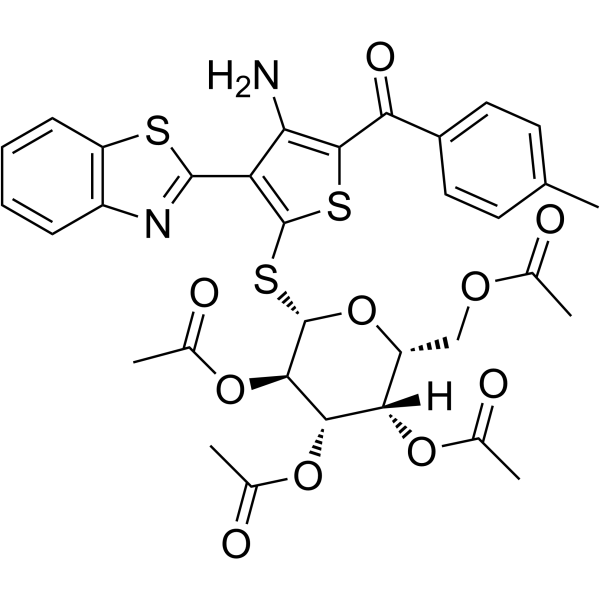
Anticancer agent 90 is a benzothiazole-2-thiophene S-glycoside derivative with antitumor activity. Anticancer agent 90 has high inhibition against the two cell line from ovarian cancer (OVCAR-4), renal cancer (A498).
Nos produits utilisent uniquement pour la recherche. Nous ne vendons pas aux patients.
- CAS No.: 2977251-03-7
- Formule: C33H32N2O10S3
- Masse moléculaire:712.81
-
Stockage:
Please store the product under the recommended conditions in the Certificate of Analysis.

To place orders, for customer services and technical support, please contact: MedChemExpress USA
Tel: 609-228-6898 E-mail: [email protected] [email protected]


-
 Activité biologique
-
Chemical Information
- Protocole
- Pureté et documentation
- Références
-
 Help & FAQs




Activité biologique
Description
In Vitro
Anticancer agent 90 (compound 6d) (0.01 mM; 24 h) has low cytotoxicity, shows high inhibition against two cell lines, SK-MEL-5, OVCAR-4[1].
MedChemExpress (MCE) has not independently confirmed the accuracy of these methods. They are for reference only. Further protocols information, click here.
-
Cell Line:FRHK-4, Hep2, BGM, Vero, and Huh 7.5 cell lines
-
Concentration:0-200 μg/mL
-
Incubation Time:24 hours
-
Result:Showed nontoxic under the doses of 100 μg/mL against FRHK-4, Hep2, BGM, Vero, and Huh 7.5 cells, respectively.
-
Cell Line:SK-MEL-5, OVCAR-4, and A498
-
Concentration:0.01 mM
-
Incubation Time:24 hours
-
Result:Inhibited SK-MEL-5 and OVCAR-4 cell viability by 30.64% and 30.71%, respectively.


Chemical Information
-
CAS No. 2977251-03-7
-
Masse moléculaire 712.81
-
Formule C33H32N2O10S3
-
SMILES
[H][C@]1([C@@H]([C@H]([C@@H](O[C@@H]1COC(C)=O)SC2=C(C(N)=C(S2)C(C3=CC=C(C=C3)C)=O)C4=NC5=C(S4)C=CC=C5)OC(C)=O)OC(C)=O)OC(C)=O
-
Livraison
Room temperature in continental US; may vary elsewhere.
-
Stockage
Please store the product under the recommended conditions in the Certificate of Analysis.

Protocole
-
Subcutaneous Cell-Line-Derived Xenograft
Subcutaneous cell-line-derived xenograft (CDX) models are established by implanting cultured human cancer cell lines into immunodeficient mice, where the injected cells form localized tumors that can be monitored in vivo as a measure of tumorigenic potential, growth kinetics, and treatment response. These models are widely used in oncology research because they allow reproducible tumor formation and enable comparative assessment of tumor growth between different cell lines or genetic manipulations in a controlled in vivo microenvironment. Subcutaneous implantation of cancer cells in immunodeficient mice is a standard approach for evaluating tumor growth behavior and therapeutic response across multiple cancer types, including prostate, esophageal, pancreatic, and colon cancer models.


Pureté et documentation
Références

Calculators
Concentration (start) × Volume (start) = Concentration (final) × Volume (final)


Anticancer agent 90 Related Classifications
HY-151588 Related Classifications
 Powered by Bioz