



pH Receptor Probe
Based on 1 publication(s) in Google Scholar
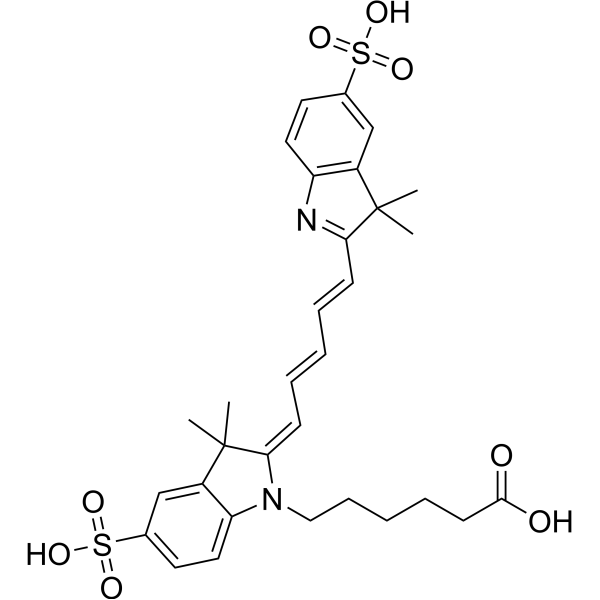
pH Receptor Probe is a pH-sensitive cyanine derivative and a environmental sensitive fluorophore. pH Receptor Probe has a pH-sensitive maximal absorption at 644 nm and emission at 664 nm. pH Receptor Probe has been used as a pH sensor of lysosomal compartments.
For research use only. We do not sell to patients.
- Purity : 98.40%
- CAS No.: 312961-83-4
- Formula: C31H36N2O8S2
- Molecular Weight:628.76
-
Storage:
4°C, protect from light
* In solvent : -80°C, 6 months; -20°C, 1 month (protect from light)

To place orders, for customer services and technical support, please contact: MedChemExpress USA
Tel: 609-228-6898 E-mail: [email protected] [email protected]


-
 Biological Activity
-
Chemical Information
-
Solvent & Solubility
- Protocols
- Purity & Documentation
- References
-
 Help & FAQs


Publications Citing Use of MedChemExpress (MCE) pH Receptor Probe
More

Biological Activity
Description
In Vitro
pH Receptor Probe technology utilizes the general ability of GPCRs to be internalized into the endosomal pathway of a cell in response to agonist ligands. The pH Receptor Probe dye is fluorescent in acidic environments, but nonfluorescent at neutral pH. When pH Receptor Probe is bound to a receptor on the extracellular surface of the cell, it is essentially nonfluorescent. On internalization into a cell, it displays a significant increase in fluorescence[1].
MedChemExpress (MCE) has not independently confirmed the accuracy of these methods. They are for reference only. Further protocols information, click here.


Chemical Information
-
CAS No. 312961-83-4
-
Appearance Solid
-
Molecular Weight 628.76
-
Formula C31H36N2O8S2
-
Color Brown to reddish brown
-
SMILES
O=C(CCCCCN1C2=CC=C(S(=O)(O)=O)C=C2C(C)(C)/C1=C\C=C\C=C\C3=NC4=C(C3(C)C)C=C(S(=O)(O)=O)C=C4)O
-
Shipping
Room temperature in continental US; may vary elsewhere.
-
Storage
4°C, protect from light
* In solvent : -80°C, 6 months; -20°C, 1 month (protect from light)


Publications (1)
-
Journal Impact Factor
-
Most Recent


Solvent & Solubility
In Vitro:
DMSO : 83.33 mg/mL (132.53 mM; Need ultrasonic; Hygroscopic DMSO has a significant impact on the solubility of product, please use newly opened DMSO)
Please refer to the solubility information to select the appropriate solvent. Once prepared, please aliquot and store the solution to prevent product inactivation from repeated freeze-thaw cycles.
Storage method and period of stock solution: -80°C, 6 months; -20°C, 1 month (protect from light). When stored at -80°C, please use it within 6 months. When stored at -20°C, please use it within 1 month.
Please refer to the solubility information to select the appropriate solvent. Once prepared, please aliquot and store the solution to prevent product inactivation from repeated freeze-thaw cycles.
Storage method and period of stock solution: -80°C, 6 months; -20°C, 1 month (protect from light). When stored at -80°C, please use it within 6 months. When stored at -20°C, please use it within 1 month.
Concentration (start) × Volume (start) = Concentration (final) × Volume (final)

Protocols
-
Lysosome and acidic-vesicle live-cell staining
Lysosome and acidic-vesicle live-cell staining detects acidic intracellular compartments by using membrane-permeant acidotropic probes that accumulate in low-pH vesicles, including lysosomes, late endosomes, autolysosomes, and acidic phagosomes. LysoTracker staining is commonly used as an intensity-based readout of acidic lysosomal compartment abundance or enlargement, while acridine orange produces green fluorescence in less concentrated compartments and red fluorescence after concentration-dependent accumulation in acidic vesicular organelles. Loss or reduction of acridine-orange red signal can be used as a readout of lysosomal membrane permeabilization or reduced acidic-vesicle integrity. This protocol is designed for live cultured cells and can be adapted for fluorescence microscopy, high-content imaging, plate-reader readout, or flow cytometry when the selected literature supports the readout. Because these dyes report acidotropic accumulation rather than lysosome identity alone,


Purity & Documentation
-
Data Sheet (276 KB)
-
SDS (252 KB)
- English - EN (252 KB)
- Français - FR (252 KB)
- Deutsch - DE (252 KB)
- Norwegian - NO (252 KB)
- Español - ES (252 KB)
- Swedish - SV (252 KB)
- Italian - IT (252 KB)
- Korean - KR (252 KB)
- Portuguese - PT (252 KB)
-
Handling Instructions (2659 KB)
References
[1]. Patrick MJ, et al. Intracellular pH measurements using perfluorocarbon nanoemulsions. J Am Chem Soc. 2013 Dec 11;135(49):18445-57. [Content Brief]
[2]. Elaine J Adie, et al. CypHer 5: a generic approach for measuring the activation and trafficking of G protein-coupled receptors in live cells. Assay Drug Dev Technol. 2003 Apr;1(2):251-9. [Content Brief]


Complete Stock Solution Preparation Table
Please refer to the solubility information to select the appropriate solvent. Once prepared, please aliquot and store the solution to prevent product inactivation from repeated freeze-thaw cycles.
Storage method and period of stock solution: -80°C, 6 months; -20°C, 1 month (protect from light). When stored at -80°C, please use it within 6 months. When stored at -20°C, please use it within 1 month.
| Optional Solvent | Concentration Solvent Mass | 1 mg | 5 mg | 10 mg | 25 mg |
|---|---|---|---|---|---|
| DMSO | 1 mM | 1.5904 mL | 7.9522 mL | 15.9043 mL | 39.7608 mL |
| 5 mM | 0.3181 mL | 1.5904 mL | 3.1809 mL | 7.9522 mL | |
| 10 mM | 0.1590 mL | 0.7952 mL | 1.5904 mL | 3.9761 mL | |
| 15 mM | 0.1060 mL | 0.5301 mL | 1.0603 mL | 2.6507 mL | |
| 20 mM | 0.0795 mL | 0.3976 mL | 0.7952 mL | 1.9880 mL | |
| 25 mM | 0.0636 mL | 0.3181 mL | 0.6362 mL | 1.5904 mL | |
| 30 mM | 0.0530 mL | 0.2651 mL | 0.5301 mL | 1.3254 mL | |
| 40 mM | 0.0398 mL | 0.1988 mL | 0.3976 mL | 0.9940 mL | |
| 50 mM | 0.0318 mL | 0.1590 mL | 0.3181 mL | 0.7952 mL | |
| 60 mM | 0.0265 mL | 0.1325 mL | 0.2651 mL | 0.6627 mL | |
| 80 mM | 0.0199 mL | 0.0994 mL | 0.1988 mL | 0.4970 mL | |
| 100 mM | 0.0159 mL | 0.0795 mL | 0.1590 mL | 0.3976 mL |


pH Receptor Probe Related Classifications
HY-D1563 Related Classifications
 Powered by Bioz