



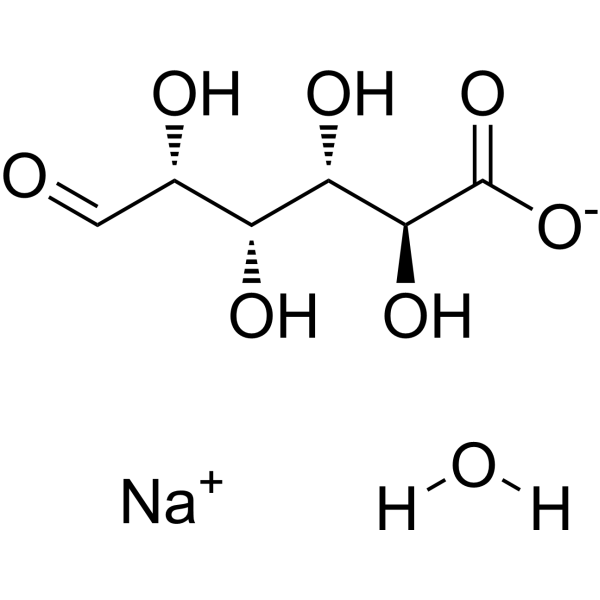
D-Glucuronic acid sodium salt monohydrate
Based on 1 publication(s) in Google Scholar
D-Glucuronic acid sodium salt monohydrate is a major component of many anti-inflammatory proteoglycans, which can promote embryonic development and inhibit cell aggregation. After being metabolized into ethyl glucuronide (HY-113093), D-Glucuronic acid sodium salt monohydrate activates Toll-like receptor 4 (TLR4), causing pain. D-Glucuronic acid sodium salt monohydrate and its derivative glucurono-lactone can serve as liver detoxifiers, and its derivatives also possess anti-tumor activity.
For research use only. We do not sell to patients.
- Purity : 98.0%
- CAS No.: 207300-70-7
- Formula: C6H11NaO8
- Molecular Weight:234.14
-
Storage:
4°C, stored under nitrogen, away from moisture
* In solvent : -80°C, 6 months; -20°C, 1 month (stored under nitrogen, away from moisture)

To place orders, for customer services and technical support, please contact: MedChemExpress USA
Tel: 609-228-6898 E-mail: [email protected] [email protected]


-
 Biological Activity
-
Chemical Information
-
Solvent & Solubility
- Purity & Documentation
- References
-
 Help & FAQs


Publications Citing Use of MedChemExpress (MCE) D-Glucuronic acid sodium salt monohydrate
MoreAll Endogenous Metabolite Isoforms
More

Biological Activity
Description
IC50 & Target
|
Human Endogenous Metabolite |
TLR4 |
In Vitro
D-Glucuronic acid sodium salt monohydrate (0.05 mM, 22 h) can promote early embryonic development of pig oocytes[3]. A high concentration of D-Glucuronic acid sodium salt monohydrate (7 mM, 6 h) significantly inhibits the aggregation factor (AF)-mediated aggregation of GEODIA cells[4][5].
MedChemExpress (MCE) has not independently confirmed the accuracy of these methods. They are for reference only.
-
Cell Line:Pig oocytes
-
Concentration:0.05 mM
-
Incubation Time:22 h
-
Result:Had beneficial effects on cumulus expansion, perivitelline space thickness, cytoplasmic maturation, reactive oxygen species level, cortical granule exocytosis, and early embryonic development after parthenogenesis and somatic cell nuclear transfer.
In Vivo
MedChemExpress (MCE) has not independently confirmed the accuracy of these methods. They are for reference only.
-
Animal Model:Sprague-Dawley rats (325-375 g)[6]
-
Dosage:0.32 μg
-
Administration:Intrathecal injection (i.t.), single dose
-
Result:Caused a significant allodynia 3 hours post injection, which was blocked by coadministered LPS-RS (Lipid A from Rhodobacter sphaeroides, a type of lipopolysaccharide (LPS) that acts as an antagonist to Toll-like receptor 4 (TLR4)).


Chemical Information
-
CAS No. 207300-70-7
-
Appearance Solid
-
Molecular Weight 234.14
-
Formula C6H11NaO8
-
Color White to off-white
-
SMILES
O=C[C@@H]([C@H]([C@@H]([C@@H](C([O-])=O)O)O)O)O.[H]O[H].[Na+]
-
Structure Classification
-
Initial Source
-
Shipping
Room temperature in continental US; may vary elsewhere.
-
Storage
4°C, stored under nitrogen, away from moisture
* In solvent : -80°C, 6 months; -20°C, 1 month (stored under nitrogen, away from moisture)


Publications (1)
-
Journal Impact Factor
-
Most Recent
-
Food Chem
Discovery of novel ascorbic acid derivatives and other metabolites in fruit of Rosa roxburghii Tratt through untargeted metabolomics and feature-based molecular networking. [Abstract]2023 Mar 30;405(Pt A):134807. PMID: 36370576


Solvent & Solubility
In Vitro:
DMSO : 10 mg/mL (42.71 mM; ultrasonic and warming and heat to 60°C; Hygroscopic DMSO has a significant impact on the solubility of product, please use newly opened DMSO)
Please refer to the solubility information to select the appropriate solvent. Once prepared, please aliquot and store the solution to prevent product inactivation from repeated freeze-thaw cycles.
Storage method and period of stock solution: -80°C, 6 months; -20°C, 1 month (stored under nitrogen, away from moisture). When stored at -80°C, please use it within 6 months. When stored at -20°C, please use it within 1 month.
Please refer to the solubility information to select the appropriate solvent. Once prepared, please aliquot and store the solution to prevent product inactivation from repeated freeze-thaw cycles.
Storage method and period of stock solution: -80°C, 6 months; -20°C, 1 month (stored under nitrogen, away from moisture). When stored at -80°C, please use it within 6 months. When stored at -20°C, please use it within 1 month.
Concentration (start) × Volume (start) = Concentration (final) × Volume (final)


Purity & Documentation
-
Data Sheet (279 KB)
-
SDS (394 KB)
- English - EN (394 KB)
- Français - FR (394 KB)
- Deutsch - DE (394 KB)
- Norwegian - NO (394 KB)
- Español - ES (394 KB)
- Swedish - SV (394 KB)
- Italian - IT (394 KB)
- Korean - KR (394 KB)
- Portuguese - PT (394 KB)
-
Handling Instructions (2659 KB)
References
[1]. Teng F, et al. Production of d-glucuronic acid from myo-inositol using Escherichia coli whole-cell biocatalyst overexpressing a novel myo-inositol oxygenase from Thermothelomyces thermophile. Enzyme Microb Technol. 2019 Aug;127:70-74. [Content Brief]
[2]. el-Nezhawy AO, et al. Design, synthesis and antitumor activity of novel D-Glucuronic acid sodium salt monohydrate derivatives. Med Chem. 2011 Nov;7(6):624-38. [Content Brief]
[3]. Lee J, et al. Effect of D-Glucuronic acid sodium salt monohydrate and N-acetyl-D-Glucosamine Treatment during In Vitro Maturation on Embryonic Development after Parthenogenesis and Somatic Cell Nuclear Transfer in Pigs. Animals (Basel). 2021 Apr 6;11(4):1034. [Content Brief]
[4]. Müller WE, et al. Purification and characterization of a species-specific aggregation factor in sponges. Exp Cell Res. 1973 Jul;80(1):95-104. [Content Brief]
[5]. Vaith P, et al. On the role of D-Glucuronic acid sodium salt monohydrate in the aggregation of cells from the marine sponge Geodia cydonium. Dev Comp Immunol. 1979 Spring;3(2):259-75. [Content Brief]
[6]. Lewis SS, et al. Glucuronic acid and the ethanol metabolite ethyl-glucuronide cause toll-like receptor 4 activation and enhanced pain. Brain Behav Immun. 2013 May;30:24-32. [Content Brief]


Complete Stock Solution Preparation Table
Please refer to the solubility information to select the appropriate solvent. Once prepared, please aliquot and store the solution to prevent product inactivation from repeated freeze-thaw cycles.
Storage method and period of stock solution: -80°C, 6 months; -20°C, 1 month (stored under nitrogen, away from moisture). When stored at -80°C, please use it within 6 months. When stored at -20°C, please use it within 1 month.
| Optional Solvent | Concentration Solvent Mass | 1 mg | 5 mg | 10 mg | 25 mg |
|---|---|---|---|---|---|
| DMSO | 1 mM | 4.2709 mL | 21.3547 mL | 42.7095 mL | 106.7737 mL |
| 5 mM | 0.8542 mL | 4.2709 mL | 8.5419 mL | 21.3547 mL | |
| 10 mM | 0.4271 mL | 2.1355 mL | 4.2709 mL | 10.6774 mL | |
| 15 mM | 0.2847 mL | 1.4236 mL | 2.8473 mL | 7.1182 mL | |
| 20 mM | 0.2135 mL | 1.0677 mL | 2.1355 mL | 5.3387 mL | |
| 25 mM | 0.1708 mL | 0.8542 mL | 1.7084 mL | 4.2709 mL | |
| 30 mM | 0.1424 mL | 0.7118 mL | 1.4236 mL | 3.5591 mL | |
| 40 mM | 0.1068 mL | 0.5339 mL | 1.0677 mL | 2.6693 mL |


D-Glucuronic acid sodium salt monohydrate Related Classifications
HY-N6612A Related Classifications
 Powered by Bioz