



DA-JC4
Based on 1 publication(s) in Google Scholar
DA-JC4 is a dual GLP-1/GIP receptor agonist and can be used for the research of neurological disease and insulin signaling pathways.
For research use only. We do not sell to patients.
- Purity : 99.27%
- CAS No.: 2315504-40-4
- Formula: C225H346N56O65
- Molecular Weight:4875.49
-
Storage:
Sealed storage, away from moisture and light, under nitrogen.
Powder -80°C, 2 years , -20°C, 1 year* In solvent : -80°C, 6 months; -20°C, 1 month (sealed storage, away from moisture and light, under nitrogen)


To place orders, for customer services and technical support, please contact: MedChemExpress USA
Tel: 609-228-6898 E-mail: [email protected] [email protected]


-
 Biological Activity
-
Chemical Information
-
Solvent & Solubility
- Protocols
- Purity & Documentation
- References
-
 Help & FAQs


-

HY-P0035
Insulin (human)Recombinant Human Insulin -
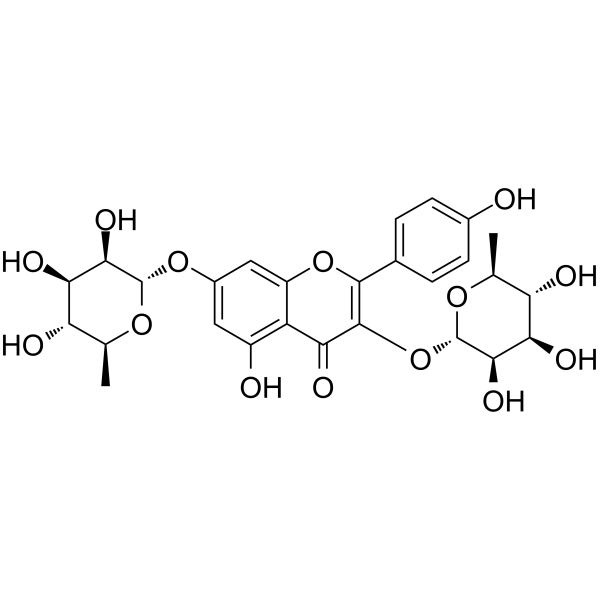
HY-N0628
KaempferitrinInsulin Receptor Activator -

HY-P3579
Gastric Inhibitory Peptide, porcineInsulinotropic Polypeptide -
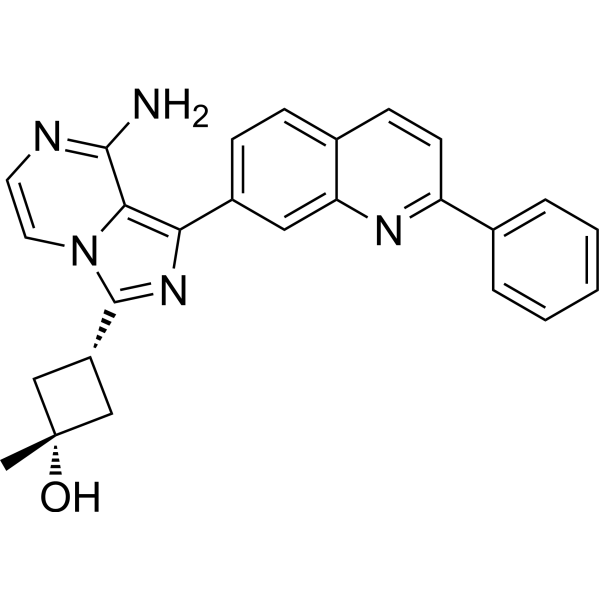
HY-10191
LinsitinibIGF-1R/Insulin Receptor Inhibitor -
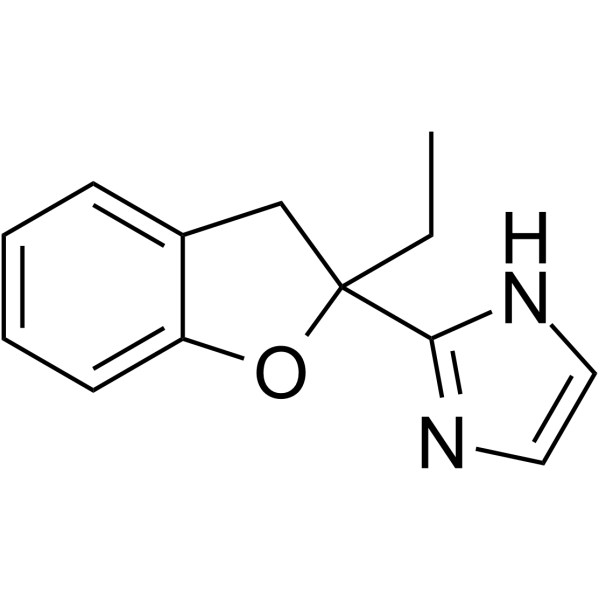
HY-15481
KU14RKATP Channel Inhibitor -
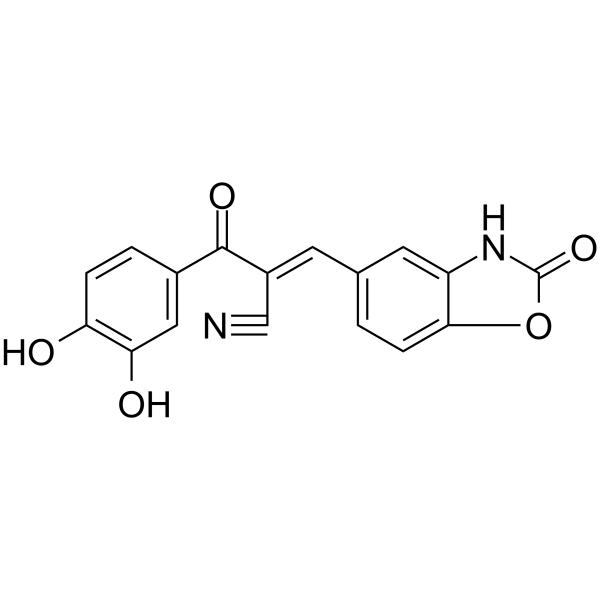
HY-112720
AGL-2263Insulin Receptor Inhibitor -

HY-P2093
S961Insulin Receptor Antagonist -

HY-108743
Insulin degludecInsulin Analogue -
HY-119152
CMX-2043α-Lipoic Acid Analogue -

HY-P2542
GIP (3-42), humanGIP Receptor Agonist -

HY-P99665
Insulin efsitora alfaInsulin Receptor Agonist -
HY-115461
MID-1MG53-IRS-1 Interaction Disruptor
Publications Citing Use of MedChemExpress (MCE) DA-JC4
More

Biological Activity
Description
IC50 & Target
GLP-1/GIP[1]
In Vitro
DA-JC4 (1~100 nM; hippocampal cells) inhibits rotenone-induced hippocampal neuron death and significantly suppresses Cyt C, Bax and Caspase activation[3].
MedChemExpress (MCE) has not independently confirmed the accuracy of these methods. They are for reference only. Further protocols information, click here.
In Vivo
DA-JC4 (25 nmol/kg; i.p.; 6 days) shows high levels expression of tyrosine Hydroxylase in the s. nigra and increases expression of neuroprotective growth factor Glial-Derived Neurotrophic Factor (GDNF)[2].
DA-JC4 (50 nmol/kg; i.p.; once-daily for 7 days) improves Parkinson's disease symptom potentially and enhances neurotransmission[3].
MedChemExpress (MCE) has not independently confirmed the accuracy of these methods. They are for reference only.
-
Animal Model:Male Sprague-Dawley rats (210–230 g)
-
Dosage:10 nmol/kg
-
Administration:I.p.
-
Result:Significantly prevented spatial learning deficits in a Y- maze test and Morris water maze tests, and decreased phosphorylated tau levels in the rat cerebral cortex and hippocampus.
-
Animal Model:Adult male C57BL/6 mice (8 week-old)
-
Dosage:25 nmol/kg/day
-
Administration:I.p.
-
Result:Showed high levels expression of tyrosine Hydroxylase in the s. nigra and increased expression of neuroprotective growth factor Glial-Derived Neurotrophic Factor (GDNF).
-
Animal Model:Adult male Sprague-Dawley (SD) rats (230-280 g)
-
Dosage:50 nmol/kg
-
Administration:I.p.
-
Result:Improved Parkinson's disease symptom potentially and enhanced neurotransmission.


Chemical Information
-
CAS No. 2315504-40-4
-
Appearance Solid
-
Molecular Weight 4875.49
-
Formula C225H346N56O65
-
Color White to off-white
-
Sequence
Tyr-{Aib}-Glu-Gly-Thr-Phe-Thr-Ser-Asp-Tyr-Ser-Ile-Tyr-Leu-Asp-Lys-Gln-Ala-Ala-{Aib}-Glu-Phe-Val-Asn-Trp-Leu-Leu-Ala-Gly-Gly-Pro-Ser-Ser-Gly-Ala-Pro-Pro-Pro-Ser-Lys-Lys-Lys-Lys-Lys-Lys-NH2
-
Sequence Shortening
Y-{Aib}-EGTFTSDYSIYLDKQAA-{Aib}-EFVNWLLAGGPSSGAPPPSKKKKKK-NH2
-
Shipping
Room temperature in continental US; may vary elsewhere.
-
Storage
Sealed storage, away from moisture and light, under nitrogen
Powder -80°C 2 years -20°C 1 year * In solvent : -80°C, 6 months; -20°C, 1 month (sealed storage, away from moisture and light, under nitrogen)


Publications (1)
-
Journal Impact Factor
-
Most Recent
-
bioRxiv
2024 Jun 10:2024.06.09.596693. PMID: 38915509


Solvent & Solubility
In Vitro:
DMSO : 25 mg/mL (5.13 mM; Need ultrasonic; Hygroscopic DMSO has a significant impact on the solubility of product, please use newly opened DMSO)
Please refer to the solubility information to select the appropriate solvent. Once prepared, please aliquot and store the solution to prevent product inactivation from repeated freeze-thaw cycles.
Storage method and period of stock solution: -80°C, 6 months; -20°C, 1 month (sealed storage, away from moisture and light, under nitrogen). When stored at -80°C, please use it within 6 months. When stored at -20°C, please use it within 1 month.
Please refer to the solubility information to select the appropriate solvent. Once prepared, please aliquot and store the solution to prevent product inactivation from repeated freeze-thaw cycles.
Storage method and period of stock solution: -80°C, 6 months; -20°C, 1 month (sealed storage, away from moisture and light, under nitrogen). When stored at -80°C, please use it within 6 months. When stored at -20°C, please use it within 1 month.
Concentration (start) × Volume (start) = Concentration (final) × Volume (final)

Protocols
-
Research Protocol for Endocrine Diseases
Endocrine diseases often arise from disrupted hormone production, hormone signaling, or target-tissue responsiveness; for diabetes-focused endocrine disease models, insulin signaling regulates glucose uptake, hepatic glucose output, lipid metabolism, and β-cell compensation. Type 2 diabetes develops through interacting defects in insulin resistance, β-cell dysfunction, adipose inflammation, hepatic glucose overproduction, altered incretin signaling, and ectopic lipid metabolism. A major unresolved question is whether endocrine dysfunction is driven primarily by target-tissue insulin resistance, intrinsic β-cell failure, immune/inflammatory stress, or combined multi-organ failure that differs by disease stage.
-
Research Protocol for Neurological Diseases
PINK1/Parkin-mediated mitophagy pathway is a mitochondrial quality-control signaling axis in which mitochondrial depolarization stabilizes PINK1 on damaged mitochondria, activates Parkin recruitment and E3 ubiquitin ligase activity, promotes ubiquitination of outer mitochondrial membrane proteins, recruits selective autophagy adaptors, and drives lysosomal degradation of damaged mitochondria. In neurological disease research, this pathway is experimentally important because neurons, especially dopaminergic neurons, are highly dependent on mitochondrial integrity, and defective mitochondrial turnover can lead to mitochondrial dysfunction, oxidative stress, impaired neuronal survival, α-synuclein accumulation, and neuroinflammatory damage-associated signals. The genetic disease link is strongest in Parkinson’s disease because mutations in PRKN/parkin cause autosomal recessive juvenile parkinsonism, mutations in PINK1 cause hereditary early-onset Parkinson’s disease, and Drosophila studie


Purity & Documentation
-
Data Sheet (278 KB)
-
SDS (254 KB)
- English - EN (254 KB)
- Français - FR (254 KB)
- Deutsch - DE (254 KB)
- Norwegian - NO (254 KB)
- Español - ES (254 KB)
- Swedish - SV (254 KB)
- Italian - IT (254 KB)
- Korean - KR (254 KB)
- Portuguese - PT (254 KB)
-
Handling Instructions (2659 KB)
References
[1]. Shi L, et al. A novel dual GLP-1/GIP receptor agonist alleviates cognitive decline by re-sensitizing insulin signaling in the Alzheimer icv. STZ rat model. Behav Brain Res. 2017;327:65-74. [Content Brief]
[2]. Feng P, et al. Two novel dual GLP-1/GIP receptor agonists are neuroprotective in the MPTP mouse model of Parkinson's disease. Neuropharmacology. 2018;133:385-394. [Content Brief]
[3]. Li T, et al. Neuroprotection of GLP-1/GIP receptor agonist via inhibition of mitochondrial stress by AKT/JNK pathway in a Parkinson's disease model. Life Sci. 2020;256:117824. [Content Brief]


Complete Stock Solution Preparation Table
Please refer to the solubility information to select the appropriate solvent. Once prepared, please aliquot and store the solution to prevent product inactivation from repeated freeze-thaw cycles.
Storage method and period of stock solution: -80°C, 6 months; -20°C, 1 month (sealed storage, away from moisture and light, under nitrogen). When stored at -80°C, please use it within 6 months. When stored at -20°C, please use it within 1 month.
| Optional Solvent | Concentration Solvent Mass | 1 mg | 5 mg | 10 mg | 25 mg |
|---|---|---|---|---|---|
| DMSO | 1 mM | 0.2051 mL | 1.0255 mL | 2.0511 mL | 5.1277 mL |
| 5 mM | 0.0410 mL | 0.2051 mL | 0.4102 mL | 1.0255 mL |


DA-JC4 Related Classifications
HY-P3255 Related Classifications
 Powered by Bioz