



Depatuxizumab mafodotin
Based on 1 publication(s) in Google Scholar
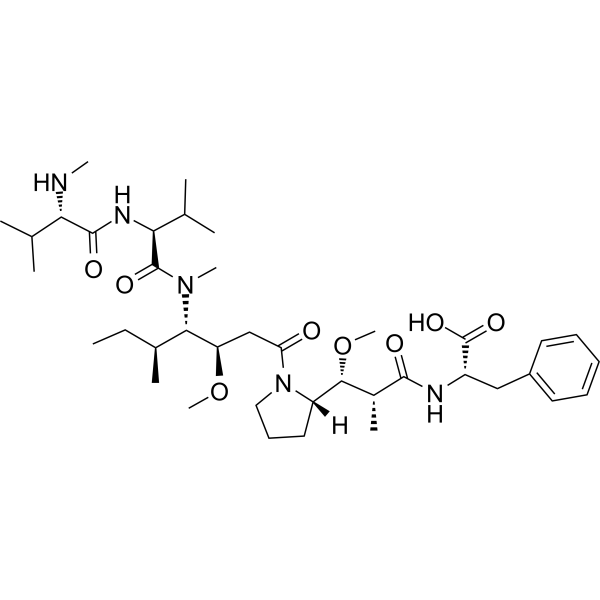
Depatuxizumab mafodotin (ABT-414) is an antibody-drug conjugate (ADC). Depatuxizumab mafodotin specifically targets the epidermal growth factor receptor (EGFR). Depatuxizumab mafodotin can be used in the study of glioma, head and neck squamous cell carcinoma, non-small cell lung cancer, epidermoid carcinoma of the skin, and squamous cell carcinoma of the tongue.
For research use only. We do not sell to patients.
- Purity : 99.65%
- CAS No.: 1585973-65-4
-
Storage:
-80°C, protect from light


To place orders, for customer services and technical support, please contact: MedChemExpress USA
Tel: 609-228-6898 E-mail: [email protected] [email protected]


-
 Biological Activity
-
Chemical Information
- Purity & Documentation
- References
-
 Help & FAQs


-

HY-141598
Datopotamab deruxtecan (solution) -

HY-132254
Sacituzumab govitecan -

HY-138298A
Trastuzumab deruxtecan -

HY-141601
Telisotuzumab vedotin -

HY-P9985
Disitamab vedotin -

HY-P99829
Cofetuzumab pelidotin -

HY-138298
Trastuzumab deruxtecan (solution) -

HY-132254A
Sacituzumab govitecan (solution) -
HY-15579
MMAF -

HY-P99001
Human IgG1 kappa, Isotype Control -

HY-P99016B
Enfortumab vedotin-ejfv (solution) -

HY-P99016A
Enfortumab vedotin-ejfv
Publications Citing Use of MedChemExpress (MCE) Depatuxizumab mafodotin
MoreAll EGFR Isoforms
More

Biological Activity
Description
In Vitro
Depatuxizumab mafodotin (up to 10 nM; up to 72 h) can induce cell death in glioma cell lines overexpressing EGFR or EGFRvIII[2].
Depatuxizumab mafodotin (0-3.38 nM; 72 h) induces cell death in a dose-dependent manner in human head and neck squamous cell carcinoma (HNSCC) cell lines (UMSCC47 and FaDu) with high EGFR expression, with IC50 values of 0.213 nM and 0.167 nM for UMSCC47 and FaDu cell lines, respectively[3].
Depatuxizumab mafodotin exhibits significant cytotoxicity against tumor cell lines overexpressing wild-type or mutant forms of EGFR[4].
MedChemExpress (MCE) has not independently confirmed the accuracy of these methods. They are for reference only.
In Vivo
Depatuxizumab mafodotin (4 mg/kg; i.p.; every 4 days; 4 times in total) significantly inhibits tumor growth in female nude mice xenografted with the FaDu cell line[3].
Depatuxizumab mafodotin (1-10 mg/kg; once every 4 days; a total of 6 administrations) significantly delays tumor growth or inhibits tumor growth in mice bearing a variety of human tumor xenografts (such as A431, NCI-H1703, HCC827.ER.LMC, SCC-15), and can cause tumor regression and cure in some models[4].
MedChemExpress (MCE) has not independently confirmed the accuracy of these methods. They are for reference only.
-
Animal Model:Immunocompromised CD1 nude mice with LN-229 EGFRvIII cell orthotopic xenograft model[2]
-
Dosage:8 mg/kg
-
Administration:Intraperitoneal administration, every 4 days, for a total of six doses
-
Result:Specifically and profoundly prolonged the survival of mice carrying EGFRvIII-expressing tumors.
Caused the loss of EGFRvIII expression in tumors.
Still caused loss of EGFRvIII several weeks after treatment ends.
-
Animal Model:Female SCID, SCID-Beige, and nude mice (weight: 20-22 g upon arrival, 6-8-week-old when tumor cells were implanted), U87MGde2-7 glioblastoma multiforme model, SN0199 and SN0207 glioblastoma multiforme patient-derived xenograft models. A431, NCI-H1703, HCC827.ER.LMC, SCC-15, LoVo, NCI-H441, SW48, A549, HCT-15 xenograft models[4]
-
Dosage:0.5, 1, 2, 3, 4, 10 mg/kg
-
Administration:once every 4 days, a total of 6 administrations
-
Result:Led to complete tumor regression and cure in the U87MGde2-7 glioblastoma model.
Caused significant tumor growth inhibition and regression in the SN0199 and SN0207 glioblastoma multiforme patient-derived xenograft models.
Did not show significant effects in some models like A549 and HCT-15 with lower levels of EGFR.
Clinical Trial
| NCT Number | Sponsor | Condition | Start Date |
Phase

|
|---|---|---|---|---|
| NCT01329991 | Plexxikon| | 2011-05 | PHASE1 |


Chemical Information
-
CAS No. 1585973-65-4
-
Appearance Liquid
-
Color Colorless to light yellow
-
SMILES
[Depatuxizumab mafodotin]
-
Synonyms
ABT-414
-
Shipping
Shipping with dry ice.
-
Storage
-80°C, protect from light


Publications (1)
-
Journal Impact Factor
-
Most Recent
-
Sci Adv
Monitoring glioblastoma extracellular vesicle evolution using a nanodiagnostic platform to detect glioma stem cells driving recurrent disease. [Abstract]2026 Jan 30;12(5):eadt2804. PMID: 41616062


Purity & Documentation
-
Data Sheet (271 KB)
-
SDS (251 KB)
- English - EN (251 KB)
- Français - FR (251 KB)
- Deutsch - DE (251 KB)
- Norwegian - NO (251 KB)
- Español - ES (251 KB)
- Swedish - SV (251 KB)
- Italian - IT (251 KB)
- Korean - KR (251 KB)
- Portuguese - PT (251 KB)
-
Handling Instructions (2659 KB)
References
[1]. Padovan M, et al. Depatuxizumab Mafodotin (Depatux-M) Plus Temozolomide in Recurrent Glioblastoma Patients: Real-World Experience from a Multicenter Study of Italian Association of Neuro-Oncology (AINO). Cancers (Basel). 2021 Jun 3;13(11):2773. [Content Brief]
[2]. von Achenbach C, et al. Depatuxizumab Mafodotin (ABT-414)-induced Glioblastoma Cell Death Requires EGFR Overexpression, but not EGFRY1068 Phosphorylation. Mol Cancer Ther. 2020 Jun;19(6):1328-1339. [Content Brief]
[3]. Mani L, et al. Efficacy of depatuxizumab mafodotin (ABT-414) in preclinical models of head and neck cancer. Carcinogenesis. 2024 Jul 8;45(7):520-526. [Content Brief]
[4]. Phillips AC, et al. ABT-414, an Antibody-Drug Conjugate Targeting a Tumor-Selective EGFR Epitope. Mol Cancer Ther. 2016 Apr;15(4):661-9. [Content Brief]
[5]. Goss G D, et al. Efficacy and safety results of depatuxizumab mafodotin (ABT‐414) in patients with advanced solid tumors likely to overexpress epidermal growth factor receptor[J]. Cancer, 2018, 124(10): 2174-2183. [Content Brief]

Calculators
Concentration (start) × Volume (start) = Concentration (final) × Volume (final)


Depatuxizumab mafodotin Related Classifications
HY-132259 Related Classifications
 Powered by Bioz