



MERS-CoV Infection
-
MERS-CoV Infection (9)


- Formula: C25H32ClF2N5O4
- Molecular Weight: 540.00
ALG-097558 is an orally active 3CLpro inhibitor. ALG-097558 demonstrates pan-coronavirus activity against various SARS-CoV-2 variants as well as other human coronaviruses (HCoVs) such as SARS-CoV-1, α-HCoV 229E, and β-HCoV OC43. ALG-097558 demonstrates potent inhibition with IC50s of 2 nM (SARS-CoV-2 3CLpro) and 6 nM (229E 3CLpro). ALG-097558 demonstrates antiviral activity in the SARS-CoV-2 hamster infection model. ALG-097558 can be used for the study of viral infections[1].

- Formula: C22H22FN5O4S
- Molecular Weight: 471.50
TDI-015051 is a highly selective, orally active antiviral agent that targets the coronavirus NSP14 guanine-N7 methyltransferase. TDI-015051 binds to substrates in a non-competitive manner and forms a stable ternary complex, precisely blocking the capping and methylation processes of viral mRNA. TDI-015051 potently inhibits a variety of coronaviruses (including SARS-CoV-2 and MERS). By impairing viral replication and translation and inducing a moderate type I interferon-mediated immune response, it significantly reduces pulmonary viral load and exhibits a synergistic effect with Nirmatrelvir (HY-138687). In addition, TDI-015051 does not inhibit non-coronavirus methyltransferases, and the drug-resistant mutations it induces impair viral fitness, demonstrating excellent antiviral properties and safety. TDI-015051 can be used for research on COVID-19 and the replication mechanism of coronaviruses.The IC50 values of TDI-015051 against SARS-CoV-2, α-hCoV-NL63, α-hCoV-229E, β-hCoV-MERS are 0.15 nM, 1.7 nM, 2.6 nM and 3.6 nM, respectively, and the Ka value against SARS-CoV-2 is 0.061 nM.

- Formula: C28H35F3N4O3
- Molecular Weight: 532.60
SB-140 is a selective, covalent PLpro inhibitor with an IC50 of ≤2.5 nM against SARS-CoV-2 PLpro. SB-140 has antiviral activity against SARS-CoV-2, MERS-CoV and SARS-CoV-1.

- Formula: C23H14F2N6O2
- Molecular Weight: 444.39

- Formula: C18H23Cl2NO
- Molecular Weight: 340.29
Chlorphenoxamine hydrochloride, an antihistamine and anticholinergic agent is a GPCR antagonist. Chlorphenoxamine hydrochloride inhibits multiple lethal viral diseases, such as SARS-CoV, MERS-CoV, EBOV and malaria. Chlorphenoxamine hydrochloride shows anti-filovirus activity against both EBOV and Marburg virus (MARV) with IC50s of 1.1 μM and 6.2 μM, respectively. Chlorphenoxamine hydrochloride is used for allergic conditions, urticaria, viral diseases and Parkinson’s disease.

- Formula: C36H43ClF3N5O5
- Molecular Weight: 718.21
TMP1 is an orally active bispecific inhibitor of M pro (IC50 = 312.5 nM)/TMPRSS2 (IC50 = 1.28 μM, KD = 10.10 μM). TMP1 exhibits broad protection against different SARS-CoV-2 variants in vitro. TMP1 cross-protects against highly pathogenic coronaviruses (SARS-CoV-1, SARS-CoV-2, and MERS-CoV) in vivo and effectively blocks the transmission of SARS-CoV-2. TMP1 can inhibit infection by SARS-CoV-2 escape mutants that are resistant to Nivolumab (HY-P9903). TMP1 can be used in coronavirus research.

- Formula: C27H41N4O8P
- Molecular Weight: 580.61
SARS-CoV-2 3CLpro-IN-38 is a 3CLpro inhibitor with an IC50 of 0.34 μM against SARS-CoV-2 3CLpro and an IC50 of 0.12 μM against MERS-CoV 3CLpro. SARS-CoV-2 3CLpro-IN-38 inhibits recombinant Cathepsin L with an IC50 of 5.23 nM. SARS-CoV-2 3CLpro-IN-38 inhibits cysteine proteases essential for the replication of SARS-CoV-2 and MERS-CoV, suppresses host cysteine proteases involved in coronavirus entry, blocks viral entry, and inhibits viral replication. SARS-CoV-2 3CLpro-IN-38 can be used in the research of COVID-19.

- Formula: C27H25BrN2O3
- Molecular Weight: 505.40
K22 is an anti-Coronaviral compound. K22 reduces double-stranded RNA. K22 displays antiviral activity beyond the Coronavirinae subfamily, namely against nidoviruses of the Torovirinae subfamily (EToV and WBV) and members of the Arteriviridae family (PRRSV, EAV). K22 displays antiviral activity against HCoV-229E.
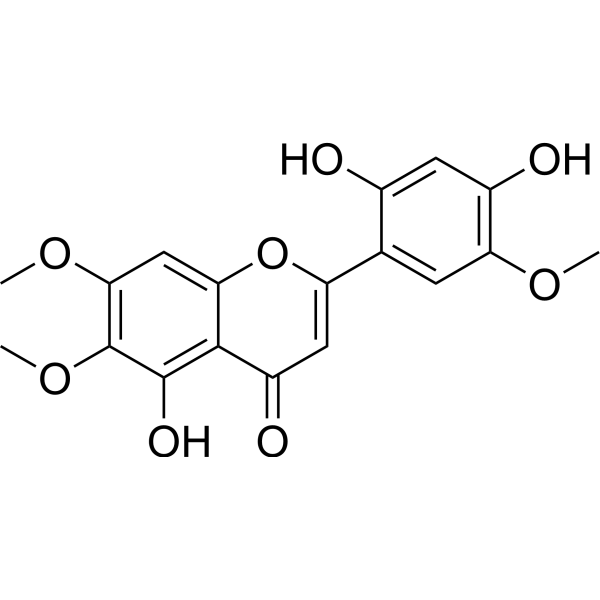
- Formula: C18H16O8
- Molecular Weight: 360.31
Arcapillin is a flavonoid that can be isolated from Artemisia capillaris Thunb. Arcapillin induces dose-dependent relaxation of ileum and pulmonary artery smooth muscle, causes slight urinary bladder smooth muscle contraction at highest tested concentrations. Arcapillin binds to the active site of SARS-CoV-2 Mpro via interactions with Gln139, His163, and His164, exhibits antiviral activity against SARS-CoV-2 and MERS-CoV. Arcapillin can be used for the research of gastrointestinal disorders, COVID-19, and Middle East respiratory syndrome (MERS).



