



hCoV-229E
-
hCoV-229E (6)

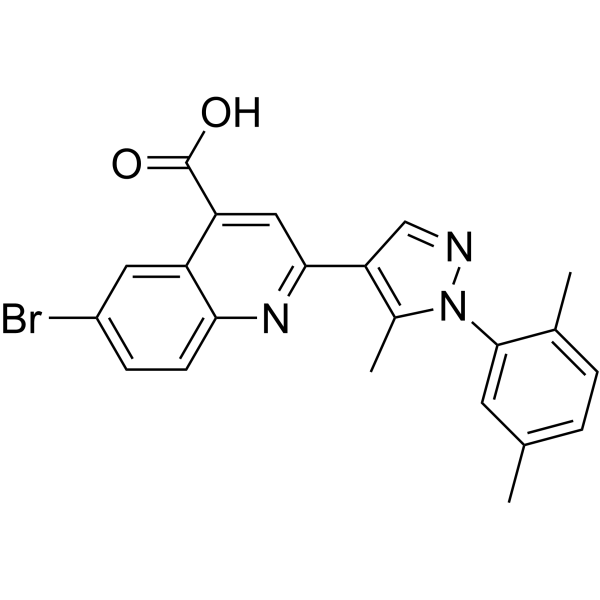
- Formula: C22H18BrN3O2
- Molecular Weight: 436.30
BPR3P0128 is an orally active, non-nucleoside RNA-dependent RNA polymerase (RdRp) inhibitor that has been shown to inhibit the activity of various SARS-CoV-2 variants. The EC50 for SARS-CoV-2 and HCoV-229E are 0.62 μM and 0.14 μM. BPR3P0128 demonstrates effective anti-pancoronavirus activity within the submicromolar range. PR3P0128 shows synergistic antiviral activity when combined with Remdesivir (HY-104077).

- Formula: C26H32N2O2S
- Molecular Weight: 436.61
Antiviral agent 86 is an anti-coronavirus agent. Antiviral agent 86 acts as a binder of coronavirus non-structural protein 15 (nsp15), with a Kd value of 67 μM against human targets. Antiviral agent 86 inhibits the replication of HCoV-229E and SARS-CoV-2. Antiviral agent 86 exerts inhibitory effects at the post-entry lifecycle stage of coronaviruses in host cells and inhibits the formation of viral double-stranded RNA (dsRNA). Antiviral agent 86 exhibits an additive antiviral effect when used in combination with GS-441524. Antiviral agent 86 can be used in studies related to coronavirus infections.
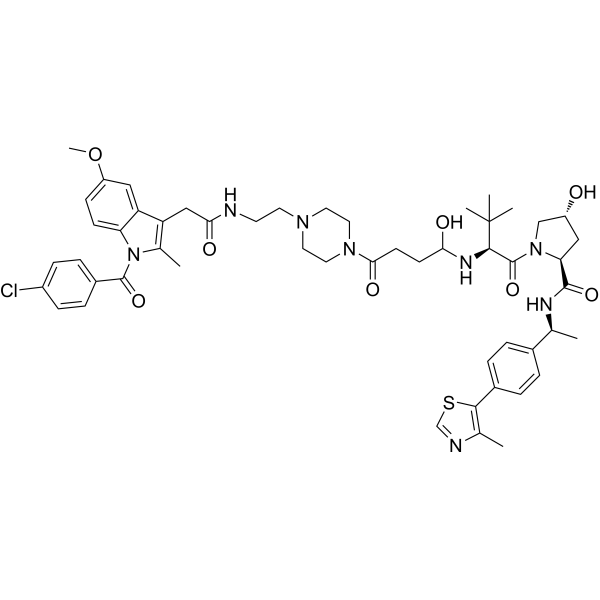
- Formula: C52H63ClN8O8S
- Molecular Weight: 995.62
PROTAC SARS-CoV-2 Mpro degrader-1 is a SARS-CoV-2 Mpro PROTAC degrader with a DC50 of 18.1 μM. PROTAC SARS-CoV-2 Mpro degrader-1 recruits the Von-Hippel Lindau (VHL) E3 ligase to mediate ubiquitination and proteasomal degradation of SARS-CoV-2 Mpro, without inhibiting the catalytic activity of Mpro. PROTAC SARS-CoV-2 Mpro degrader-1 exhibits broad-spectrum antiviral activity against coronaviruses (SARS-CoV-2, HCoV-OC43, HCoV-229E). PROTAC SARS-CoV-2 Mpro degrader-1 can be used in studies related to SARS-CoV-2 infection, HCoV-OC43 infection, and HCoV-229E infection.
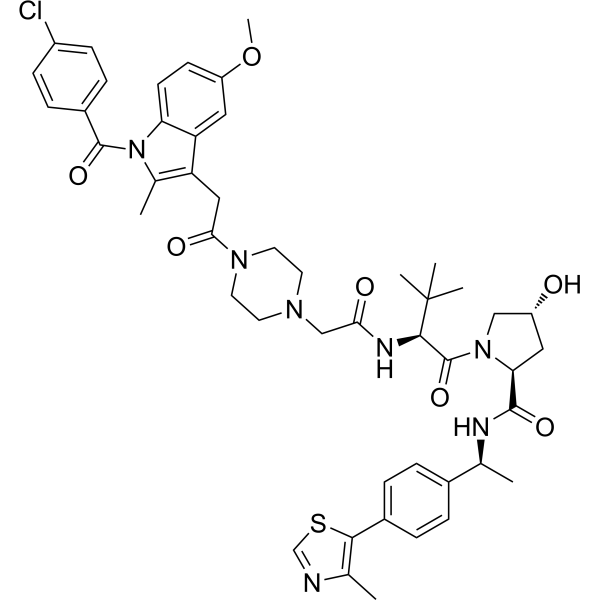
- Formula: C48H56ClN7O7S
- Molecular Weight: 910.52
PROTAC SARS-CoV-2 Mpro degrader-2 is a SARS-CoV-2 Mpro PROTAC degrader with a DC50 of 1.34 μM. PROTAC SARS-CoV-2 Mpro degrader-2 recruits the VHL E3 ligase to mediate ubiquitination and proteasomal degradation of SARS-CoV-2 Mpro, without inhibiting the catalytic activity of Mpro. PROTAC SARS-CoV-2 Mpro degrader-2 exhibits anti-SARS-CoV-2 activity in infected cells, as well as broad-spectrum antiviral activity against coronaviruses including HCoV-OC43 and HCoV-229E. PROTAC SARS-CoV-2 Mpro degrader-2 can be used in studies related to SARS-CoV-2 infection, HCoV-OC43 infection, and HCoV-229E infection.

- Formula: C23H29N3O5
- Molecular Weight: 427.49
UAWJ9-36-3 is a Mpro and cathepsin L (IC50: 1.81 μM) inhibitor. UAWJ9-36-3 shows potent binding and enzymatic inhibition against the Mpros from SARS-CoV-2, SARS-CoV, MERS-CoV, HCoV-OC43, HCoV-NL63, HCoV-229E, and HCoV-HKU1. UAWJ9-36-3 demonstrates broad-spectrum antiviral activity against not only SARS-CoV-2, but also the common human coronaviruses HCoV-OC43, HCoV-NL63, and HCoV-229E.

- Formula: C27H25BrN2O3
- Molecular Weight: 505.40
K22 is an anti-Coronaviral compound. K22 reduces double-stranded RNA. K22 displays antiviral activity beyond the Coronavirinae subfamily, namely against nidoviruses of the Torovirinae subfamily (EToV and WBV) and members of the Arteriviridae family (PRRSV, EAV). K22 displays antiviral activity against HCoV-229E.



