



BPR3P0128

Based on 1 Customer Validation
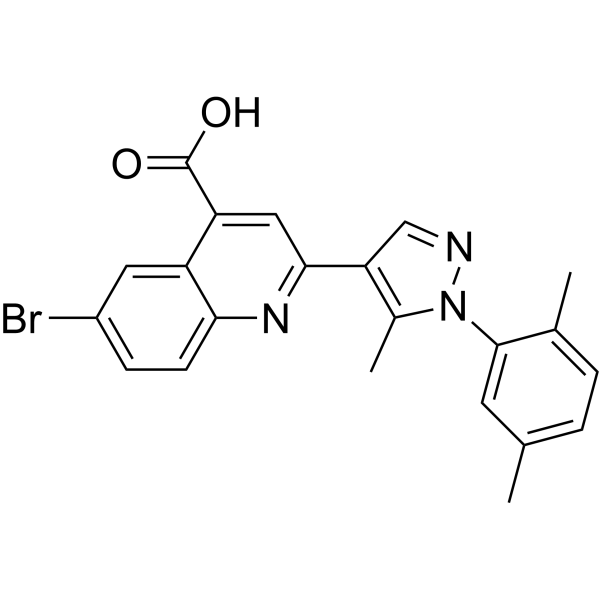
BPR3P0128 is an orally active, non-nucleoside RNA-dependent RNA polymerase (RdRp) inhibitor that has been shown to inhibit the activity of various SARS-CoV-2 variants. The EC50 for SARS-CoV-2 and HCoV-229E are 0.62 μM and 0.14 μM. BPR3P0128 demonstrates effective anti-pancoronavirus activity within the submicromolar range. PR3P0128 shows synergistic antiviral activity when combined with Remdesivir (HY-104077).
For research use only. We do not sell to patients.
- Purity : 98.58%
- CAS No.: 1345406-09-8
- Formula: C22H18BrN3O2
- Molecular Weight:436.30
-
Storage:Powder -20°C, 3 years , 4°C, 2 years ; In solvent -80°C, 6 months , -20°C, 1 month

To place orders, for customer services and technical support, please contact: MedChemExpress USA
Tel: 609-228-6898 E-mail: [email protected] [email protected]


-
 Biological Activity
-
Chemical Information
- Protocols
- Purity & Documentation
- References
-
 Help & FAQs


All DNA/RNA Synthesis Isoforms
More

Biological Activity
Description
IC50 & Target
|
RNA Polymerase |
In Vitro
BPR3P0128 (10 μM, 24 hours) can effectively inhibit the replication of SARS-CoV-2 in human lung cancer cell line Calu-3 and reduce the expression of cytokines induced by viral infection[1].
BPR3P0128 (1 μM, 10 μM) has comprehensive activity against coronavirus and can effectively inhibit different SARS-CoV-2 (including α, β, γ, δ, and plasmid strains) variants[1].
MedChemExpress (MCE) has not independently confirmed the accuracy of these methods. They are for reference only.
-
Cell Line:Vero E6 cells containing SARS-CoV-2 virus
-
Concentration:10 μM
-
Incubation Time:0-24h
-
Result:Significantly decreased the mRNA expression levels of CXCL10, IL-6, TNF-α and INF-β.
-
Cell Line:Vero E6 cells containing SARS-CoV-2 virus
-
Concentration:BPR3P0128: 1 μM, 2 μM; Remdesivir: 4 μM, 8 μM
-
Incubation Time:24h
-
Result:And Remdesivir synergistically inhibited NP expression more significantly.
-
Cell Line:HEK293T cell-based RdRp reporter model
-
Concentration:BPR3P0128: 0.1 μM, 1 μM, 10 μM; Remdesivir: 1 μM, 10 μM, 100 μM
-
Incubation Time:24h
-
Result:Inhibited the activity of SARS-CoV-2 RdRp, but did not decrease the expression level of nsp12.
In Vivo
Pharmacokinetic Analysis in Sprague-Dawley rats Model[1]
| Route | Dose (mg/kg) | Cl (mL min/kg) | t1/2 (h) | F (%) |
| i.v. | 0.01 | 1.3 | / | / |
| p.o. | 0.01 | / | 8.1 | 78.7% |
MedChemExpress (MCE) has not independently confirmed the accuracy of these methods. They are for reference only.


Chemical Information
-
CAS No. 1345406-09-8
-
Appearance Solid
-
Molecular Weight 436.30
-
Formula C22H18BrN3O2
-
Color Light yellow to brown
-
SMILES
O=C(O)C1=CC(C2=C(C)N(C3=CC(C)=CC=C3C)N=C2)=NC4=CC=C(Br)C=C41
-
Shipping
Room temperature in continental US; may vary elsewhere.
-
Storage
Powder -20°C 3 years 4°C 2 years In solvent -80°C 6 months -20°C 1 month


Purity & Documentation
-
Data Sheet (277 KB)
-
SDS (251 KB)
- English - EN (251 KB)
- Français - FR (251 KB)
- Deutsch - DE (251 KB)
- Norwegian - NO (251 KB)
- Español - ES (251 KB)
- Swedish - SV (251 KB)
- Italian - IT (251 KB)
- Korean - KR (251 KB)
- Portuguese - PT (251 KB)
-
Handling Instructions (2659 KB)
References
[1]. Tang W-F, et al. BPR3P0128, a non-nucleoside RNA-dependent RNA polymerase inhibitor, inhibits SARS-CoV-2 variants of concern and exerts synergistic antiviral activity in combination with remdesivir. Antimicrob Agents Chemother. 2024;68(4):e0095623. [Content Brief]
[2]. Yeh JY, et al. Anti-influenza drug discovery: identification of an orally bioavailable quinoline derivative through activity- and property-guided lead optimization. ChemMedChem. 2012;7(9):1546-1550. [Content Brief]

Calculators
Concentration (start) × Volume (start) = Concentration (final) × Volume (final)


BPR3P0128 Related Classifications
HY-161356 Related Classifications
 Powered by Bioz