



Ethyl (E,Z)-2,4-decadienoate
Ethyl (E,Z)-2,4-decadienoate is an attractant. Ethyl (E,Z)-2,4-decadienoate can be isolated from pears. Ethyl (E,Z)-2,4-decadienoate elicits electroantennographic responses in codling moths and tortricid moths, and activates their olfactory receptor neurons. Ethyl (E,Z)-2,4-decadienoate acts as an attractant for codling moths and tortricid moths. Ethyl (E,Z)-2,4-decadienoate shows no significant field attractant activity against green budworms.
For research use only. We do not sell to patients.
- CAS No.: 3025-30-7
- Formula: C12H20O2
- Molecular Weight:196.29
-
Storage:
Store at room temperature, keep dry and cool.
In solvent -80°C, 1 year , -20°C, 6 months


To place orders, for customer services and technical support, please contact: MedChemExpress USA
Tel: 609-228-6898 E-mail: [email protected] [email protected]


-
 Biological Activity
-
Chemical Information
-
Solvent & Solubility
- Purity & Documentation
- References
-
 Help & FAQs


-
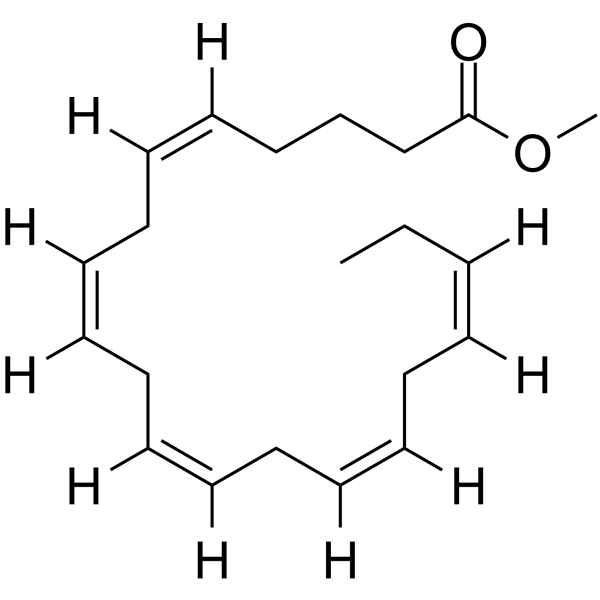
HY-W011311
Eicosapentaenoic acid methyl esterApoptosis Inducer Degrader -
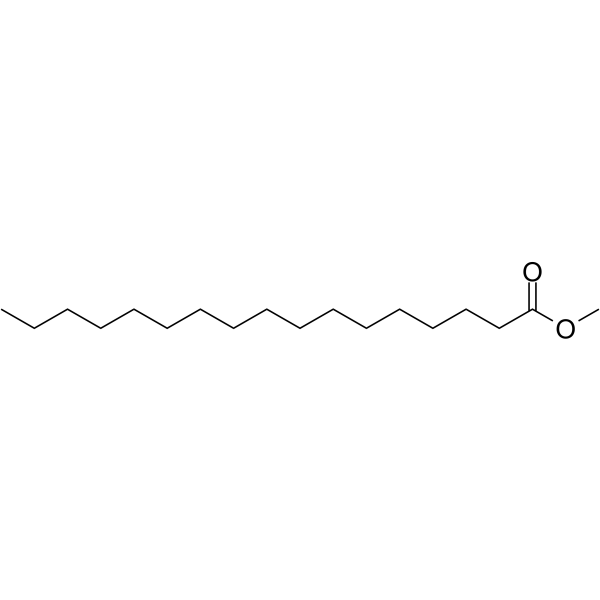
HY-W004290
Methyl heptadecanoateInternal Standard for Biodiesel -
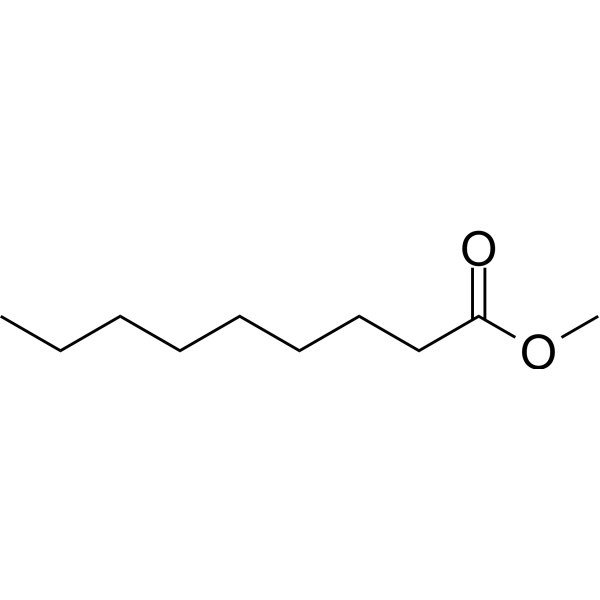
HY-W015308
Methyl nonanoateBiochemical Assay Reagent -
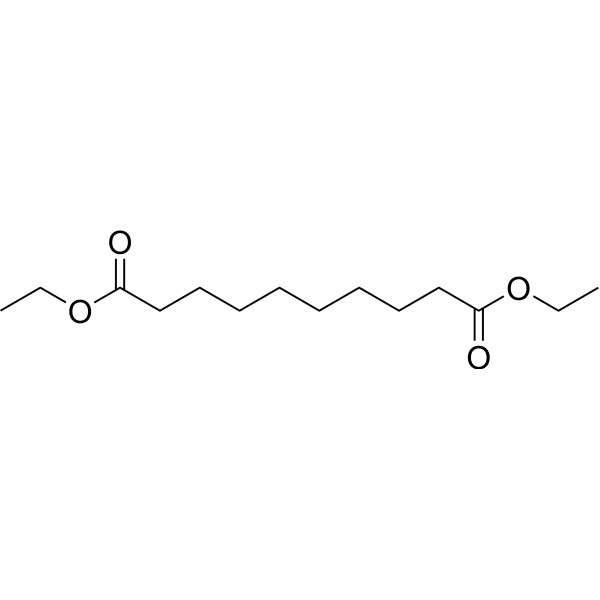
HY-W009443
Diethyl decanedioateBiochemical Assay Reagent -
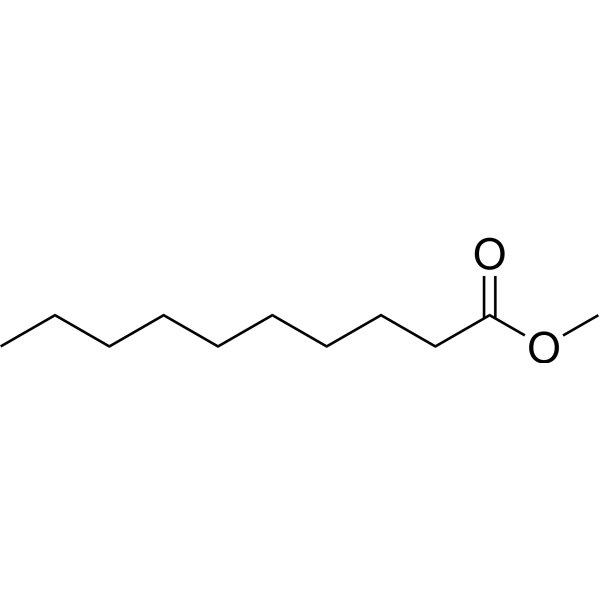
HY-W016172
Methyl decanoateBiochemical Assay Reagent -
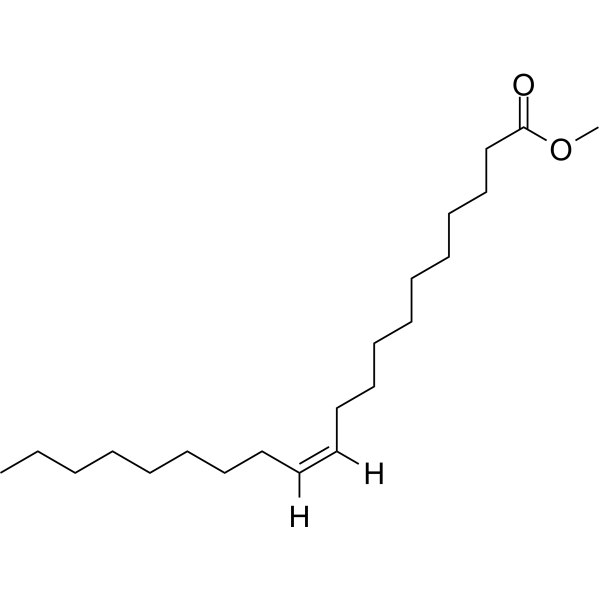
HY-W011267
(Z)-Methyl icos-11-enoateBiochemical Assay Reagent -

HY-W015308R
Methyl nonanoate (Standard)Biochemical Assay Reagent -

HY-W004290R
Methyl heptadecanoate (Standard)Standard Of Methyl heptadecanoate -
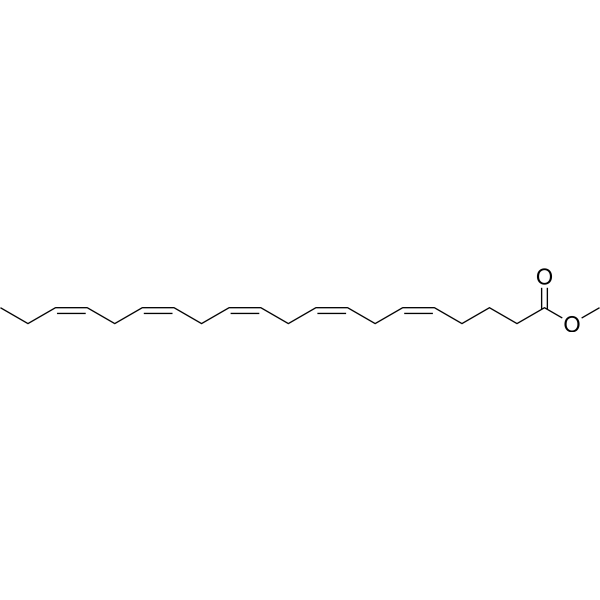
HY-W011311R
Eicosapentaenoic acid methyl ester (Standard)Reference Standard -

HY-W011267R
(Z)-Methyl icos-11-enoate (Standard)Reference Standard -

HY-W009443R
Diethyl decanedioate (Standard)Biochemical Assay Reagent -

HY-W016172R
Methyl decanoate (Standard)Biochemical Assay Reagent


Biological Activity
Description
In Vitro
Ethyl (E,Z)-2,4-decadienoate elicits strong excitatory responses from large-, medium-, and small-amplitude ORNs housed in rabbit-eared shoehorn sensilla auricillica on excised antennae of both male and female Cydia pomonella when tested at a 10 mg dose[1].
Ethyl (E,Z)-2,4-decadienoate elicits strong-to-moderate excitatory responses from large-amplitude ORNs housed in regular shoehorn sensilla auricillica on excised antennae of female Cydia pomonella (no responses observed in ORNs from males) when tested at a 10 mg dose[1].
Ethyl (E,Z)-2,4-decadienoate (10-6-100 μg/μl; 60-s intervals between stimuli) elicits dose-dependent electroantennographic responses from antennae of adult Cydia pomonella, Cydia fagiglandana, Cydia splendana, and Hedya nubiferana, with peak responses at 1 μg/μL for C. pomonella and 10 μg/μL for the other three species[2].
MedChemExpress (MCE) has not independently confirmed the accuracy of these methods. They are for reference only. .
In Vivo
Ethyl (E,Z)-2,4-decadienoate (0.1-40 mg per trap) attracts male and female Cydia pomonella in apple orchards, with the highest total captures observed at 10 mg in 2003 and 3 mg in 2004, and a male-biased capture ratio of ~2.2-2.5:1, but captures fewer moths overall than pheromone-baited traps[2].
Ethyl (E,Z)-2,4-decadienoate (0.1-40 mg per trap) does not show significant attraction activity against Hedya nubiferana in natural apple/cherry tree environments, but the number of females trapped at a dose of 1 mg was numerically higher than that in the control group without bait[2].
MedChemExpress (MCE) has not independently confirmed the accuracy of these methods. They are for reference only.
-
Animal Model:Cydia splendana (adult males and females)[2]
-
Dosage:0.1 mg, 1 mg, 3 mg, 10 mg, 40 mg per trap
-
Administration:volatile release; continuous field deployment for entire trapping season
-
Result:Captured significantly more males (7.3, 5.3, 9.7, respectively) and females (7.3, 6.3, 12.0, respectively) than unbaited controls at Drena 2003 with 1 mg, 10 mg, 40 mg doses; yielded highest total captures (21.7) at Drena 2003 with 40 mg dose.
Captured 1.7 males and 6.0 females at Drena 2004 with 40 mg dose, with total captures (7.7) not significantly different from pheromone-baited traps.
Captured significantly more males (6.0, 15.0, 12.0, 11.3, respectively) and females (5.3, 7.3, 11.0, 13.0, respectively) than unbaited controls at Cusano Mutri 2003 with 1 mg, 3 mg, 10 mg, 40 mg doses; yielded highest total captures (24.3) and captured more total moths than pheromone-baited traps at Cusano Mutri 2003 with 40 mg dose.
Captured significantly more males and females than unbaited controls at Cusano Mutri 2004 with all doses; yielded highest total captures (20.0) and captured more total moths than pheromone-baited traps at Cusano Mutri 2004 with 40 mg dose.
Maintained a near 1:1 male:female capture ratio across sites and years with all active doses.


Chemical Information
-
CAS No. 3025-30-7
-
Appearance Liquid (Density: 0.905 g/cm3)
-
Molecular Weight 196.29
-
Formula C12H20O2
-
Color Colorless to light yellow
-
SMILES
CCCCC/C=C\C=C\C(OCC)=O
-
Structure Classification
-
Initial Source
Cydia pomonella
-
Shipping
Room temperature in continental US; may vary elsewhere.
-
Storage
Store at room temperature, keep dry and cool
In solvent -80°C 1 year -20°C 6 months


Solvent & Solubility
In Vitro:
DMSO : 200 mg/mL (1018.90 mM; Need ultrasonic; Hygroscopic DMSO has a significant impact on the solubility of product, please use newly opened DMSO)
Please refer to the solubility information to select the appropriate solvent. Once prepared, please aliquot and store the solution to prevent product inactivation from repeated freeze-thaw cycles.
Storage method and period of stock solution: -80°C, 1 year; -20°C, 6 months. When stored at -80°C, please use it within 1 year. When stored at -20°C, please use it within 6 months.
Please refer to the solubility information to select the appropriate solvent. Once prepared, please aliquot and store the solution to prevent product inactivation from repeated freeze-thaw cycles.
Storage method and period of stock solution: -80°C, 1 year; -20°C, 6 months. When stored at -80°C, please use it within 1 year. When stored at -20°C, please use it within 6 months.
Concentration (start) × Volume (start) = Concentration (final) × Volume (final)
In Vivo:
Select the appropriate dissolution method based on your experimental animal and administration route.
- For the following dissolution methods, please ensure to first prepare a clear stock solution using an In Vitro approach and then sequentially add co-solvents:
- To ensure reliable experimental results, the clarified stock solution can be appropriately stored based on storage conditions. As for the working solution for In Vivo experiments, it is recommended to prepare freshly and use it on the same day.
- The percentages shown for the solvents indicate their volumetric ratio in the final prepared solution. If precipitation or phase separation occurs during preparation, heat and/or sonication can be used to aid dissolution.
Add each solvent one by one: 10% DMSO 40% PEG300 5% Tween-80 45% Saline
Solubility: ≥ 5 mg/mL (25.47 mM); Clear solution
This protocol yields a clear solution of ≥ 5 mg/mL (saturation unknown).
Taking 1 mL working solution as an example, add 100 μL DMSO stock solution (50.0 mg/mL) to 400 μL PEG300, and mix evenly; then add 50 μL Tween-80 and mix evenly; then add 450 μL Saline to adjust the volume to 1 mL.
Preparation of Saline: Dissolve 0.9 g sodium chloride in ddH₂O and dilute to 100 mL to obtain a clear Saline solution.
Add each solvent one by one: 10% DMSO 90% (20% SBE-β-CD in Saline)
Solubility: 5 mg/mL (25.47 mM); Suspended solution; Need ultrasonic
This protocol yields a suspended solution of 5 mg/mL. Suspended solution can be used for oral and intraperitoneal injection.
Taking 1 mL working solution as an example, add 100 μL DMSO stock solution (50.0 mg/mL) to 900 μL 20% SBE-β-CD in Saline, and mix evenly.
Preparation of 20% SBE-β-CD in Saline (4°C, storage for one week): 2 g SBE-β-CD powder is dissolved in 10 mL Saline, completely dissolve until clear.
In Vivo Dissolution Calculator
Please enter the basic information of animal experiments:
-
-
-
-
Recommended: Prepare an additional quantity of animals to account for potential losses during experiments.
Please enter your animal formula composition:
-
%DMSO +
Recommended: Keep the proportion of DMSO in working solution below 2% if your animal is weak.
-
%+
-
+%Tween-80 + +
-
%Saline +
The co-solvents required include: DMSO, . All of co-solvents are available by MedChemExpress (MCE). , Tween 80. All of co-solvents are available by MedChemExpress (MCE).
Working solution concentration: 0.22 mg/mL
Method for preparing stock solution: mg drug dissolved in μL DMSO. Stock solution concentration: mg/mL.
1. Take μL DMSO stock solution;
2. Add μL .
μL , mix evenly;
3. Then add μL Tween 80, mix evenly;
4. Then add μL
Please ensure that the stock solution in the first step is dissolved to a clear state, and add co-solvents in sequence. You can use ultrasonic heating (ultrasonic cleaner, recommended frequency 20-40 kHz), vortexing, etc. to assist dissolution.


Purity & Documentation
-
Data Sheet (272 KB)
-
SDS (252 KB)
- Français - FR (252 KB)
- Deutsch - DE (252 KB)
- Norwegian - NO (252 KB)
- Español - ES (252 KB)
- Swedish - SV (252 KB)
- Italian - IT (252 KB)
- Korean - KR (252 KB)
- Portuguese - PT (252 KB)
-
Handling Instructions (2659 KB)
References


Complete Stock Solution Preparation Table
Please refer to the solubility information to select the appropriate solvent. Once prepared, please aliquot and store the solution to prevent product inactivation from repeated freeze-thaw cycles.
Storage method and period of stock solution: -80°C, 1 year; -20°C, 6 months. When stored at -80°C, please use it within 1 year. When stored at -20°C, please use it within 6 months.
| Optional Solvent | Concentration Solvent Mass | 1 mg | 5 mg | 10 mg | 25 mg |
|---|---|---|---|---|---|
| DMSO | 1 mM | 5.0945 mL | 25.4725 mL | 50.9450 mL | 127.3626 mL |
| 5 mM | 1.0189 mL | 5.0945 mL | 10.1890 mL | 25.4725 mL | |
| 10 mM | 0.5095 mL | 2.5473 mL | 5.0945 mL | 12.7363 mL | |
| 15 mM | 0.3396 mL | 1.6982 mL | 3.3963 mL | 8.4908 mL | |
| 20 mM | 0.2547 mL | 1.2736 mL | 2.5473 mL | 6.3681 mL | |
| 25 mM | 0.2038 mL | 1.0189 mL | 2.0378 mL | 5.0945 mL | |
| 30 mM | 0.1698 mL | 0.8491 mL | 1.6982 mL | 4.2454 mL | |
| 40 mM | 0.1274 mL | 0.6368 mL | 1.2736 mL | 3.1841 mL | |
| 50 mM | 0.1019 mL | 0.5095 mL | 1.0189 mL | 2.5473 mL | |
| 60 mM | 0.0849 mL | 0.4245 mL | 0.8491 mL | 2.1227 mL | |
| 80 mM | 0.0637 mL | 0.3184 mL | 0.6368 mL | 1.5920 mL | |
| 100 mM | 0.0509 mL | 0.2547 mL | 0.5095 mL | 1.2736 mL |


Ethyl (E,Z)-2,4-decadienoate Related Classifications
HY-W322222 Related Classifications
 Powered by Bioz