



Ethyl maltol (Standard)

Based on 1 Customer Validation
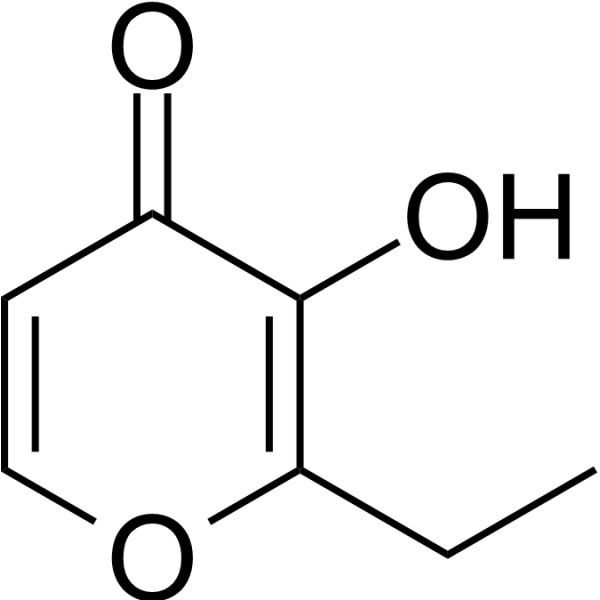
Ethyl maltol (Standard) is the analytical standard of Ethyl maltol. This product is intended for research and analytical applications. Ethyl maltol (2-Ethyl-3-hydroxy-4H-pyran-4-one) is an orally active and important food additive and flavor enhancer. Ethyl maltol is less toxic to rats and dogs. Ethyl maltol can enhance copper-mediated cytotoxicity and induce apoptosis in lung epithelial cells.
For research use only. We do not sell to patients.
- Purity : 99.98%
- CAS No.: 4940-11-8
- Formula: C7H8O3
- Molecular Weight:140.14
-
Storage:
Please store the product under the recommended conditions in the Certificate of Analysis.


To place orders, for customer services and technical support, please contact: MedChemExpress USA
Tel: 609-228-6898 E-mail: [email protected] [email protected]


-
 Product Information
-
Chemical Information
- Purity & Documentation
-
 Help & FAQs




Product Information
Information
Application
The compound is the grade of analytical standard, which is the reference standard supplied assay. It is commonly used in qualitative, quantitative and methodological research experiments in HPLC, GC and MS.


Chemical Information
-
CAS No. 4940-11-8
-
Appearance Solid
-
Molecular Weight 140.14
-
Formula C7H8O3
-
Color White to off-white
-
SMILES
O=C1C(O)=C(CC)OC=C1
-
Synonyms
2-Ethyl-3-hydroxy-4H-pyran-4-one (Standard)
-
Shipping
Room temperature in continental US; may vary elsewhere.
-
Storage
Please store the product under the recommended conditions in the Certificate of Analysis.


Purity & Documentation
-
SDS (393 KB)
- English - EN (393 KB)
- Français - FR (393 KB)
- Deutsch - DE (393 KB)
- Norwegian - NO (393 KB)
- Español - ES (393 KB)
- Swedish - SV (393 KB)
- Italian - IT (393 KB)
- Korean - KR (393 KB)
- Portuguese - PT (393 KB)
-
Handling Instructions (2659 KB)
References
[1]. Li Z, et al. Toxicity Studies of Ethyl Maltol and Iron Complexes in Mice.Biomed Res Int. 2017;2017:2640619. [Content Brief]
[2]. Niu Y, et al. Characterization of odor-active compounds of various cherry wines by gas chromatography-mass spectrometry, gas chromatography-olfactometry and their correlation with sensory attributes. J Chromatogr B Analyt Technol Biomed Life Sci. 2011 Aug 1;879(23):2287-93. [Content Brief]

Calculators
Concentration (start) × Volume (start) = Concentration (final) × Volume (final)


Ethyl maltol (Standard) Related Classifications
HY-W010320R Related Classifications
 Powered by Bioz