



Fomivirsen sodium
Based on 2 publication(s) in Google Scholar
Fomivirsen (ISIS-2922) sodium is an antisense 21 mer phosphorothioate oligonucleotide. Fomivirsen sodium is an antiviral agent that is used cytomegalovirus retinitis (CMV) research, incluiding in AIDs. Fomivirsen sodium binds to and degrades the mRNAs encoding CMV immediate-early 2 protein, thus inhibiting virus proliferation.
For research use only. We do not sell to patients.
- Purity : 99.71%
- CAS No.: 160369-77-7
- Molecular Weight:6682.4 (free acid)
-
Storage:
-20°C, stored under nitrogen
* In solvent : -80°C, 6 months; -20°C, 1 month (stored under nitrogen)


To place orders, for customer services and technical support, please contact: MedChemExpress USA
Tel: 609-228-6898 E-mail: [email protected] [email protected]


-
 Biological Activity
-
Chemical Information
-
Solvent & Solubility
- Protocols
- Purity & Documentation
- References
-
 Help & FAQs


-
HY-108764
Mipomersen sodiumapoB Inhibitor -

HY-112980
NusinersenSMN Inducer -
HY-112980A
Nusinersen sodiumSMN Inducer -
HY-16305
MaribavirAnti-CMV Agent -
HY-15523
Braco-19Telomerase Inhibitor -
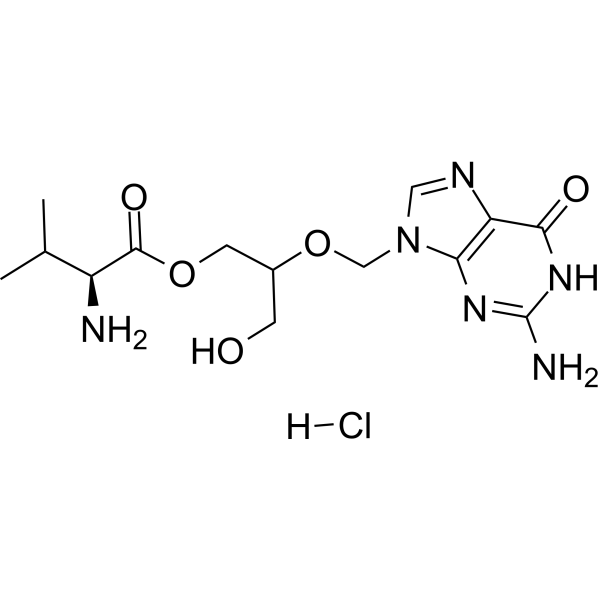
HY-A0032A
Valganciclovir hydrochlorideAntiviral Agent -

HY-132580A
Tofersen sodiumAntisense Oligonucleotide -
HY-132608
Inotersen sodiumAntisense Oligonucleotide -

HY-16305R
Maribavir (Standard)Anti-CMV Agent -
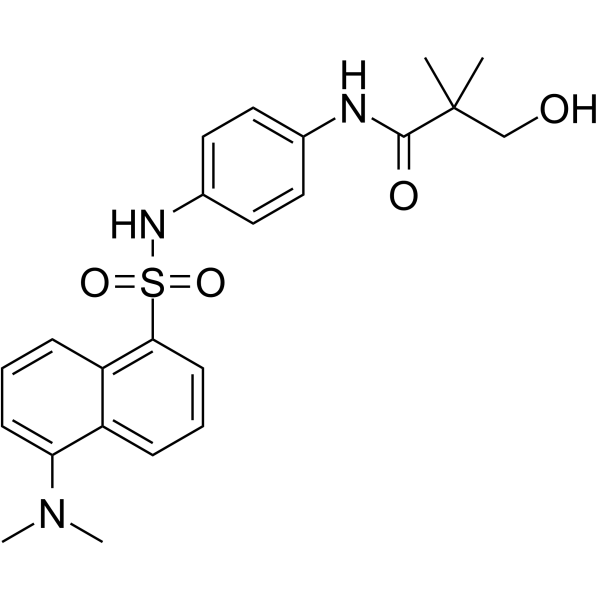
HY-108261
TomeglovirCMV Inhibitor -

HY-P0014
LiraglutideGLP-1R Agonist -

HY-132586A
Viltolarsen sodiumAntisense Oligonucleotide
Publications Citing Use of MedChemExpress (MCE) Fomivirsen sodium
More

Biological Activity
Description
In Vitro
Antisense oligonucleotide acts a complementary nucleotide to the messenger RNA of the major immediate-early region proteins of human cytomegalovirus, it disrupts the replication of the virus through an antisense mechanism[1].Fomivirsen is 21-mer phosphorothioate ASO with CpG motif near its 5′ end, with the sequence 5′-GCG TTT GCT CTT CTT CTT GCG-3′, resulting in mRNA degradation by RNase H-mediated mechanism[2].Fomivirsen inhibits CMV replication in human retinal pigment epithelial (RPE) cells and in human fibroblast cells (MRC-5 cells) in a dose-dependent manner. The mean IC50 are 0.03 μM for RPE cells and 0.2 μM for MRC5 cells[1].
MedChemExpress (MCE) has not independently confirmed the accuracy of these methods. They are for reference only. Further protocols information, click here.
Clinical Trial
| NCT Number | Sponsor | Condition | Start Date |
Phase

|
|---|---|---|---|---|
| NCT01329991 | Plexxikon| | 2011-05 | PHASE1 |


Chemical Information
-
CAS No. 160369-77-7
-
Appearance Solid
-
Molecular Weight 6682.4 (free acid)
-
Color White to off-white
-
SMILES
[Fomivirsen (sodium)]
-
Synonyms
ISIS-2922 sodium
-
Sequence
DNA, d(P-thio)(G-C-G-T-T-T-G-C-T-C-T-T-C-T-T-C-T-T-G-C-G), eicosasodium salt
-
Shipping
Room temperature in continental US; may vary elsewhere.
-
Storage
-20°C, stored under nitrogen
* In solvent : -80°C, 6 months; -20°C, 1 month (stored under nitrogen)


Publications (2)
-
Journal Impact Factor
-
Most Recent
-
J Mass Spectrom
Characterisation of Antisense Oligonucleotides by Ion-Pair Reversed-Phase UHPLC-HRMS: Method development using Design of Experiments. [Abstract]2026 Apr;61(4):e70049. PMID: 41856548 -


Solvent & Solubility
In Vitro:
H2O : 100 mg/mL (Need ultrasonic)
In Vivo:
For the following dissolution methods, please prepare the working solution directly:
It is recommended to prepare fresh solutions and use them promptly within a short period of time.
The percentages shown for the solvents indicate their volumetric ratio in the final prepared solution. If precipitation or phase separation occurs during preparation, heat and/or sonication can be used to aid dissolution.
Add each solvent one by one: PBS
Solubility: 100 mg/mL; Clear solution; Need ultrasonic

Protocols
-
Research Protocol for Infectious Diseases
Infectious-disease experiments test how pathogens interact with host barriers, innate immune receptors, inflammatory signaling, pathogen replication, and tissue injury; pattern-recognition receptors such as TLRs, RIG-I-like receptors, NOD-like receptors, and inflammasomes detect microbial molecules and activate NF-κB, interferon, and cytokine responses. The central hypothesis is that infection severity reflects the balance between pathogen burden and host response: protective inflammation restricts pathogen growth, whereas excessive or mislocalized inflammation contributes to tissue damage and disease phenotype. Unresolved questions include which host pathways are protective versus pathogenic, why some infection models fail to translate to human disease, and which combined readouts best predict clinically relevant infection outcomes.
-
Cell Viability Determination by MTT Colorimetric Assay
The following protocol uses the MTT colorimetric assay as a classic literature-established method for assessing cell viability/metabolic activity in cultured mammalian cells. MTT[3-(4,5-dimethylthiazol-2-yl)-2,5-diphenyltetrazolium bromide] is reduced by metabolically active cells to a colored formazan product; the amount of formazan is quantified spectrophotometrically and provides an indirect measure of metabolically active viable cells. Importantly, MTT reduction reflects cellular oxidoreductase/metabolic activity rather than an absolute direct count of living cells, so changes in cellular metabolism can alter the signal independently of cell number.


Purity & Documentation
-
Data Sheet (269 KB)
-
SDS (252 KB)
- English - EN (252 KB)
- Français - FR (252 KB)
- Deutsch - DE (252 KB)
- Norwegian - NO (252 KB)
- Español - ES (252 KB)
- Swedish - SV (252 KB)
- Italian - IT (252 KB)
- Korean - KR (252 KB)
- Portuguese - PT (252 KB)
-
Handling Instructions (2242 KB)
References
[1]. M D de Smet, et al. Fomivirsen- a phosphorothioate oligonucleotide for the treatment of CMV retinitis. Ocul Immunol Inflamm. 1999 Dec;7(3-4):189-98. [Content Brief]
[2]. Anna Kilanowska, et al. In vivo and in vitro studies of antisense oligonucleotides – a review. (Review Article) RSC Adv., 2020, 10, 34501-34516 [Content Brief]

Calculators
Concentration (start) × Volume (start) = Concentration (final) × Volume (final)


Fomivirsen sodium Related Classifications
HY-109528 Related Classifications
 Powered by Bioz