



Galanin (2-29) (rat)
Galanin (2-29) (rat) inhibits rat pancreatic protein and CCK-8-stimulated amylase secretion. Galanin (2-29) (rat) is an GAL2R agonist (Ki: 3.5 nM).
For research use only. We do not sell to patients.
- CAS No.: 141696-11-9
- Formula: C139H208N42O40
- Molecular Weight:3107.40
-
Storage:
Please store the product under the recommended conditions in the Certificate of Analysis.

To place orders, for customer services and technical support, please contact: MedChemExpress USA
Tel: 609-228-6898 E-mail: [email protected] [email protected]


-
 Biological Activity
-
Chemical Information
- Protocols
- Purity & Documentation
- References
-
 Help & FAQs


-
HY-P1130
M871GalR2 Antagonist -
HY-P1131
M617GAL1 Agonist -
HY-P1135
M1145GAL2 Agonist -

HY-P1128
Galanin (swine)Galanin Receptor Agonist -
HY-P1127
Galanin (1-30), humanGalR Agonist -

HY-P1132
Galanin (1-29)(rat, mouse)Galanin Receptor Agonist -
HY-103536
GalnonGalanin Receptor Agonist -
HY-P1129
AR-M1896GalR2 Agonist -

HY-P1134
Galanin (1-15) (porcine, rat)5-HT1A Receptor Modulator -
HY-P1025
M40Galanin Receptor Modulator
All Neuropeptide Y Receptor Isoforms
More

Biological Activity
Description


Chemical Information
-
CAS No. 141696-11-9
-
Molecular Weight 3107.40
-
Formula C139H208N42O40
-
Synonyms
Rat galanin(2-29)
-
Sequence
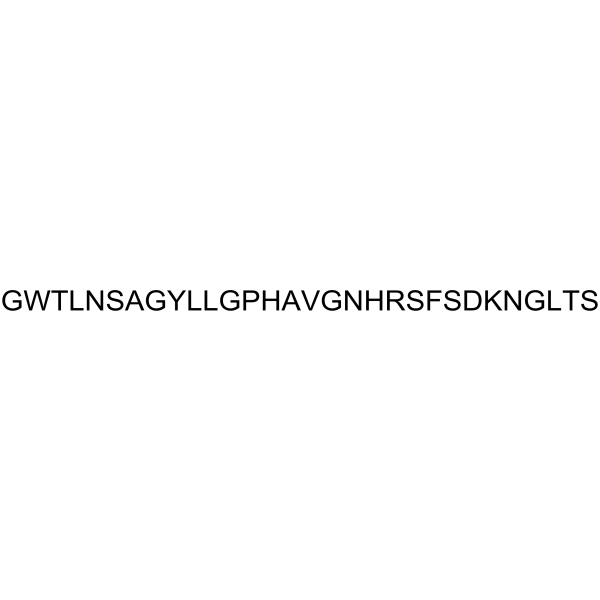
Trp-Thr-Leu-Asn-Ser-Ala-Gly-Tyr-Leu-Leu-Gly-Pro-His-Ala-Ile-Asp-Asn-His-Arg-Ser-Phe-Ser-Asp-Lys-His-Gly-Leu-Thr-NH2
-
Sequence Shortening
WTLNSAGYLLGPHAIDNHRSFSDKHGLT-NH2
-
Shipping
Room temperature in continental US; may vary elsewhere.
-
Storage
Please store the product under the recommended conditions in the Certificate of Analysis.

Protocols
-
CCK-8/WST-8 Cell Proliferation Assay
The CCK-8/WST-8 assay is based on the reduction of the water-soluble tetrazolium salt WST-8 to a water-soluble formazan product by cellular dehydrogenases in metabolically active cells, where the generated formazan amount is proportional to the number of living cells and is quantified by measuring absorbance in the visible range, providing a colorimetric readout for cell viability and proliferation assessment. This class of tetrazolium-based assays improves upon earlier MTT-based systems by producing a water-soluble formazan, eliminating the need for organic solubilization steps and enabling direct spectrophotometric measurement in culture medium.


Purity & Documentation
References
[1]. Rossowski WJ, et al. Galanin: structure-dependent effect on pancreatic amylase secretion and jejunal strip contraction. Eur J Pharmacol. 1993 Aug 24;240(2-3):259-67. [Content Brief]
[2]. Wang S, et al. Molecular cloning and pharmacological characterization of a new galanin receptor subtype. Mol Pharmacol. 1997 Sep;52(3):337-43. [Content Brief]

Calculators
Concentration (start) × Volume (start) = Concentration (final) × Volume (final)


Galanin (2-29) (rat) Related Classifications
HY-P1133 Related Classifications
 Powered by Bioz