



AX20017
Based on 2 publication(s) in Google Scholar
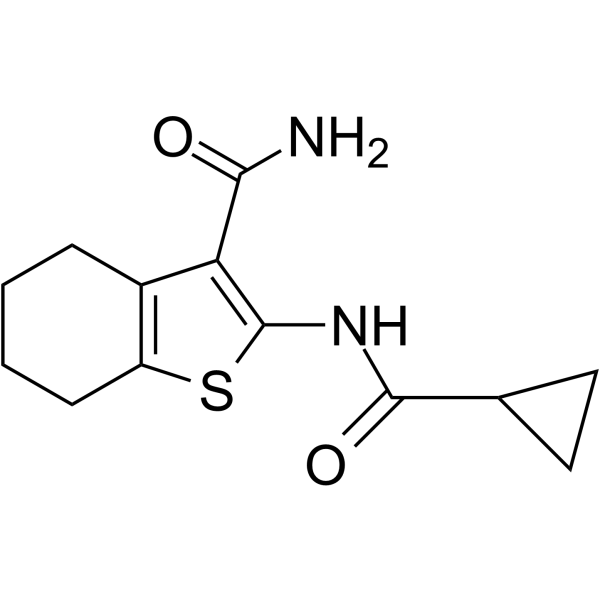
AX20017 is a small-molecule protein kinase G (PknG) inhibitor with an IC50 of 0.39 μM.
Para uso exclusivo en investigación. No vendemos a pacientes.
- Pureza : 99.69%
- No. CAS: 329221-38-7
- Fòrmula: C13H16N2O2S
- Peso molecular:264.34
-
Almacenamiento:Powder -20°C, 3 years , 4°C, 2 years ; In solvent -80°C, 2 years , -20°C, 1 year

To place orders, for customer services and technical support, please contact: MedChemExpress USA
Tel: 609-228-6898 E-mail: [email protected] [email protected]


-
 Actividad biológica
-
Chemical Information
-
Solvente y solubilidad
- Pureza y Documentación
- Referencias
-
 Help & FAQs



Publications Citing Use of MedChemExpress (MCE) AX20017
More

Actividad biológica
Descripciòn
IC50 & Target
IC50: 0.39 μM (PknG)[1]
Cellular Effect
|
Cell Line

|
Type | Value | Description | References |
|---|---|---|---|---|
| MV4-11 | IC50 |
1.2 μM
Compound: 4
|
Antiproliferative activity against human MV4-11 cells
Antiproliferative activity against human MV4-11 cells
|
[PMID: 16580199] |
In Vitro
The compound AX20017 inhibitor is bound deep within a narrow pocket formed by the inter lobe cleft of the PknG domain. The main chain Glu233:O and Val235:NH of PknG form hydrogen bonds with AX20017[2].AX20017 results in mycobacterial transfer to lysosomes and killing of the mycobacteria. AX20017 does not affect the human kinases, whereas the activity of PknG is effectively inhibited. AX20017 does not affect cellular morphology, membrane ruffling, or macropinocytosis[3].
MedChemExpress (MCE) has not independently confirmed the accuracy of these methods. They are for reference only.


Chemical Information
-
No. CAS 329221-38-7
-
Appearance Solid
-
Peso molecular 264.34
-
Fòrmula C13H16N2O2S
-
Color White to off-white
-
SMILES
O=C(N)C1=C(NC(C2CC2)=O)SC3=C1CCCC3
-
Envío
Room temperature in continental US; may vary elsewhere.
-
Almacenamiento
Powder -20°C 3 years 4°C 2 years In solvent -80°C 2 years -20°C 1 year


Publications (2)
-
Journal Impact Factor
-
Most Recent
-
Cell Rep
Pathogenic phosphorylation of linear ubiquitin machinery causes inflammasome sensor degradation. [Abstract]2025 Sep 12;44(9):116286. PMID: 40944911 -
ACS Omega
Identifying RO9021 as a Potential Inhibitor of PknG from Mycobacterium tuberculosis: Combinative Computational and In Vitro Studies. [Abstract]2022 May 31;7(23):20204-20218. PMID: 35721990


Solvente y solubilidad
In Vitro:
DMSO : 130 mg/mL (491.79 mM; Need ultrasonic; Hygroscopic DMSO has a significant impact on the solubility of product, please use newly opened DMSO)
Please refer to the solubility information to select the appropriate solvent. Once prepared, please aliquot and store the solution to prevent product inactivation from repeated freeze-thaw cycles.
Storage method and period of stock solution: -80°C, 2 years; -20°C, 1 year. When stored at -80°C, please use it within 2 years. When stored at -20°C, please use it within 1 year.
Please refer to the solubility information to select the appropriate solvent. Once prepared, please aliquot and store the solution to prevent product inactivation from repeated freeze-thaw cycles.
Storage method and period of stock solution: -80°C, 2 years; -20°C, 1 year. When stored at -80°C, please use it within 2 years. When stored at -20°C, please use it within 1 year.
Concentration (start) × Volume (start) = Concentration (final) × Volume (final)
In Vivo:
Select the appropriate dissolution method based on your experimental animal and administration route.
- For the following dissolution methods, please ensure to first prepare a clear stock solution using an In Vitro approach and then sequentially add co-solvents:
- To ensure reliable experimental results, the clarified stock solution can be appropriately stored based on storage conditions. As for the working solution for In Vivo experiments, it is recommended to prepare freshly and use it on the same day.
- The percentages shown for the solvents indicate their volumetric ratio in the final prepared solution. If precipitation or phase separation occurs during preparation, heat and/or sonication can be used to aid dissolution.
In Vivo Dissolution Calculator
Please enter the basic information of animal experiments:
-
-
-
-
Recommended: Prepare an additional quantity of animals to account for potential losses during experiments.
Please enter your animal formula composition:
-
%DMSO +
Recommended: Keep the proportion of DMSO in working solution below 2% if your animal is weak.
-
%+
-
+%Tween-80 + +
-
%Saline +
The co-solvents required include: DMSO, . All of co-solvents are available by MedChemExpress (MCE). , Tween 80. All of co-solvents are available by MedChemExpress (MCE).
Working solution concentration: 0.22 mg/mL
Method for preparing stock solution: mg drug dissolved in μL DMSO. Stock solution concentration: mg/mL.
1. Take μL DMSO stock solution;
2. Add μL .
μL , mix evenly;
3. Then add μL Tween 80, mix evenly;
4. Then add μL
Please ensure that the stock solution in the first step is dissolved to a clear state, and add co-solvents in sequence. You can use ultrasonic heating (ultrasonic cleaner, recommended frequency 20-40 kHz), vortexing, etc. to assist dissolution.


Pureza y Documentación
-
Ficha de datos (278 KB)
-
SDS (393 KB)
- English - EN (393 KB)
- Français - FR (393 KB)
- Deutsch - DE (393 KB)
- Norwegian - NO (393 KB)
- Español - ES (393 KB)
- Swedish - SV (393 KB)
- Italian - IT (393 KB)
- Korean - KR (393 KB)
- Portuguese - PT (393 KB)
-
Instrucciones de manejo (2659 KB)
Referencias
[1]. Walburger A, et al. Protein kinase G from pathogenic mycobacteria promotes survival within macrophages. Science. 2004 Jun 18;304(5678):1800-4. [Content Brief]
[2]. Santhi N, et al. Insights from the molecular docking of withanolide derivatives to the target protein PknG from Mycobacterium tuberculosis. Bioinformation. 2011;7(1):1-4. [Content Brief]
[3]. Scherr N, et al. Structural basis for the specific inhibition of protein kinase G, a virulence factor of Mycobacterium tuberculosis. Proc Natl Acad Sci U S A. 2007 Jul 17;104(29):12151-6. [Content Brief]


Complete Stock Solution Preparation Table
Please refer to the solubility information to select the appropriate solvent. Once prepared, please aliquot and store the solution to prevent product inactivation from repeated freeze-thaw cycles.
Storage method and period of stock solution: -80°C, 2 years; -20°C, 1 year. When stored at -80°C, please use it within 2 years. When stored at -20°C, please use it within 1 year.
| Optional Solvent | Concentration Solvent Mass | 1 mg | 5 mg | 10 mg | 25 mg |
|---|---|---|---|---|---|
| DMSO | 1 mM | 3.7830 mL | 18.9150 mL | 37.8301 mL | 94.5752 mL |
| 5 mM | 0.7566 mL | 3.7830 mL | 7.5660 mL | 18.9150 mL | |
| 10 mM | 0.3783 mL | 1.8915 mL | 3.7830 mL | 9.4575 mL | |
| 15 mM | 0.2522 mL | 1.2610 mL | 2.5220 mL | 6.3050 mL | |
| 20 mM | 0.1892 mL | 0.9458 mL | 1.8915 mL | 4.7288 mL | |
| 25 mM | 0.1513 mL | 0.7566 mL | 1.5132 mL | 3.7830 mL | |
| 30 mM | 0.1261 mL | 0.6305 mL | 1.2610 mL | 3.1525 mL | |
| 40 mM | 0.0946 mL | 0.4729 mL | 0.9458 mL | 2.3644 mL | |
| 50 mM | 0.0757 mL | 0.3783 mL | 0.7566 mL | 1.8915 mL | |
| 60 mM | 0.0631 mL | 0.3153 mL | 0.6305 mL | 1.5763 mL | |
| 80 mM | 0.0473 mL | 0.2364 mL | 0.4729 mL | 1.1822 mL | |
| 100 mM | 0.0378 mL | 0.1892 mL | 0.3783 mL | 0.9458 mL |


AX20017 Related Classifications
HY-14987 Related Classifications
 Powered by Bioz