



Direct Violet 1

Based on 1 Customer Validation
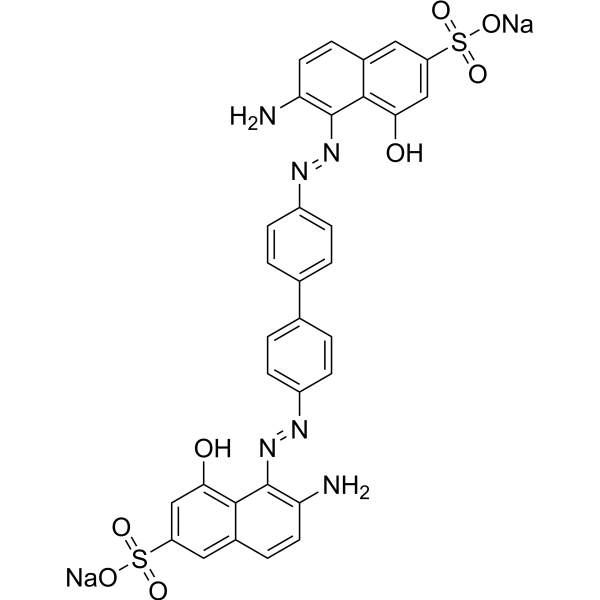
Direct Violet 1, an azo dye, is a textile dye. Direct Violet 1 is also the protein-protein interaction (PPI) between the SARS-CoV-2 spike protein and ACE2 inhibitor with IC50s of 1.47-2.63 μM.
Para uso exclusivo en investigación. No vendemos a pacientes.
- No. CAS: 2586-60-9
- Fòrmula: C32H22N6Na2O8S2
- Peso molecular:728.66
-
Almacenamiento:
4°C, sealed storage, away from moisture and light
* In solvent : -80°C, 6 months; -20°C, 1 month (sealed storage, away from moisture and light)

To place orders, for customer services and technical support, please contact: MedChemExpress USA
Tel: 609-228-6898 E-mail: [email protected] [email protected]


-
 Actividad biológica
-
Chemical Information
-
Solvente y solubilidad
- Protocolo
- Pureza y Documentación
- Referencias
-
 Help & FAQs


-
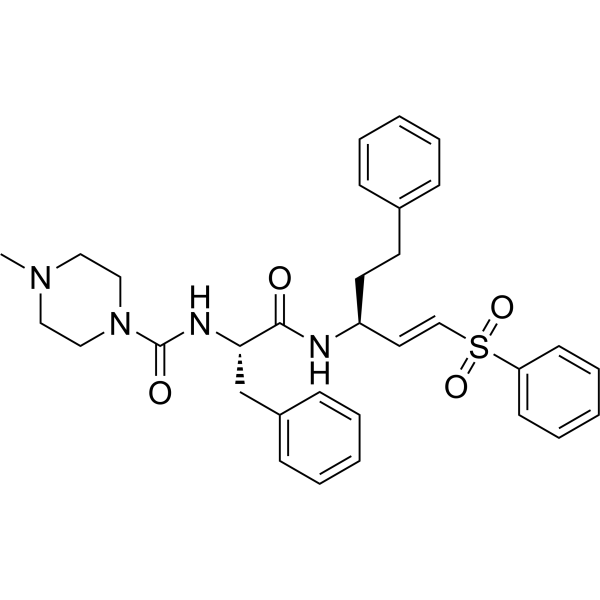
HY-119293
K777Cysteine Protease Inhibitor -
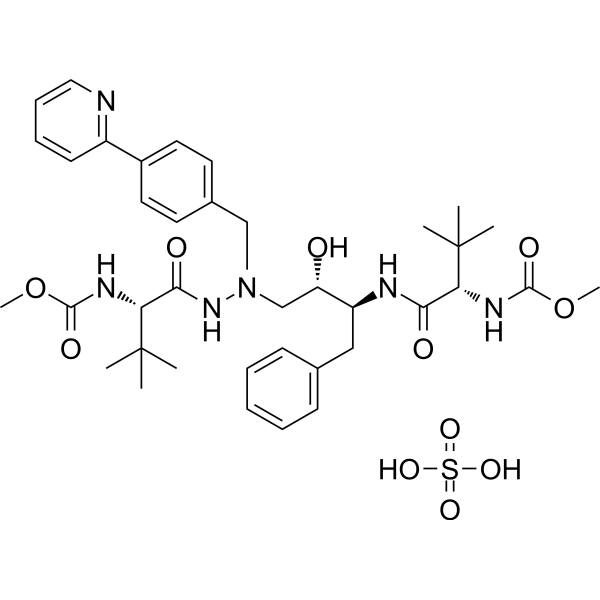
HY-17367A
Atazanavir sulfateHIV Protease Inhibitor -
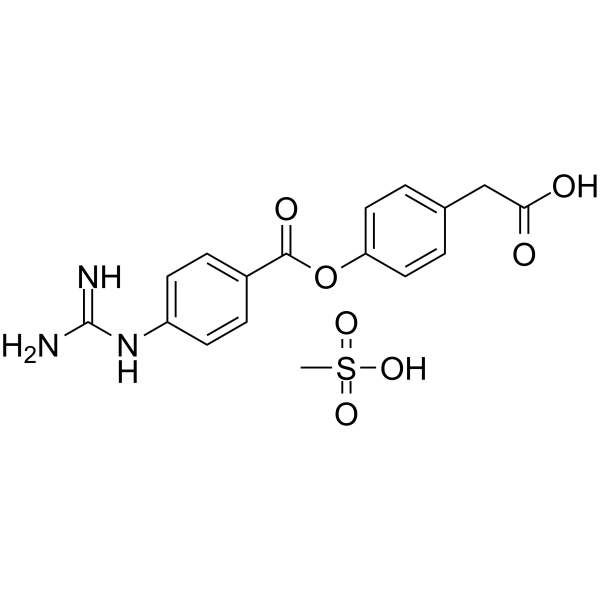
HY-19727A
FOY 251Proteinase Inhibitor -
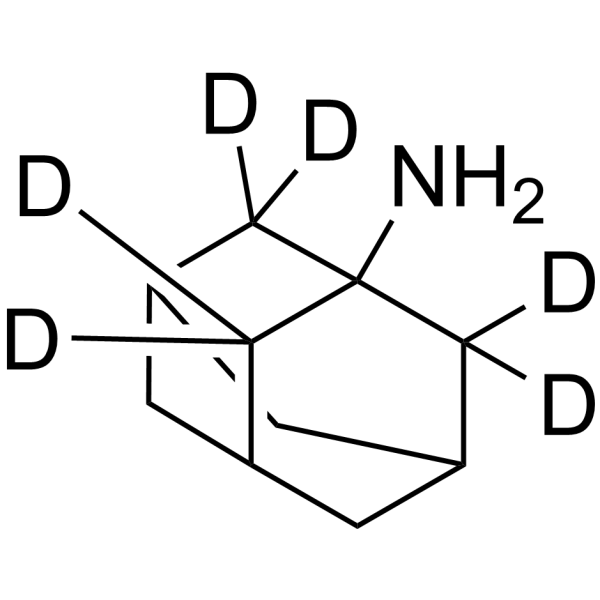
HY-B0402S1
Amantadine-d6Stable Isotope -

HY-17367AR
Atazanavir sulfate (Standard)HIV Protease Inhibitor -

HY-19727AR
FOY 251 (Standard)Proteinase Inhibitor -
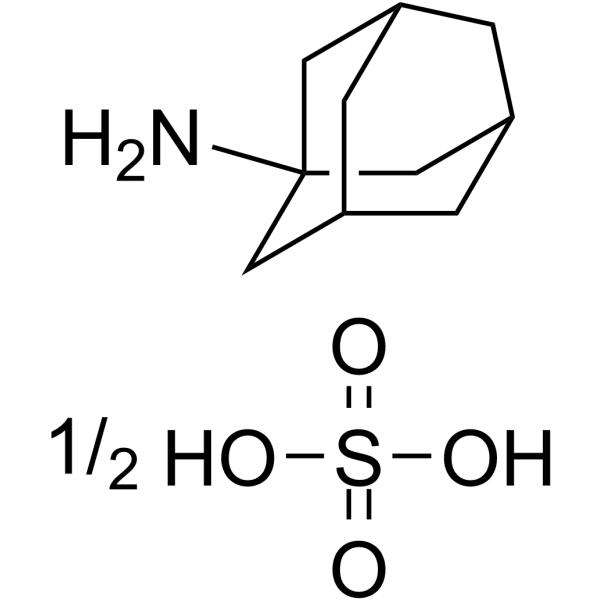
HY-B0402B
Amantadine sulfateAntiviral Agent


Actividad biológica
Descripciòn
IC50 & Target
IC50: 1.47 µM (SARS-CoV-2-S-RBD binding to ACE2); 2.63 µM (SARS-CoV-S1S2 binding to ACE2); 2.11 µM (TNF-R1-TNFα binding)[1]
In Vitro
Direct Violet 1 inhibits SARS-CoV-2-S-RBD binding to human ACE2, inhibits SARS-CoV-S1S2 binding to ACE2, and inhibits TNF-R1 binding to TNFα with IC50 values of 1.47 μM, 2.63 μM, and 2.11 μM, respectively[1].
Direct Violet 1 inhibits SARS-CoV-2 pseudovirus entry into hACE2 expressing host cells in a concentration-dependent manner with an IC50 of 35.8 μM[1].
MedChemExpress (MCE) has not independently confirmed the accuracy of these methods. They are for reference only.


Chemical Information
-
No. CAS 2586-60-9
-
Appearance Solid
-
Peso molecular 728.66
-
Fòrmula C32H22N6Na2O8S2
-
Color Off-white to brown
-
SMILES
O=S(C1=CC(O)=C2C(/N=N/C3=CC=C(C4=CC=C(/N=N/C5=C(N)C=CC6=CC(S(=O)(O[Na])=O)=CC(O)=C56)C=C4)C=C3)=C(N)C=CC2=C1)(O[Na])=O
-
Envío
Room temperature in continental US; may vary elsewhere.
-
Almacenamiento
4°C, sealed storage, away from moisture and light
* In solvent : -80°C, 6 months; -20°C, 1 month (sealed storage, away from moisture and light)


Solvente y solubilidad
In Vitro:
H2O : 62.5 mg/mL (85.77 mM; Need ultrasonic)
Please refer to the solubility information to select the appropriate solvent. Once prepared, please aliquot and store the solution to prevent product inactivation from repeated freeze-thaw cycles.
Storage method and period of stock solution: -80°C, 6 months; -20°C, 1 month (sealed storage, away from moisture and light). When stored at -80°C, please use it within 6 months. When stored at -20°C, please use it within 1 month.
* Note: If you choose water as the stock solution, please dilute it to the working solution, then filter and sterilize it with a 0.22 μm filter before use.
Please refer to the solubility information to select the appropriate solvent. Once prepared, please aliquot and store the solution to prevent product inactivation from repeated freeze-thaw cycles.
Storage method and period of stock solution: -80°C, 6 months; -20°C, 1 month (sealed storage, away from moisture and light). When stored at -80°C, please use it within 6 months. When stored at -20°C, please use it within 1 month.
* Note: If you choose water as the stock solution, please dilute it to the working solution, then filter and sterilize it with a 0.22 μm filter before use.
Concentration (start) × Volume (start) = Concentration (final) × Volume (final)


Pureza y Documentación
-
Ficha de datos (275 KB)
-
SDS (393 KB)
- English - EN (393 KB)
- Français - FR (393 KB)
- Deutsch - DE (393 KB)
- Norwegian - NO (393 KB)
- Español - ES (393 KB)
- Swedish - SV (393 KB)
- Italian - IT (393 KB)
- Korean - KR (393 KB)
- Portuguese - PT (393 KB)
-
Instrucciones de manejo (2659 KB)
Referencias


Complete Stock Solution Preparation Table
Please refer to the solubility information to select the appropriate solvent. Once prepared, please aliquot and store the solution to prevent product inactivation from repeated freeze-thaw cycles.
Storage method and period of stock solution: -80°C, 6 months; -20°C, 1 month (sealed storage, away from moisture and light). When stored at -80°C, please use it within 6 months. When stored at -20°C, please use it within 1 month.
| Optional Solvent | Concentration Solvent Mass | 1 mg | 5 mg | 10 mg | 25 mg |
|---|---|---|---|---|---|
| H2O | 1 mM | 1.3724 mL | 6.8619 mL | 13.7238 mL | 34.3096 mL |
| 5 mM | 0.2745 mL | 1.3724 mL | 2.7448 mL | 6.8619 mL | |
| 10 mM | 0.1372 mL | 0.6862 mL | 1.3724 mL | 3.4310 mL | |
| 15 mM | 0.0915 mL | 0.4575 mL | 0.9149 mL | 2.2873 mL | |
| 20 mM | 0.0686 mL | 0.3431 mL | 0.6862 mL | 1.7155 mL | |
| 25 mM | 0.0549 mL | 0.2745 mL | 0.5490 mL | 1.3724 mL | |
| 30 mM | 0.0457 mL | 0.2287 mL | 0.4575 mL | 1.1437 mL | |
| 40 mM | 0.0343 mL | 0.1715 mL | 0.3431 mL | 0.8577 mL | |
| 50 mM | 0.0274 mL | 0.1372 mL | 0.2745 mL | 0.6862 mL | |
| 60 mM | 0.0229 mL | 0.1144 mL | 0.2287 mL | 0.5718 mL | |
| 80 mM | 0.0172 mL | 0.0858 mL | 0.1715 mL | 0.4289 mL |
* Note: If you choose water as the stock solution, please dilute it to the working solution, then filter and sterilize it with a 0.22 μm filter before use.


Direct Violet 1 Related Classifications
HY-D1270 Related Classifications
 Powered by Bioz