



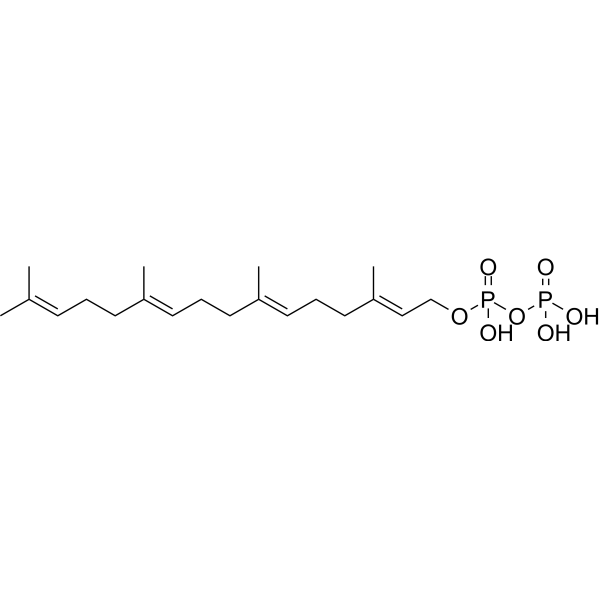
Geranylgeranyl pyrophosphate
Geranylgeranyl pyrophosphate is a type of isoprenoid metabolic intermediate, mainly synthesized through the mevalonate pathway. Geranylgeranyl pyrophosphate is a key precursor in various biological synthesis processes, especially as a necessary substrate for post-translational modification of proteins - geranylgeranyl phosphorylation. Geranylgeranyl pyrophosphate regulates various cellular processes and disease progression through protein geranylgeranyl phosphorylation, such as activating the YAP signaling pathway, promoting cell proliferation and inhibiting apoptosis; promoting IL-2 production and STAT5 phosphorylation; and influencing metabolic homeostasis and cancer, etc.
The free form of the compound is prone to instability, it is advisable to consider the stable salt form (Geranylgeranyl pyrophosphate triammonium) that retains the same biological activity.
For research use only. We do not sell to patients.
- CAS No.: 6699-20-3
- Formula: C20H36O7P2
- Molecular Weight:450.44
-
Storage:
Please store the product under the recommended conditions in the Certificate of Analysis.

To place orders, for customer services and technical support, please contact: MedChemExpress USA
Tel: 609-228-6898 E-mail: [email protected] [email protected]


-
 Biological Activity
-
Chemical Information
- Protocols
- Purity & Documentation
- References
-
 Help & FAQs




Biological Activity
Description
IC50 & Target
[4]|
IL-2 |
STAT5 |
In Vitro
Geranylgeranyl pyrophosphate (10 μM, 24 h) completely reverses the inhibition of insulin-stimulated glucose uptake and the disorder of GLUT4 membrane translocation caused by Simvastatin (HY-17502) in C2C12 cells[1].
Geranylgeranyl pyrophosphate (25 μM, 72 h) regulates the TGF-β1-induced fibroblast-myofibroblast transformation through linalyl modification[2].
Geranylgeranyl pyrophosphate (10 μM, 48 h) promotes hepatic lipid accumulation by prenylation of Perilipin4 in primary mouse liver cells[3].
Geranylgeranyl pyrophosphate (10 μM, 96 h) in primary CD4+ and CD25 T cells modifies Ras protein by geranylgeranylylation, activates the Ras/ERK pathway, promotes IL-2 expression, and thereby enhances STAT5 phosphorylation, driving Treg cell differentiation[4].
Geranylgeranyl pyrophosphate (10 μM, 12 h) completely reverses the proliferation defect and cell apoptosis caused by GGPS1 knockdown or Simvastatin in human umbilical vein endothelial cells[5].
Geranylgeranyl pyrophosphate, when its levels are reduced, inhibits the geranylgeranylation of oncogenic GTPases, ultimately inducing cancer cell death[6].
MedChemExpress (MCE) has not independently confirmed the accuracy of these methods. They are for reference only.
-
Cell Line:Primary human dermal fibroblasts and primary human cardiac fibroblasts
-
Concentration:25 μM with Digeranyl bisphosphonate (DGBP) (HY-U00145) and TGF-β1
-
Incubation Time:72 h
-
Result:Reversed the inhibitory effect of DGBP, the levels of markers such as α-SMA, HSP47, periostin, and FAP were increased.
-
Cell Line:Primary CD4+ and CD25 T cells
-
Concentration:10 μM
-
Incubation Time:96 h
-
Result:Promoted the geranylgeranylation of Ras protein and activated the phosphorylation of ERK1/2.
-
Cell Line:Primary CD4+ and CD25 T cells
-
Concentration:10 μM
-
Incubation Time:96 h
-
Result:Increased the expression of IL-2 mRNA and enhanced the phosphorylation of STAT5.
-
Cell Line:human umbilical vein endothelial cells
-
Concentration:10 μM
-
Incubation Time:12 h
-
Result:Completely reversed cell apoptosis caused by GGPS1 knockdown or Simvastatin.
In Vivo
MedChemExpress (MCE) has not independently confirmed the accuracy of these methods. They are for reference only.
-
Animal Model:Colitis induced by DSS established in female C57BL/6 mice (8-12 weeks old)[1]
-
Dosage:10 mg/kg
-
Administration:Intraperitoneal injection (i.p.), once daily for 10 days
-
Result:Significantly reduced weight loss, increased colon length, and lowered bleeding score. Reduced inflammatory cell infiltration and mucosal damage. Regulated the balance of T cells.
- Western Blot
- Annexin V plus membrane-impermeant dye apoptosis staining
- BrdU Incorporation Assay
- Somatic Cell Culture
- CFSE Dye Dilution Proliferation Assay
- Dye-dilution cell tracking and proliferation staining
- CCK-8/WST-8 Cell Proliferation Assay
- Protocol for Cell Cycle
- Cell Counting-Based Growth Curve Assay
- Colony Formation (Clonogenic) Assay
- Cell Viability Determination by MTT Colorimetric Assay
- Kinase activity and phosphorylation assays
- EdU Incorporation Assay (Click Chemistry-Based DNA Synthesis Measurement)
- Ki-67 Immunostaining Proliferation Assay
- Detection of Apoptosis
- TUNEL staining for apoptotic DNA fragmentation
- PCNA Immunodetection Proliferation Assay
- Protocol for Cell Counting and Cell Density Analysis
- Apoptosis Solutions
- Protocol for Kinase activity and phosphorylation assays
- MTT Cell Proliferation Assay


Chemical Information
-
CAS No. 6699-20-3
-
Molecular Weight 450.44
-
Formula C20H36O7P2
-
SMILES
O=P(O)(OP(O)(O)=O)OC/C=C(C)/CC/C=C(C)/CC/C=C(C)/CC/C=C(C)/C
-
Structure Classification
-
Initial Source
-
Shipping
Room temperature in continental US; may vary elsewhere.
-
Storage
Please store the product under the recommended conditions in the Certificate of Analysis.


Purity & Documentation
References
[1]. Zhu L, et al. Dietary Geranylgeranyl Pyrophosphate Counteracts the Benefits of Statin Therapy in Experimental Pulmonary Hypertension. Circulation. 2021 May 4;143(18):1775-1792. [Content Brief]
[2]. Wang L, et al. Geranylgeranyl pyrophosphate depletion by statins compromises skeletal muscle insulin sensitivity. J Cachexia Sarcopenia Muscle. 2022 Dec;13(6):2697-2711. [Content Brief]
[3]. Ross GR, et al. Geranylgeranyl Pyrophosphate Promotes Profibrotic Factors and Collagen-Specific Chaperone HSP47 in Fibroblasts. J Cell Mol Med. 2024 Dec;28(24):e70273. [Content Brief]
[4]. Zhao Y, et al. Geranylgeranyl Pyrophosphate Promotes Hepatic Lipid Accumulation by Prenylation of Perilipin4. Cell Mol Gastroenterol Hepatol. 2025;19(9):101546. [Content Brief]
[5]. Pandit M, et al. Geranylgeranyl pyrophosphate amplifies Treg differentiation via increased IL-2 expression to ameliorate DSS-induced colitis. Eur J Immunol. 2021 Jun;51(6):1461-1472. [Content Brief]
[6]. Waller DD, et al. Inhibition of farnesyl pyrophosphate (FPP) and/or geranylgeranyl pyrophosphate (GGPP) biosynthesis and its implication in the treatment of cancers. Crit Rev Biochem Mol Biol. 2019 Feb;54(1):41-60. [Content Brief]

Calculators
Concentration (start) × Volume (start) = Concentration (final) × Volume (final)


Geranylgeranyl pyrophosphate Related Classifications
HY-126370 Related Classifications
 Powered by Bioz