



ICG-DBCO

Based on 1 Customer Validation
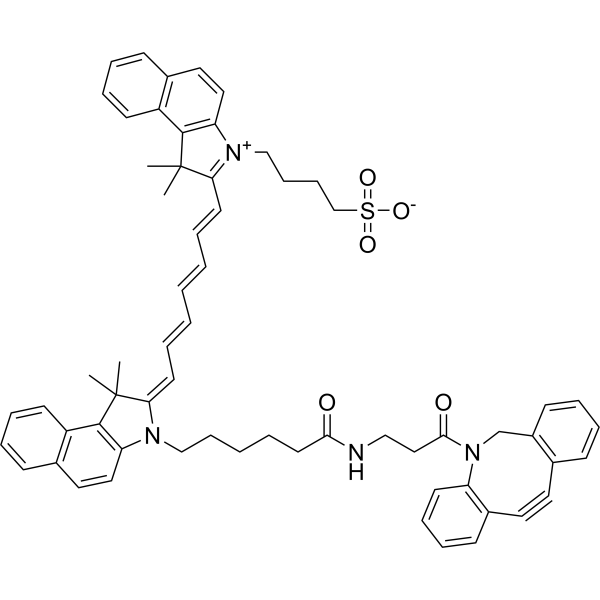
ICG-DBCO is a near-infrared fluorescent click chemistry reagent (Ex/Em = 789/813 nm), composed of Indocyanine green (ICG) (HY-D0711) and dibenzocyclooctyne (DBCO). ICG-DBCO enables copper-free, strain-promoted azide-alkyne cycloaddition (SPAAC) for labeling biomolecules such as antibodies, proteins and peptides, thereby facilitating deep tissue optical imaging.
For research use only. We do not sell to patients.
- Purity : 98.83%
- CAS No.: 3024705-52-7
- Formula: C63H64N4O5S
- Molecular Weight:989.27
-
Storage:
Please store the product under the recommended conditions in the Certificate of Analysis.

To place orders, for customer services and technical support, please contact: MedChemExpress USA
Tel: 609-228-6898 E-mail: [email protected] [email protected]


-
 Biological Activity
-
Chemical Information
-
Solvent & Solubility
- Protocols
- Purity & Documentation
- References
-
 Help & FAQs




Biological Activity
Description
In Vitro
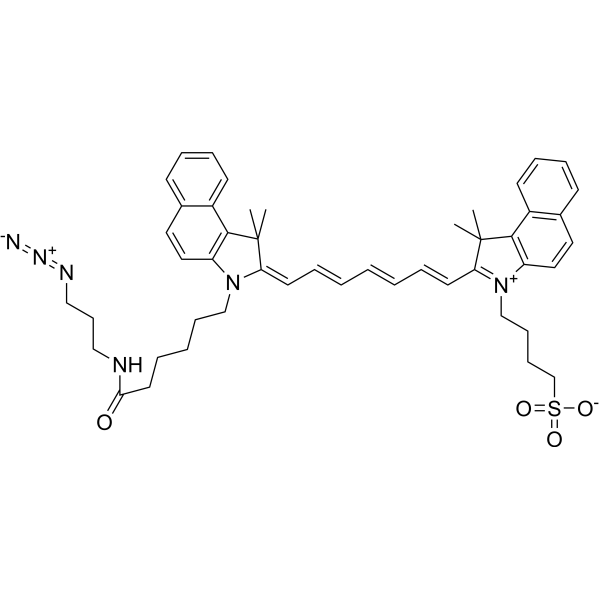
IC50 is not present here; correcting to apply proper tags per rules:\nICG-DBCO (320 µM; 12 h) covalently binds to HA-N3 via copper-free click chemistry at a 4:1 molar ratio (ICG-DBCO:HA-N3) for 12 h at room temperature, forming an intermediate that self-assembles into HA@ICG NPs with a redshifted fluorescence emission peak at 830 nm[1].
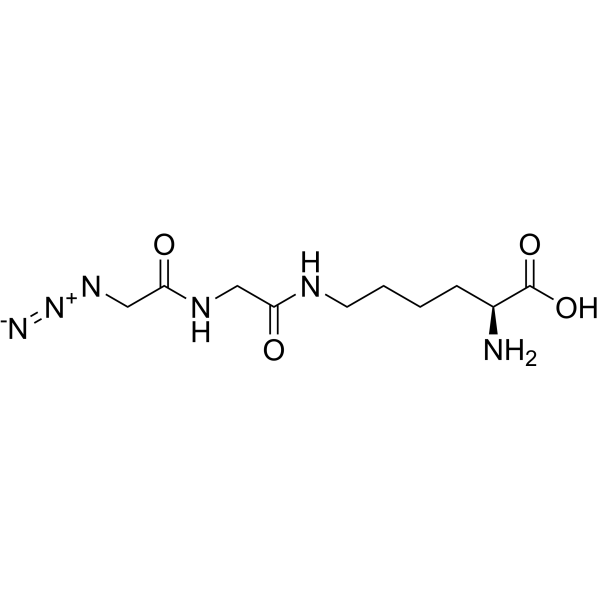
IC50G-DBCO (8:1 molar ratio; 12 h) successfully labels peptide-polymer conjugates PEG-K(N3)-MP9 and PEG-K(N3)-MP9-aPDL1 via click chemistry to generate fluorescently tagged constructs for in vivo biodistribution studies[2].
MedChemExpress (MCE) has not independently confirmed the accuracy of these methods. They are for reference only. Further protocols information, click here.


Chemical Information
-
CAS No. 3024705-52-7
-
Appearance Solid
-
Molecular Weight 989.27
-
Formula C63H64N4O5S
-
Color Brown to breen
-
SMILES
CC1(C)C2=C(C=CC3=C2C=CC=C3)N(CCCCCC(NCCC(N4CC5=C(C#CC6=C4C=CC=C6)C=CC=C5)=O)=O)/C1=C/C=C/C=C/C=C/C7=[N+](CCCCS(=O)([O-])=O)C8=C(C9=C(C=CC=C9)C=C8)C7(C)C
-
Shipping
Room temperature in continental US; may vary elsewhere.
-
Storage
Please store the product under the recommended conditions in the Certificate of Analysis.


Solvent & Solubility
In Vitro:
DMSO : 50 mg/mL (50.54 mM; Need ultrasonic; Hygroscopic DMSO has a significant impact on the solubility of product, please use newly opened DMSO)
Concentration (start) × Volume (start) = Concentration (final) × Volume (final)

Protocols
-
EdU Incorporation Assay (Click Chemistry-Based DNA Synthesis Measurement)
The EdU incorporation assay measures DNA synthesis by adding the thymidine analog 5-ethynyl-2′-deoxyuridine to cells or tissues, where it is incorporated into newly synthesized DNA during S phase. Incorporated EdU is detected by copper-catalyzed azide-alkyne cycloaddition, in which a fluorescent azide covalently reacts with the ethynyl group on EdU, allowing S-phase cells to be detected by fluorescence microscopy, flow cytometry, or high-content imaging. EdU detection does not require DNA denaturation or anti-BrdU antibody access, which preserves sample structure and improves compatibility with immunostaining and multiparameter cytometry compared with BrdU-based detection. EdU can be cytotoxic in a cell-type- and exposure-dependent manner, so pulse duration, concentration, and continuous-labeling designs should be validated for each cell type.


Purity & Documentation
-
Data Sheet (277 KB)
-
SDS (394 KB)
- English - EN (394 KB)
- Français - FR (394 KB)
- Deutsch - DE (394 KB)
- Norwegian - NO (394 KB)
- Español - ES (394 KB)
- Swedish - SV (394 KB)
- Italian - IT (394 KB)
- Korean - KR (394 KB)
- Portuguese - PT (394 KB)
-
Handling Instructions (2659 KB)
References
[1]. Zhang H, et al. Hyaluronic acid modified indocyanine green nanoparticles: a novel targeted strategy for NIR-II fluorescence lymphatic imaging. Frontiers in chemistry. 2024;12:1435627. [Content Brief]
[2]. Lu L, et al. Polymer chimera of stapled oncolytic peptide coupled with anti-PD-L1 peptide boosts immunotherapy of colorectal cancer. Theranostics. 2022;12(7):3456-3473. [Content Brief]


Complete Stock Solution Preparation Table
| Optional Solvent | Concentration Solvent Mass | 1 mg | 5 mg | 10 mg | 25 mg |
|---|---|---|---|---|---|
| DMSO | 1 mM | 1.0108 mL | 5.0542 mL | 10.1085 mL | 25.2712 mL |
| 5 mM | 0.2022 mL | 1.0108 mL | 2.0217 mL | 5.0542 mL | |
| 10 mM | 0.1011 mL | 0.5054 mL | 1.0108 mL | 2.5271 mL | |
| 15 mM | 0.0674 mL | 0.3369 mL | 0.6739 mL | 1.6847 mL | |
| 20 mM | 0.0505 mL | 0.2527 mL | 0.5054 mL | 1.2636 mL | |
| 25 mM | 0.0404 mL | 0.2022 mL | 0.4043 mL | 1.0108 mL | |
| 30 mM | 0.0337 mL | 0.1685 mL | 0.3369 mL | 0.8424 mL | |
| 40 mM | 0.0253 mL | 0.1264 mL | 0.2527 mL | 0.6318 mL | |
| 50 mM | 0.0202 mL | 0.1011 mL | 0.2022 mL | 0.5054 mL |


ICG-DBCO Related Classifications
HY-W588722 Related Classifications
 Powered by Bioz