



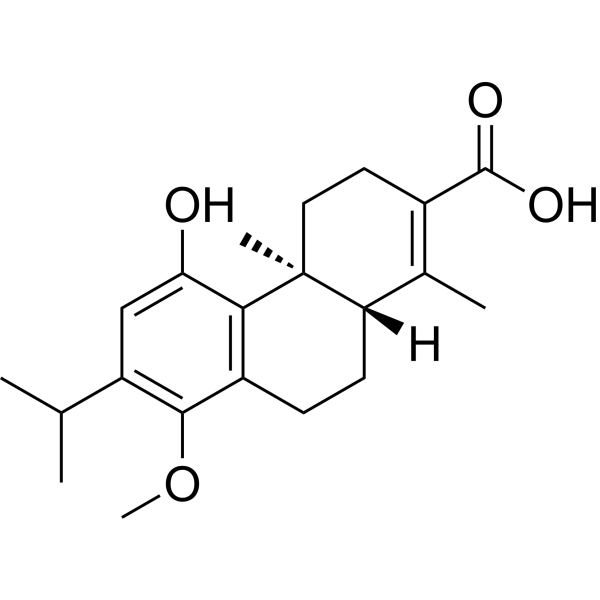
Triptobenzene H
Triptobenzene H (Hypoglic acid) significantly increases TNF-α and IL-1β mRNA levels in macrophages, causing indirect liver damage.
For research use only. We do not sell to patients.
- CAS No.: 146900-55-2
- Formula: C21H28O4
- Molecular Weight:344.44
-
Storage:
Please store the product under the recommended conditions in the Certificate of Analysis.

To place orders, for customer services and technical support, please contact: MedChemExpress USA
Tel: 609-228-6898 E-mail: [email protected] [email protected]


-
 Biological Activity
-
Chemical Information
- Protocols
- Purity & Documentation
- References
-
 Help & FAQs




Biological Activity
Description
Cellular Effect
|
Cell Line

|
Type | Value | Description | References |
|---|---|---|---|---|
| A549 | IC50 |
>100 μM
Compound: 14
|
Cytotoxicity against human A549 cells after 48 hrs by MTT assay
Cytotoxicity against human A549 cells after 48 hrs by MTT assay
|
[PMID: 27133593] |
| Bcap37 | IC50 |
>100 μM
Compound: 14
|
Cytotoxicity against human Bcap37 cells after 48 hrs by MTT assay
Cytotoxicity against human Bcap37 cells after 48 hrs by MTT assay
|
[PMID: 27133593] |
| Hep 3B2 | IC50 |
>100 μM
Compound: 14
|
Cytotoxicity against human Hep3B cells after 48 hrs by MTT assay
Cytotoxicity against human Hep3B cells after 48 hrs by MTT assay
|
[PMID: 27133593] |
| HepG2 | IC50 |
>100 μM
Compound: 14
|
Cytotoxicity against human HepG2 cells after 48 hrs by MTT assay
Cytotoxicity against human HepG2 cells after 48 hrs by MTT assay
|
[PMID: 27133593] |
| MCF7 | IC50 |
>100 μM
Compound: 14
|
Cytotoxicity against human MCF7 cells after 48 hrs by MTT assay
Cytotoxicity against human MCF7 cells after 48 hrs by MTT assay
|
[PMID: 27133593] |
| U-251 | IC50 |
>100 μM
Compound: 14
|
Cytotoxicity against human U251 cells after 48 hrs by MTT assay
Cytotoxicity against human U251 cells after 48 hrs by MTT assay
|
[PMID: 27133593] |


Chemical Information
-
CAS No. 146900-55-2
-
Molecular Weight 344.44
-
Formula C21H28O4
-
SMILES
O=C(C1=C(C)[C@]2([H])CCC3=C(C(O)=CC(C(C)C)=C3OC)[C@@]2(C)CC1)O
-
Synonyms
Hypoglic acid
-
Structure Classification
-
Initial Source
-
Shipping
Room temperature in continental US; may vary elsewhere.
-
Storage
Please store the product under the recommended conditions in the Certificate of Analysis.

Protocols
-
RNA extraction experimental
By lysing cells, releasing RNA, and removing impurities such as proteins and DNA, high-purity RNA products are finally obtained. The commonly used traditional method is the guanidine isothiocyanate/phenol/chloroform method (Trizol), which is suitable for a variety of animal materials including animal tissues, microorganisms, cultured cells, etc., and most plant materials.
-
Hepatotoxicity Study
This protocol evaluates hepatotoxicity using complementary in vivo mouse APAP acute liver injury and in vitro hepatocyte-based cytotoxicity readouts. In vivo APAP injury is assessed by serum ALT/AST, liver histology, hepatic glutathione, protein adducts, necrosis, inflammation, and regeneration-related endpoints. In vitro hepatotoxicity is assessed by loss of viability, leakage of ALT/AST/LDH, oxidative-stress markers, mitochondrial function, nuclear morphology, intracellular calcium, and high-content imaging endpoints.
-
Pyroptosis Solutions
Pyroptosis is a lytic inflammatory cell-death pathway executed by gasdermin pores, most classically through inflammasome-mediated activation of caspase-1, cleavage of gasdermin D, membrane pore formation, LDH release, and secretion of IL-1β and IL-18. The canonical pathway is commonly modeled by priming cells with an inflammatory signal such as LPS to induce pro-IL-1β and inflammasome components, followed by an activation signal such as ATP or nigericin to activate NLRP3, ASC speck formation, caspase-1 cleavage, GSDMD cleavage, cytokine release, and pyroptotic membrane rupture. The non-canonical pathway is triggered when cytosolic LPS activates mouse caspase-11 or human caspase-4/5, leading to GSDMD cleavage and pyroptosis, and this can secondarily activate NLRP3-dependent IL-1β release. Pyroptosis is linked to inflammatory injury, infection, cancer, liver disease, ocular disease, placental inflammation, and other disease phenotypes, but unresolved questions include which gasdermin fam


Purity & Documentation
References

Calculators
Concentration (start) × Volume (start) = Concentration (final) × Volume (final)


Triptobenzene H Related Classifications
HY-N1125 Related Classifications
 Powered by Bioz