



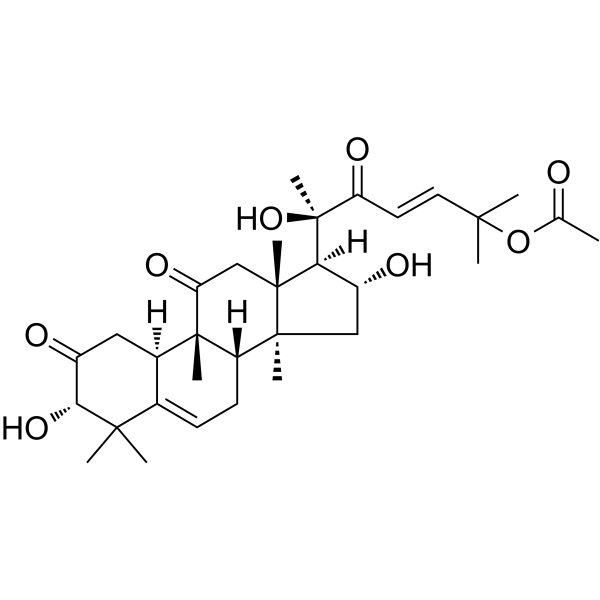
Isocucurbitacin B

Based on 1 Customer Validation
Isocucurbitacin B is a natural terpenoid compound found in Pedicellus Melo. Isocucurbitacin B can inhibit the PI3K/AKT, MAPK, and STAT3 signaling pathways and downregulate CAV1 expression. Isocucurbitacin B can inhbit cancer cell proliferation, migration and invision. Isocucurbitacin B can induce apoptosis and cause G2/M phase arrest. Isocucurbitacin B can decrease intracellular cholesterol and PH levels and increase intracellular calcium levels. Isocucurbitacin B can be used for the research of cancer, such as glioma[1][2].
For research use only. We do not sell to patients.
- Purity : 98.98%
- CAS No.: 17278-28-3
- Formula: C32H46O8
- Molecular Weight:558.70
-
Storage:
4°C, protect from light
* In solvent : -80°C, 6 months; -20°C, 1 month (protect from light)

To place orders, for customer services and technical support, please contact: MedChemExpress USA
Tel: 609-228-6898 E-mail: [email protected] [email protected]


-
 Biological Activity
-
Chemical Information
- Protocols
- Purity & Documentation
- References
-
 Help & FAQs




Biological Activity
Description
IC50 & Target
[1]|
STAT3 |
In Vitro
Isocucurbitacin B (0.001-25 μmol/L; 12-24 h) inhibits the proliferation of U251 and U87 cells[1][2].
Isocucurbitacin B (0-1 μmol/L; 24 h) induces U251 and GL261 cell apoptosis[1][2].
IsoCuB (0-1 μmol/L; 24 hours) blocks the cell cycle at the G2/M phase, reducing cyclin A2 and CDK1 expression in U251 cells[2].
Isocucurbitacin B (0-0.1 μmol/L; 12-36 hours) inhibits U251 and GL261 cells migration and invasion, reducing MMP2, N-cadherin, and vimentin levels[1][2].
Isocucurbitacin B (0-0.1 μmol/L; 24 h) inhibits U251 and GL261 cells invasion[1][2].
Isocucurbitacin B (0-1 μmol/L; 24 h) inhibits the activation of PI3K/AKT, MAPK, and STAT3 signaling pathways in U251 cells[1].
Isocucurbitacin B (0-1 μmol/L; 24 h) downregulates pdk1, RXRα, PPAα, and Bcl-2 mRNA expressions in U251 cells[1].
Isocucurbitacin B (0-1 μmol/L; 24 hours) decreases intracellular cholesterol and PH levels and increases intracellular calcium levels in U251 cells[2].
MedChemExpress (MCE) has not independently confirmed the accuracy of these methods. They are for reference only.
-
Cell Line:U251 and U87 cells
-
Concentration:0.001, 0.01, 0.1, 0.5, 1, 5, 25 μmol/L
-
Incubation Time:12 h, 24 h
-
Result:Inhibited U251 and U87 cell proliferation in a concentration- and time-dependent manner.
-
Cell Line:U251 and GL261 cells
-
Concentration:0, 0.1, 0.5, 1 μmol/L
-
Incubation Time:24 h
-
Result:Promoted the apoptosis of U251 and GL261 cells in a concentration-dependent manner. Increaseed BCL-2 amd BAX levels.
-
Cell Line:U251 and GL261
-
Concentration:0, 0.001, 0.01, 0.005, 0.1 μmol/L
-
Incubation Time:12 h, 24 h, 36 h
-
Result:Inhibited the migration of U251 and GL 261 cells in a concentration- and time-dependent manner.
-
Cell Line:U251 and GL261
-
Concentration:0, 0.001, 0.01, 0.05, 0.1 μmol/L
-
Incubation Time:24 h
-
Result:Inhibited the invasion of U251 and GL261 cells in a concentration-dependent manner.
-
Cell Line:U251
-
Concentration:0, 0.1, 0.5, 1 μmol/L
-
Incubation Time:24 h
-
Result:Inhibited the activation of the PI3K/AKT, MAPK, and STAT3 signaling pathways by decreasing the levels of p-MAPK1/3, total PI3K, t-AKT, PDK1, and p-STAT3 proteins.
-
Cell Line:U251
-
Concentration:0, 0.1, 0.5, 1 μmol/L
-
Incubation Time:24 h
-
Result:Downregulated the mRNA expressions of PDK1, RXRα, PPARα, and Bcl-2 in U251 cells.
-
Cell Line:U251 cells
-
Concentration:0, 0.1, 0.5, 1 μmol/L
-
Incubation Time:24 hours
-
Result:Blocked the cell cycle of U251 cells at the G2/M phase in a concentration-dependent manner and reduced expression levels of cyclin A2 and CDK1.
In Vivo
Isocucurbitacin B (0.025-0.05 mg/L; 72 hours) reduces tumor burden in glioma cell-induced zebrafish[2].
Isocucurbitacin B (1 mg/kg; intraperitoneal; daily; 21 days from day 7) inhibits glioma growth in GL261 cell-induced glioma in C57BL/6 mice[2].
MedChemExpress (MCE) has not independently confirmed the accuracy of these methods. They are for reference only.
-
Animal Model:Six-week-old specific pathogen-free (SPF) BALB/c nude mice transplanted with U251 cells [1]
-
Dosage:2 mg/kg
-
Administration:Intraperitoneally injection; daily; 18 days from day 6
-
Result:Tumor growth was significantly inhibited. No significant effect on body weight was observed.
-
Animal Model:C57BL/6 (Male, 5 weeks old)[2]
-
Dosage:1 mg/kg
-
Administration:intraperitoneal; daily; 27 days
-
Result:Tumor volume was significantly reduced, and cell proliferation and glial fibrillary acidic protein expression were decreased.
-
Animal Model:Glioma cell-induced Zebrafish[2]
-
Dosage:0.025 mg/L, 0.05 mg/L
-
Administration:In water; 72 hours
-
Result:Fluorescence intensity was significantly reduced, indicating a reduction in tumor burden.
- RNA extraction experimental
- Annexin V plus membrane-impermeant dye apoptosis staining
- BrdU Incorporation Assay
- Cell migration
- Somatic Cell Culture
- CFSE Dye Dilution Proliferation Assay
- Dye-dilution cell tracking and proliferation staining
- CCK-8/WST-8 Cell Proliferation Assay
- Protocol for Cell Cycle
- Cell Counting-Based Growth Curve Assay
- Ca2+ Staining Technique
- Colony Formation (Clonogenic) Assay
- Cell Viability Determination by MTT Colorimetric Assay
- EdU Incorporation Assay (Click Chemistry-Based DNA Synthesis Measurement)
- Ki-67 Immunostaining Proliferation Assay
- Detection of Apoptosis
- TUNEL staining for apoptotic DNA fragmentation
- PCNA Immunodetection Proliferation Assay
- Flow cytometric DNA-content cell-cycle staining
- Protocol for Cell Counting and Cell Density Analysis
- Apoptosis Solutions
- Calcium Spark Assay
- MTT Cell Proliferation Assay


Chemical Information
-
CAS No. 17278-28-3
-
Appearance Solid
-
Molecular Weight 558.70
-
Formula C32H46O8
-
Color White to off-white
-
SMILES
C[C@]12[C@@]([C@]([C@@](C)(O)C(/C=C/C(C)(C)OC(C)=O)=O)([H])[C@H](O)C1)(CC([C@]3(C)[C@@]2([H])CC=C4[C@@]3([H])CC([C@@H](O)C4(C)C)=O)=O)C
-
Structure Classification
-
Initial Source
-
Shipping
Room temperature in continental US; may vary elsewhere.
-
Storage
4°C, protect from light
* In solvent : -80°C, 6 months; -20°C, 1 month (protect from light)


Purity & Documentation
-
Data Sheet (280 KB)
-
SDS (252 KB)
- English - EN (252 KB)
- Français - FR (252 KB)
- Deutsch - DE (252 KB)
- Norwegian - NO (252 KB)
- Español - ES (252 KB)
- Swedish - SV (252 KB)
- Italian - IT (252 KB)
- Korean - KR (252 KB)
- Portuguese - PT (252 KB)
-
Handling Instructions (2659 KB)
References
[1]. Han M, et al. Isocucurbitacin B inhibits glioma growth through PI3K/AKT pathways and increases glioma sensitivity to TMZ by inhibiting hsa-mir-1286a. Cancer Drug Resist. 2024;7:16. Published 2024 May 8. [Content Brief]
[2]. Han M, et al. Isocucurbitacin B inhibits gliomas through the promotion of anoikis by targeting caveolin 1. Cancer Lett. 2025;629:217873. [Content Brief]

Calculators
Concentration (start) × Volume (start) = Concentration (final) × Volume (final)


Isocucurbitacin B Related Classifications
HY-N4189 Related Classifications
 Powered by Bioz