



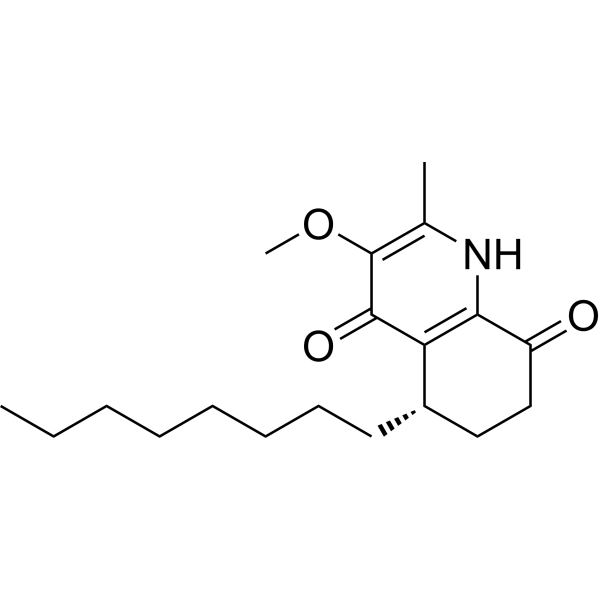
Antidesmone
Antidesmone is a isoquinoline alkaloid that can be isolated from Antidesma membranaceum. Antidesmone can prevent acute lung injury in vivo via inhibiting MAPK and NF-κb activities.
For research use only. We do not sell to patients.
- CAS No.: 222629-77-8
- Formula: C19H29NO3
- Molecular Weight:319.44
-
Storage:
Please store the product under the recommended conditions in the Certificate of Analysis.

To place orders, for customer services and technical support, please contact: MedChemExpress USA
Tel: 609-228-6898 E-mail: [email protected] [email protected]


-
 Biological Activity
-
Chemical Information
- Protocols
- Purity & Documentation
- References
-
 Help & FAQs




Biological Activity
Description
Cellular Effect
|
Cell Line

|
Type | Value | Description | References |
|---|---|---|---|---|
| A549 | IC50 |
8.4 μM
Compound: 8
|
Antiproliferative activity against human A549 cells assessed as reduction in cell viability after 72 hrs by SRB assay
Antiproliferative activity against human A549 cells assessed as reduction in cell viability after 72 hrs by SRB assay
|
[PMID: 32946697] |
| HeLa | IC50 |
23.4 μg/mL
Compound: 13
|
Cytotoxicity against human HeLa cells after 48 hrs by SRB assay
Cytotoxicity against human HeLa cells after 48 hrs by SRB assay
|
[PMID: 26848627] |
| KB | IC50 |
17.7 μM
Compound: 8
|
Antiproliferative activity against human KB cells assessed as reduction in cell viability after 72 hrs by SRB assay
Antiproliferative activity against human KB cells assessed as reduction in cell viability after 72 hrs by SRB assay
|
[PMID: 32946697] |
| L6 | IC50 |
184.3 μM
Compound: 10
|
Cytotoxicity against rat L6 cells
Cytotoxicity against rat L6 cells
|
[PMID: 25314007] |
| MCF7 | IC50 |
6.4 μM
Compound: 8
|
Antiproliferative activity against human MCF7 cells assessed as reduction in cell viability after 72 hrs by SRB assay
Antiproliferative activity against human MCF7 cells assessed as reduction in cell viability after 72 hrs by SRB assay
|
[PMID: 32946697] |
| MDA-MB-231 | IC50 |
6.7 μM
Compound: 8
|
Antiproliferative activity against human MDA-MB-231 cells assessed as reduction in cell viability after 72 hrs by SRB assay
Antiproliferative activity against human MDA-MB-231 cells assessed as reduction in cell viability after 72 hrs by SRB assay
|
[PMID: 32946697] |
| RAW264.7 | IC50 |
16.1 μM
Compound: 18
|
Inhibition of NO production in LPS-stimulated mouse RAW264.7 cells preincubated for 15 mins followed by LPS stimulation and measured after 20 hrs by Griess reagent based assay
Inhibition of NO production in LPS-stimulated mouse RAW264.7 cells preincubated for 15 mins followed by LPS stimulation and measured after 20 hrs by Griess reagent based assay
|
[PMID: 36746775] |


Chemical Information
-
CAS No. 222629-77-8
-
Molecular Weight 319.44
-
Formula C19H29NO3
-
SMILES
O=C1C(OC)=C(C)NC2=C1[C@@H](CCCCCCCC)CCC2=O
-
Structure Classification
-
Initial Source
-
Shipping
Room temperature in continental US; may vary elsewhere.
-
Storage
Please store the product under the recommended conditions in the Certificate of Analysis.


Purity & Documentation
References

Calculators
Concentration (start) × Volume (start) = Concentration (final) × Volume (final)


Antidesmone Related Classifications
HY-119731 Related Classifications
 Powered by Bioz