



ML402
Based on 1 publication(s) in Google Scholar
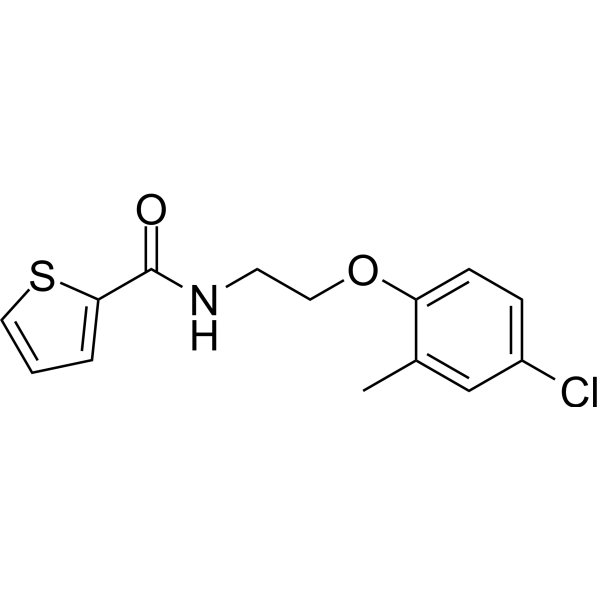
ML402, a thiophene-carboxamide, is a selective K2P2.1(TREK-1) and K2P10.1(TREK-2) activator. ML402 is inactive against K2P4.1(TRAAK).
For research use only. We do not sell to patients.
- Purity : 99.42%
- CAS No.: 298684-44-3
- Formula: C14H14ClNO2S
- Molecular Weight:295.78
-
Storage:Powder -20°C, 3 years , 4°C, 2 years ; In solvent -80°C, 2 years , -20°C, 1 year

To place orders, for customer services and technical support, please contact: MedChemExpress USA
Tel: 609-228-6898 E-mail: [email protected] [email protected]


-
 Biological Activity
-
Chemical Information
-
Solvent & Solubility
- Purity & Documentation
- References
-
 Help & FAQs


-
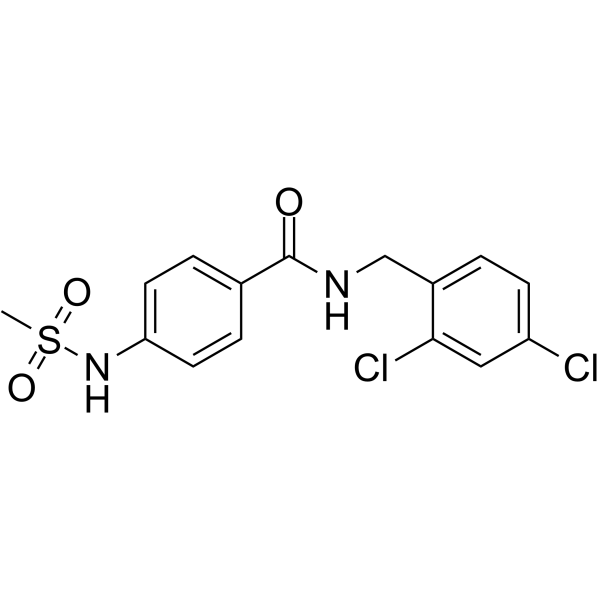
HY-104005
ML335TREK-1/2 Activator -
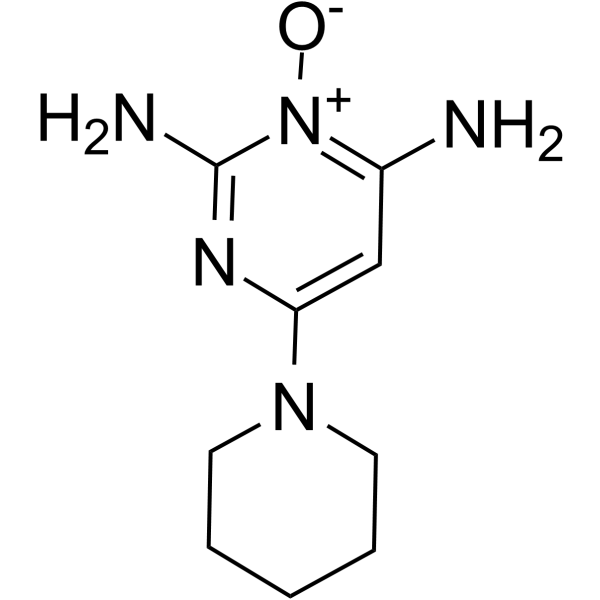
HY-B0112
MinoxidilEndogenous Metabolite -
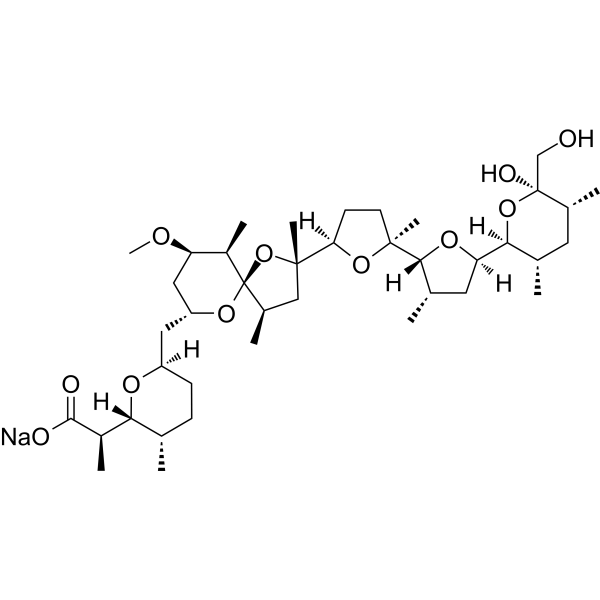
HY-100381
Nigericin sodium saltNLRP3 Activator -
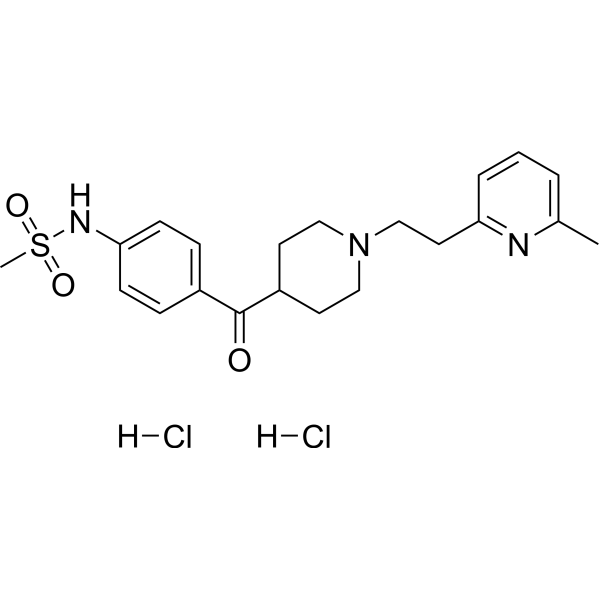
HY-15551
E-4031hERG Channels Blocker -
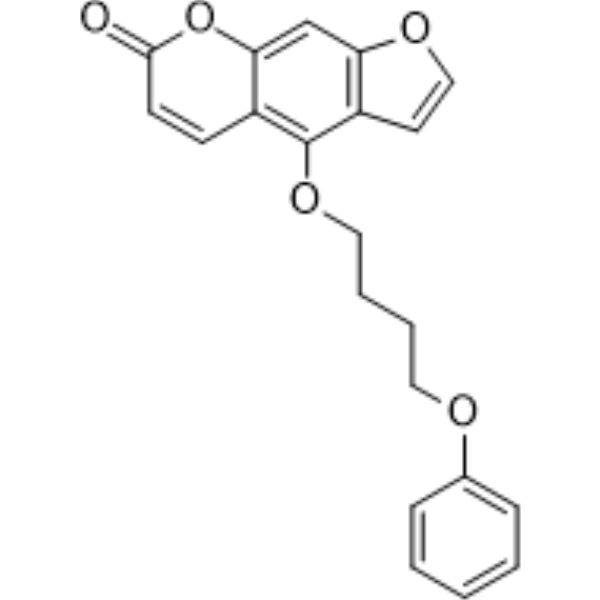
HY-10015
PAP-1Kv1.3 Blocker -
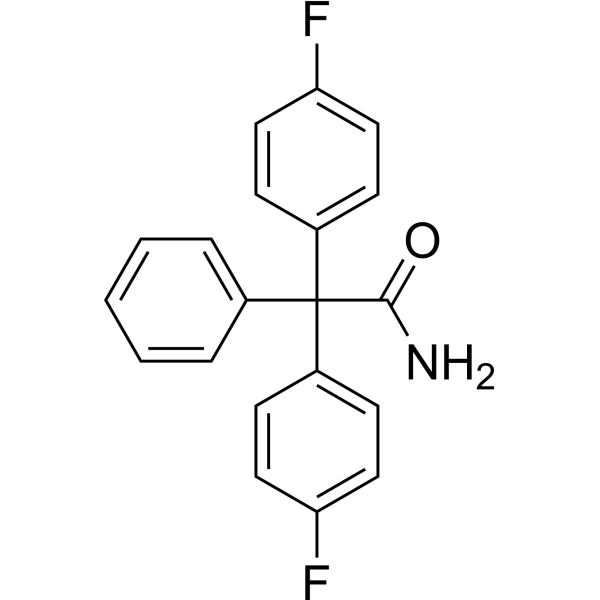
HY-50694
SenicapocGardos Channel Blocker -
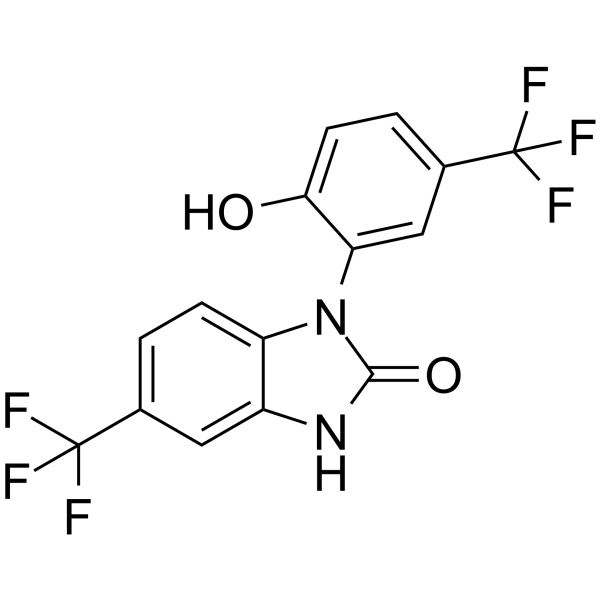
HY-12496
NS-1619BK Channel Opener -
HY-K0010
Protease Inhibitor Cocktail (EDTA-Free, 100× in DMSO) -
HY-K0011
Protease Inhibitor Cocktail, mini-Tablet (EDTA-Free) -
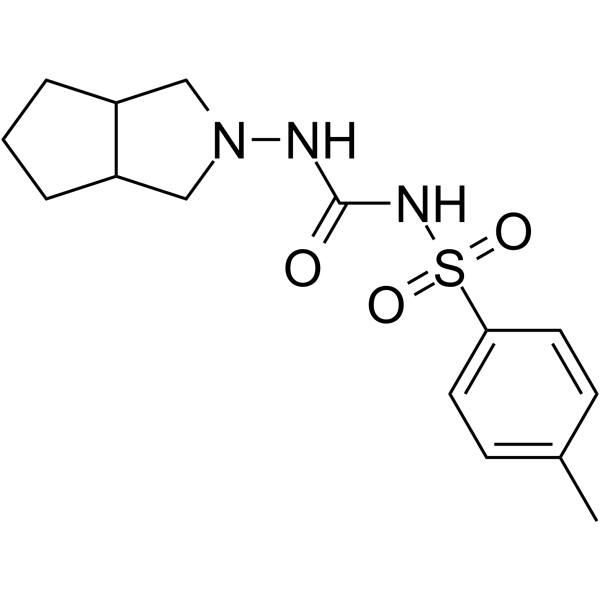
HY-B0753
GliclazidePotassium Currents Blocker -

HY-B0112R
Minoxidil (Standard)Endogenous Metabolite -
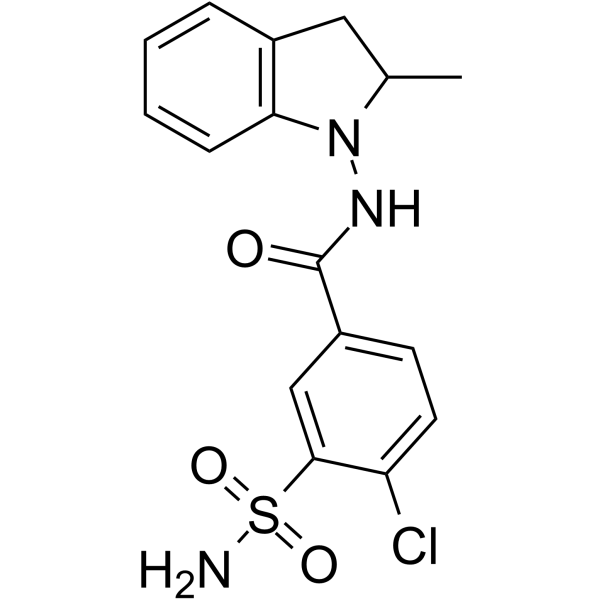
HY-B0259
IndapamideDiuretic Agent
Publications Citing Use of MedChemExpress (MCE) ML402
More

Biological Activity
Description
IC50 & Target
TREK-1/2[1]
In Vitro
Xenopus oocyte two-electrode voltage-clamp measurements show that ML335 and ML402 activate K2P2.1 and K2P10.1 but not K2P4.1(14.3±2.7 μM, K2P2.1-ML335; 13.7±7.0 μM, K2P2.1-ML402; 5.2±0.5 μM, K2P10.1-ML335; and 5.9±1.6 μM, K2P10.1-ML402). The K2P modulator pocket has a single difference among TREK subfamily members at the cation-π interaction position, K2P2.1 Lys271, which is also a lysine in K2P10.1 but a glutamine in K2P4.1. Swapping the Lys271 equivalent between K2P2.1 and K2P4.1 results in a clear phenotype reversal for ML335 and M402 activation. K2P2.1 (K271Q) is insensitive to ML335 and ML402, whereas K2P4.1 (Q258K) responds to both with a similar EC50 to K2P2.1 (14.3±2.7 μM, K2P2.1-ML335; 16.2±3.0 μM, K2P4.1(Q258K)-ML335; 13.7±7.0 μM, K2P2.1-ML402; 13.6±1.5 μM, K2P4.1 (Q258K)-ML402) but with a lower magnitude response than K2P2.1[1].
MedChemExpress (MCE) has not independently confirmed the accuracy of these methods. They are for reference only.


Chemical Information
-
CAS No. 298684-44-3
-
Appearance Solid
-
Molecular Weight 295.78
-
Formula C14H14ClNO2S
-
Color White to off-white
-
SMILES
O=C(C1=CC=CS1)NCCOC2=CC=C(Cl)C=C2C
-
Shipping
Room temperature in continental US; may vary elsewhere.
-
Storage
Powder -20°C 3 years 4°C 2 years In solvent -80°C 2 years -20°C 1 year


Publications (1)
-
Journal Impact Factor
-
Most Recent
-
Sci Rep
2024 Jul 2;14(1):15244. PMID: 38956407


Solvent & Solubility
In Vitro:
DMSO : ≥ 100 mg/mL (338.09 mM; Hygroscopic DMSO has a significant impact on the solubility of product, please use newly opened DMSO)
* "≥" means soluble, but saturation unknown.
Please refer to the solubility information to select the appropriate solvent. Once prepared, please aliquot and store the solution to prevent product inactivation from repeated freeze-thaw cycles.
Storage method and period of stock solution: -80°C, 2 years; -20°C, 1 year. When stored at -80°C, please use it within 2 years. When stored at -20°C, please use it within 1 year.
Please refer to the solubility information to select the appropriate solvent. Once prepared, please aliquot and store the solution to prevent product inactivation from repeated freeze-thaw cycles.
Storage method and period of stock solution: -80°C, 2 years; -20°C, 1 year. When stored at -80°C, please use it within 2 years. When stored at -20°C, please use it within 1 year.
Concentration (start) × Volume (start) = Concentration (final) × Volume (final)
In Vivo:
Select the appropriate dissolution method based on your experimental animal and administration route.
- For the following dissolution methods, please ensure to first prepare a clear stock solution using an In Vitro approach and then sequentially add co-solvents:
- To ensure reliable experimental results, the clarified stock solution can be appropriately stored based on storage conditions. As for the working solution for In Vivo experiments, it is recommended to prepare freshly and use it on the same day.
- The percentages shown for the solvents indicate their volumetric ratio in the final prepared solution. If precipitation or phase separation occurs during preparation, heat and/or sonication can be used to aid dissolution.
Add each solvent one by one: 10% DMSO 40% PEG300 5% Tween-80 45% Saline
Solubility: ≥ 2.5 mg/mL (8.45 mM); Clear solution
This protocol yields a clear solution of ≥ 2.5 mg/mL (saturation unknown).
Taking 1 mL working solution as an example, add 100 μL DMSO stock solution (25.0 mg/mL) to 400 μL PEG300, and mix evenly; then add 50 μL Tween-80 and mix evenly; then add 450 μL Saline to adjust the volume to 1 mL.
Preparation of Saline: Dissolve 0.9 g sodium chloride in ddH₂O and dilute to 100 mL to obtain a clear Saline solution.
In Vivo Dissolution Calculator
Please enter the basic information of animal experiments:
-
-
-
-
Recommended: Prepare an additional quantity of animals to account for potential losses during experiments.
Please enter your animal formula composition:
-
%DMSO +
Recommended: Keep the proportion of DMSO in working solution below 2% if your animal is weak.
-
%+
-
+%Tween-80 + +
-
%Saline +
The co-solvents required include: DMSO, . All of co-solvents are available by MedChemExpress (MCE). , Tween 80. All of co-solvents are available by MedChemExpress (MCE).
Working solution concentration: 0.22 mg/mL
Method for preparing stock solution: mg drug dissolved in μL DMSO. Stock solution concentration: mg/mL.
1. Take μL DMSO stock solution;
2. Add μL .
μL , mix evenly;
3. Then add μL Tween 80, mix evenly;
4. Then add μL
Please ensure that the stock solution in the first step is dissolved to a clear state, and add co-solvents in sequence. You can use ultrasonic heating (ultrasonic cleaner, recommended frequency 20-40 kHz), vortexing, etc. to assist dissolution.


Purity & Documentation
-
Data Sheet (274 KB)
-
SDS (393 KB)
- English - EN (393 KB)
- Français - FR (393 KB)
- Deutsch - DE (393 KB)
- Norwegian - NO (393 KB)
- Español - ES (393 KB)
- Swedish - SV (393 KB)
- Italian - IT (393 KB)
- Korean - KR (393 KB)
- Portuguese - PT (393 KB)
-
Handling Instructions (2659 KB)
References


Complete Stock Solution Preparation Table
Please refer to the solubility information to select the appropriate solvent. Once prepared, please aliquot and store the solution to prevent product inactivation from repeated freeze-thaw cycles.
Storage method and period of stock solution: -80°C, 2 years; -20°C, 1 year. When stored at -80°C, please use it within 2 years. When stored at -20°C, please use it within 1 year.
| Optional Solvent | Concentration Solvent Mass | 1 mg | 5 mg | 10 mg | 25 mg |
|---|---|---|---|---|---|
| DMSO | 1 mM | 3.3809 mL | 16.9045 mL | 33.8089 mL | 84.5223 mL |
| 5 mM | 0.6762 mL | 3.3809 mL | 6.7618 mL | 16.9045 mL | |
| 10 mM | 0.3381 mL | 1.6904 mL | 3.3809 mL | 8.4522 mL | |
| 15 mM | 0.2254 mL | 1.1270 mL | 2.2539 mL | 5.6348 mL | |
| 20 mM | 0.1690 mL | 0.8452 mL | 1.6904 mL | 4.2261 mL | |
| 25 mM | 0.1352 mL | 0.6762 mL | 1.3524 mL | 3.3809 mL | |
| 30 mM | 0.1127 mL | 0.5635 mL | 1.1270 mL | 2.8174 mL | |
| 40 mM | 0.0845 mL | 0.4226 mL | 0.8452 mL | 2.1131 mL | |
| 50 mM | 0.0676 mL | 0.3381 mL | 0.6762 mL | 1.6904 mL | |
| 60 mM | 0.0563 mL | 0.2817 mL | 0.5635 mL | 1.4087 mL | |
| 80 mM | 0.0423 mL | 0.2113 mL | 0.4226 mL | 1.0565 mL | |
| 100 mM | 0.0338 mL | 0.1690 mL | 0.3381 mL | 0.8452 mL |


ML402 Related Classifications
HY-104027 Related Classifications
 Powered by Bioz